Solomon and Sheba

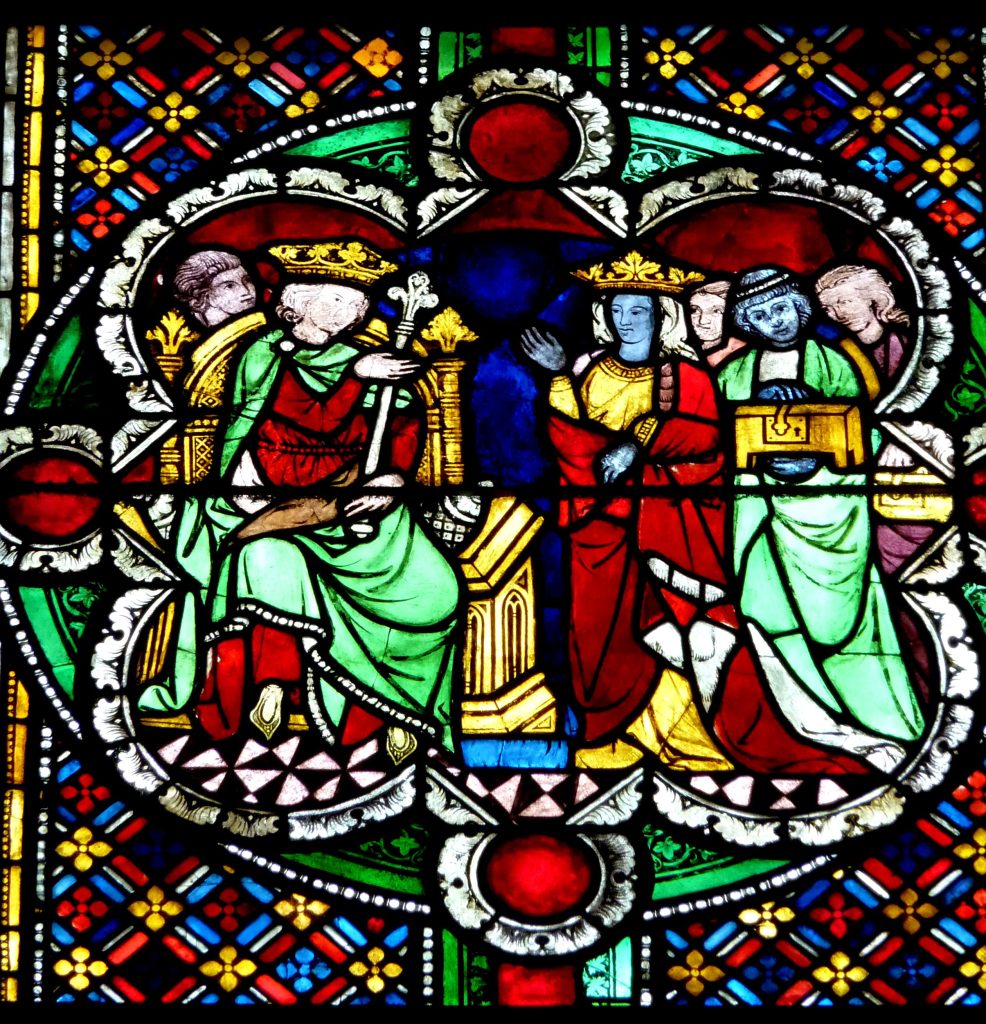
The following is a 1280 stained glass window from the Kölner Dom in Cologne, Germany:

Source: Art in the Christian Tradition , a project of the Vanderbilt University Divinity Library, Nashville, TN. Original source: Wikimedia

Stained glass is not just highly decorative, it’s a medium which has been used to express important religious messages for centuries. Literacy was not widespread in the medieval and Renaissance periods and the Church used stained glass and other artworks to teach the central beliefs of Christianity. In Gothic churches, the windows were filled with extensive narrative scenes in stained glass — like huge and colorful picture storybooks — in which worshipers could ‘read’ the stories of Christ and the saints and learn what was required for their religious salvation. (Source: Victoria and Albert Museum )

Solomon

The Hebrew, Latin and Greek that is transliterated as “Solomon” in English is translated in Spanish Sign Language with the sign for “wise” referring to 1 Kings 3:12. (Source: Steve Parkhurst)


“Solomon” in Spanish Sign Language, source: Sociedad Bíblica de España

For more information on translations of proper names with sign language see Sign Language Bible Translations Have Something to Say to Hearing Christians .

Click or tap here to see a short video clip about King Solomon (source: Bible Lands 2012)

Learn more on Bible Odyssey: Solomon .

complete verse (2 Chronicles 9:12)

Following are a number of back-translations as well as a sample translation for translators of 2 Chronicles 9:12:

  • Kupsabiny: “Solomon also gave (as a gift) that woman who was ruling the land of Sheba everything that she wanted. (He) donated more things than (she) had come with. Then, that woman returned to the country with her peace delegation.” (Source: Kupsabiny Back Translation)
  • Newari: “Solomon gave Queen Sheba everything she asked for. He gave the Queen more than the Queen had brought to Solomon. Then, with her people, she went back to her own country.” (Source: Newari Back Translation)
  • Hiligaynon: “King Solomon gave to the queen of Sheba whatever she asked-for. Solomon gave her more than she had brought. Then the queen went-home to her place with her people.” (Source: Hiligaynon Back Translation)
  • English: “King Solomon gave to the queen of Sheba everything that she wanted. He gave her more than she had given to him. Then she and those who came with her returned to her own land.
    In the ships that belonged to King Hiram, Hiram’s workers and Solomon’s workers brought gold from Ophir. They also brought a large amount of juniper wood and gems. King Solomon told his workers to use that wood to make railings in the temple and in his palace and also to make harps and lyres for the musicians. That wood was the the finest wood that had ever been seen in Israel.” (Source: Translation for Translators)

king

Some languages do not have a concept of kingship and therefore no immediate equivalent for the Greek, Hebrew, Aramaic, and Latin that is translated as “king” in English. Here are some (back-) translations:

(Click or tap here to see details)

  • Piro: “a great one”
  • Highland Totonac: “the big boss”
  • Huichol: “the one who commanded” (source for this and above: Bratcher / Nida)
  • Ekari: “the one who holds the country” (source: Reiling / Swellengrebel)
  • Una: weik sienyi: “big headman” (source: Kroneman 2004, p. 407)
  • Pass Valley Yali: “Big Man” (source: Daud Soesilo)
  • Ninia Yali: “big brother with the uplifted name” (source: Daud Soesilio in Noss 2007, p. 175)
  • Nyamwezi: mutemi: generic word for ruler, by specifying the city or nation it becomes clear what kind of ruler (source: Pioneer Bible Translators, project-specific translation notes in Paratext)
  • Ghomála’: Fo (“The word Fo refers to the paramount ruler in the kingdoms of West Cameroon. He holds administrative, political, and religious power over his own people, who are divided into two categories: princes (descendants of royalty) and servants (everyone else).” (Source: Michel Kenmogne in Theologizing in Context: An Example from the Study of a Ghomala’ Christian Hymn))

Faye Edgerton retells how the term in Navajo (Dinė) was determined:

“[This term was] easily expressed in the language of Biblical culture, which had kings and noblemen with their brilliant trappings and their position of honor and praise. But leadership among the Navajos is not accompanied by any such titles or distinctions of dress. Those most respected, especially in earlier days, were their headmen, who were the leaders in raids, and the shaman, who was able to serve the people by appealing for them to the gods, or by exorcising evil spirits. Neither of these made any outward show. Neither held his position by political intrigue or heredity. If the headman failed consistently in raids, he was superceded by a better warrior. If the shaman failed many times in his healing ceremonies, it was considered that he was making mistakes in the chants, or had lost favor with the gods, and another was sought. The term Navajos use for headman is derived from a verb meaning ‘to move the head from side to side as in making an oration.’ The headman must be a good orator, able to move the people to go to war, or to follow him in any important decision. This word is naat’áanii which now means ‘one who rules or bosses.’ It is employed now for a foreman or boss of any kind of labor, as well as for the chairman of the tribal council. So in order to show that the king is not just a common boss but the highest ruler, the word ‘aláahgo, which expresses the superlative degree, was put before naat’áanii, and so ‘aláahgo naat’áanii ‘anyone-more-than-being around-he-moves-his-head-the-one-who’ means ‘the highest ruler.’ Naat’áanii was used for governor as the context usually shows that the person was a ruler of a country or associated with kings.”

(Source: Faye Edgerton in The Bible Translator 1962, p. 25ff. )

See also king (Japanese honorifics).

servant / slave

While the Greek term doulos in the New Testament and ‘ebed in the Old Testament refer to slightly different concepts (unlike in New Testament Judea in Old Testament Israel and Judah, Hebrew servants/slaves were required to be released after six years of labor and, regardless of when they started their servitude, all Hebrew servants were to be automatically freed during the year of Jubilee), translation issues are somewhat similar.

Joel Baden (2025, p. 65ff.) says this about the Hebrew term used in the Old Testament / Hebrew Bible:

“The English words ‘servant’ and ‘slave’ have decidedly different connotations. ‘Servant’ has the sense of ‘employee.’ ‘Slave,’ by contrast, carries with it the ideas of an owned and controlled body, of violence and dishonor. The connotation of ‘servant’ can verge on the positive; ‘slave’ is predominantly negative. How a reader of the Bible understands the identity of a character or the relationship between one character and another or the world of ancient Israel depends significantly on whether the word ‘servant’ or ‘slave’ is used. In Hebrew, however, there is but one word underlying every occurrence of ‘servant’ and ‘slave’ in our modern translations. The distinction between the two exists only on the level of interpretation.

“It is not a matter of mere nomenclature. Take the story of Genesis 24, in which Abraham sends his servant off to find a wife for Isaac. The servant — though the main character of the passage — has no name and is identified only by his title, which he even uses to introduce himself: ‘I am Abraham’s servant,’ he says (Genesis 24:34, Jewish Publication Society). This is often read as a warm story about a devoted servant — usually imagined to be relatively old — who carries out the elderly patriarch’s final wishes. How does it change, how do we reimagine it, when we read all thirteen mentions of Abraham’s servant as, in fact, Abraham’s slave? We know Abraham has slaves: His ‘servant’ even says so in this very chapter in the very next verse: ‘The Lord has greatly blessed my master, and he has become rich: he has given him sheep and cattle, silver and gold, male and female slaves, camels and asses’ (24:35, JPS). Yet generations of translators, interpreters, and readers have failed to connect the slaves (the property with which God has blessed Abraham) and the servant — the slave who is the protagonist of this same story.

“When slaves are turned into servants, the Bible itself is changed. Our revulsion at the institution of slavery is kept at a distance from the biblical text that stands as our religious heritage. The Bible is protected, albeit from itself. Slavery is minimized, or worse: The King James Version, notably, does not translate ‘ebed as ‘slave’ a single time. The result? Some KJV readers have denied that there is any slavery in the Bible whatsoever. Yet the word ‘ebed appears around 800 times in the Bible. That’s 800 moments when a slave, and the existence of slavery in ancient Israel and the biblical text, has been erased.

“The social role that we associate with the term ‘servant’ didn’t exist in ancient Israel. Slaves, however, did. Israel knew what it was to be a slave, and Israel knew, too, what it was to own a slave. And thus Israel uses the language and metaphor of slavery again and again to express the basic notions of obedience, of power disparity, of bodily control and the absence of agency. Samuel says to Yahweh upon being called, ‘Speak, Lord, for your servant is listening’ (1 Samuel 3:9, JPS). ‘Let my lord go ahead of his servant,’ Jacob says to Esau in Genesis 33:14 (JPS). Rendered as ‘servant’ in every translation, this is a sort of formally obsequious, self-abnegating speech. While literal slavery is not at stake in these sorts of expressions, the metaphorical reference to the relative status of slave and master is lost when it is translated as ‘servant.’

“So, too, when those figures who are the ‘ebed to a king are referred to as ‘courtiers,’ ‘officials,’ ‘attendants,’ ‘soldiers,’ ‘subjects,’ ‘envoys,’ ‘ministers,’ or even sometimes simply ‘men,’ of the king. These are all translations of the same word, and the instinct to specify their distinctive roles in the royal court is understandable. Yet in doing so, translations obscure the actual language with the connotations that it presents: subordination, threat of violence to one’s person, absolute control over will and agency. And so, too, when it is not a human king but God to whom one is said to be ‘ebed. In the book of Joshua, God states, ‘My servant Moses is dead’ (1:2, JPS) — we are relatively comfortable with the idea of serving God but perhaps less so with the idea of being God’s slave. Yet the qualities of obedience, subservience, and loyalty — and the implicit threat of punishment for the lack thereof — are part of this picture as well. One might point to the way this language is picked up in the New Testament in the phrase ‘slave of Christ’ in 1 Corinthians 7:22.

“If ‘servants’ and ‘slaves’ are not understood to be equivalent — and in modern English it is safe to say that they are not — then every time that the word ‘ebed appears, a choice has to be made by the translator. The diminishment of the very word ‘slave’ in English translations of the Hebrew Bible results in the diminishment of the idea and reality of slavery in the Bible and in the world that produced it. Though there is no debate to be had about whether there was slavery in the Bible and in ancient Israel, a lay reader of the text in translation might well wonder.

“Our ears, and eyes, have become accustomed to seeing the word ‘servant’ in the Bible. ‘Slave’ often sounds wrong, inapt, almost harsh. Yet it is just this discomfort that signals how important the change is. Whenever we encounter the word ‘servant’ in our English translations, we should be obliged to ask why it says ‘servant’ and not ‘slave’ — and what difference it would make to our reading of the text as an individual, as a community, and as a culture if we were instead to read ‘slave.’”

Ruden (2021, p. lviii) says this about the Greek term in the New Testament:

“In Judea, servitude was sui generis and could be complicated, and accordingly the Greek vocabulary in scripture is varied. But there appears to be no basis for sugarcoating the word meaning a chattel slave in nearly all Greek literature, doulos. It is unlikely that the internationally oriented authors of the Gospels didn’t mean what their peers meant by the word — ‘slave.’ Also, the English word ‘servant’ is too vague for the array of servitors (including trusted house slaves and personal attendants), military and administrative subordinates, and ritual helpers the Greek of the Gospels distinguishes.”

Some English New Testament translations (Ruden 2021, Hart 2017, The Orthodox New Testament 2004) have consistently used slave for the Greek doulos but no Old Testament translation consistently translates ‘ebed with only one term.

In a number of leading German translations, including the Catholic Einheitsübersetzung (1980 / 2016) and the Protestant Elberfelder Bibel (1871 / 2006), BasisBibel (2021), as well as the translation by Luther (all editions) use the term Knecht throughout. Knecht is an old-fashioned term for a low-class, often agricultural servant with little or no social mobility, a position that is somewhat located between Diener (“servant”) and Sklave (“slave”). The only times these versions specifically don’t use Knecht is where slavery is specifically in the focus (such as Leviticus 25:44 or Philemon 1:16).

Translation commentary on 2 Chronicles 9:12

Verse 12 returns to the story of the queen of Sheba, which was interrupted by the digression in verses 10-11.

And King Solomon gave to the queen of Sheba all that she desired, whatever she asked: All that she desired is understood in the Ethiopian tradition to mean that she wanted to give birth to a son of Solomon. That tradition claims that she gave birth to a son named Menelik, whose father was King Solomon. Apart from the historical questions this raises, translators should not make this phrase more precise than it is in Hebrew. God’s Word translates “anything she wanted.” Good News Translation combines the verbs desired and asked, saying “asked for,” since people usually ask for what they desire.

Besides what she had brought to the king: As the footnote in Good News Translation indicates, the Hebrew text is not clear here. The parallel text in 1 Kgs 10.13 says “besides what was given her by the bounty of King Solomon.” But here in 2 Chronicles, the Masoretic Text reads “besides what she had brought the king.” This part of the verse makes no sense, since it is not likely that Solomon simply gave back to the queen of Sheba what she had brought to him. The Targum has the additional words “what he gave her freely in return for,” which may have been original and may have been accidentally omitted. So some translations correct the text to read as in Good News Translation (so Revised English Bible, New Jerusalem Bible). Revised English Bible, for example, corrects the first sentence of this verse to read as follows: “King Solomon gave the queen of Sheba whatever she desired and asked for, in addition to his gifts in return for what she had brought him.” Critique Textuelle de l’Ancien Testament gives a {B} rating to the Masoretic Text here. If the Masoretic Text is followed, the following renderings are possible for this sentence:

• (1) “King Solomon gave the queen of Sheba everything that pleased her and that she desired except that which she herself had brought to the king.”

• (2) “… everything that pleased her and she desired except [that which he had given in exchange for] that which she herself had brought to the king.” This translation basically agrees with the understanding that was made explicit in the Targum rendering.

• (3) “… all she asked for plus other gifts that had greater value than what she had brought to him.” This translation seems to be the basis for the New Jewish Publication Society’s Tanakh rendering “… everything she expressed a desire for, exceeding a return for what she had brought to the king.”

So she turned and went back to her own land, with her servants: The two Hebrew verbs translated turned and went back may be rendered by a single verb, such as “returned” (New Revised Standard Version). But it is also possible to see the first verb as focusing on the initial departure and the second one on the journey. Revised English Bible says “Then she departed with her retinue and went back to her own land.” Good News Translation makes it explicit that her own land was “the land of Sheba.” With her servants is literally “she and her servants.” This phrase comes at the very end of the verse. The Hebrew keeps the focus on the queen of Sheba, but for all practical purposes the servants are a part of the subject of the sentence. In many languages it will be more natural to say “Accompanied by her servants, she went back to her own country.”

Quoted with permission from Omanson, Roger L. and Ellington, John E. A Handbook on 1-2 Chronicles, Volume 1. (UBS Helps for Translators). Miami: UBS, 2014. For this and other handbooks for translators see here .

SIL Translator’s Notes on 2 Chronicles 9:12

9:12a King Solomon gave the queen of Sheba all she desired—whatever she asked—

King Solomon gave the queen of Sheba all that she wanted.
-or-
King Solomon gave the queen of Sheba everything she asked for.

9:12b far more than she had brought the king.

He even gave her more than she had given to him.
-or-
He gave her more presents than the queen gave him.

9:12c Then she left and returned to her own country, along with her servants.

Then the queen and those who accompanied her went back to her own land.
-or-
After that, the queen went back to her own country. She went back with all her servants.

Section 9:13-28

King Solomon was wealthy and powerful

© 2021, 2022 by SIL International®
Made available under the terms of a Creative Commons Attribution-ShareAlike 4.0 License (CC BY-SA) creativecommons.org/licenses/by-sa/4.0.
All Scripture quotations in this publication, unless otherwise indicated, are from The Holy Bible, Berean Standard Bible.
BSB is produced in cooperation with Bible Hub, Discovery Bible, OpenBible.com, and the Berean Bible Translation Committee.