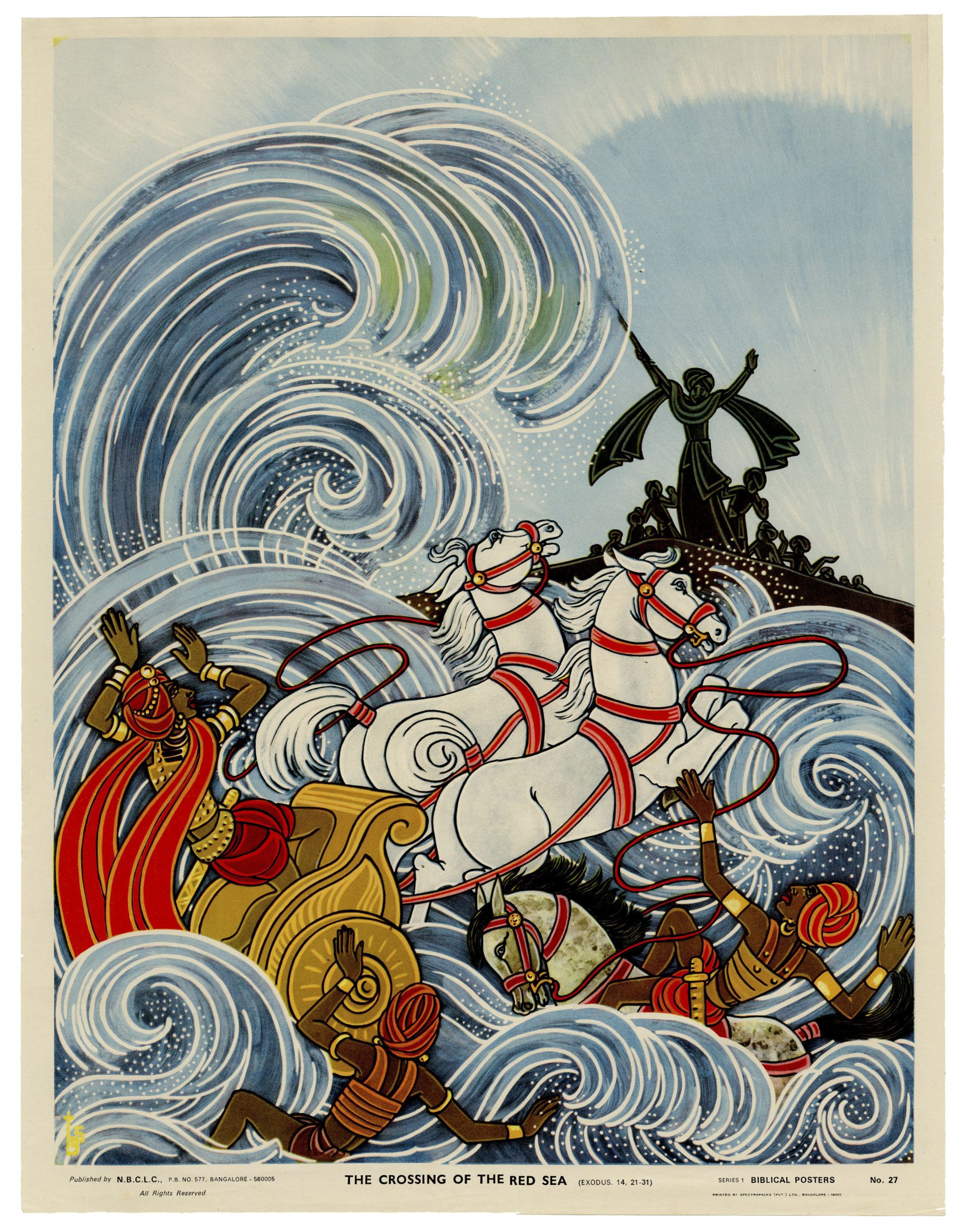
This is a contemporary tempera/gouache on leather painting by an unknown Ethiopian artist. Source: Sacred Art Pilgrim website .
Following is a painting by Chen Yuandu 陳緣督 (1902–1967):
Housed in the Société des Auxiliaires des Missions Collection – Whitworth University.
Image taken from Chinese Christian Posters . For more information on the “Ars Sacra Pekinensis” school of art, see this article , for other artworks of that school in TIPs, see here.
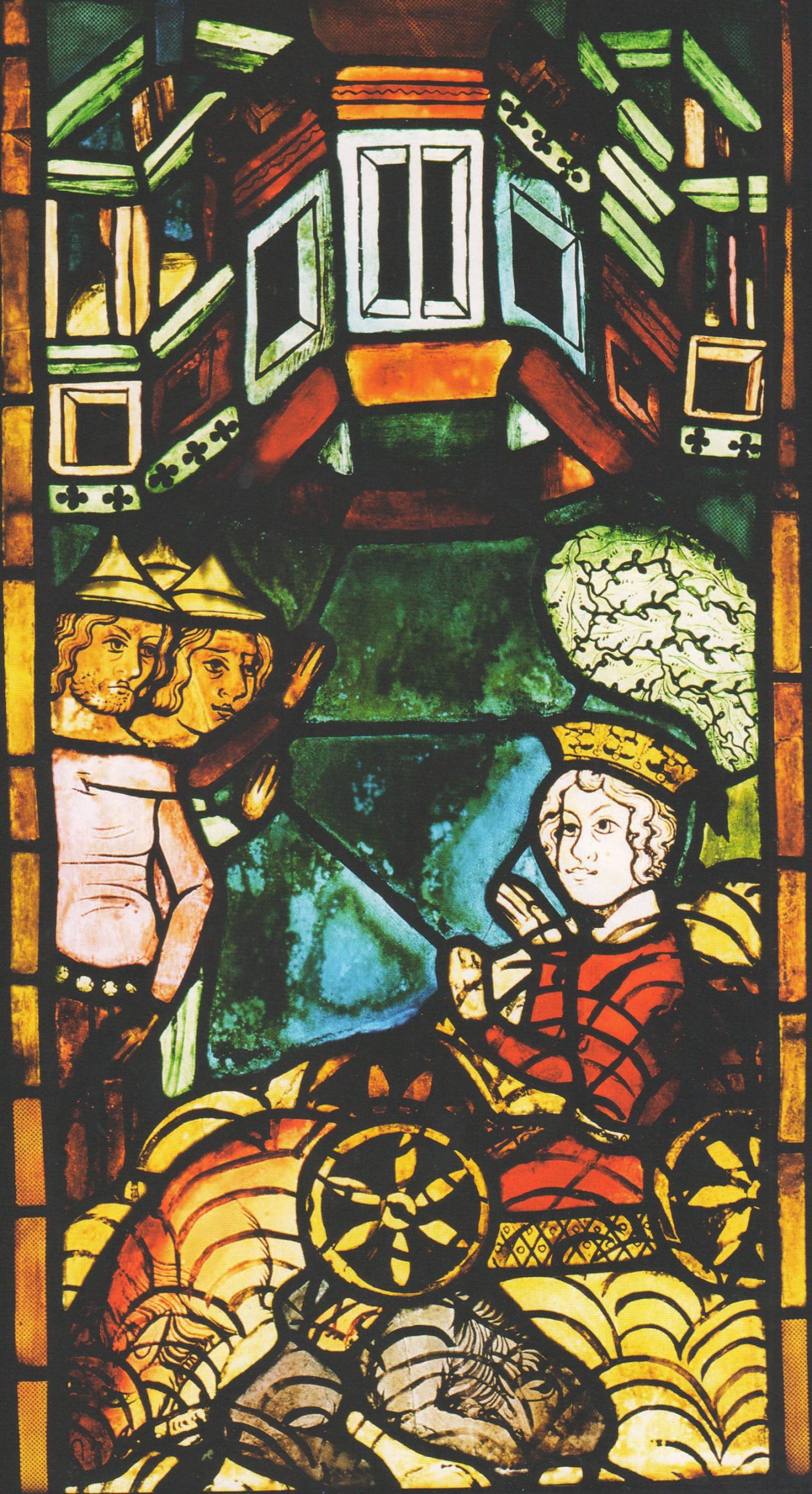
The following is a stained glass window from the Three choir windows in the Marienkirche, Frankfurt (Oder), Germany, of the 14th century:
Source: Der gläserne Schatz: Die Bilderbibel der St. Marienkirche in Frankfurt (Oder), Neuer Berlin Verlag, 2005, copyright for this image: Brandenburgisches Landesamt für Denkmalpflege und Archäologisches Landesmuseum
Stained glass is not just highly decorative, it’s a medium which has been used to express important religious messages for centuries. Literacy was not widespread in the medieval and Renaissance periods and the Church used stained glass and other artworks to teach the central beliefs of Christianity. In Gothic churches, the windows were filled with extensive narrative scenes in stained glass — like huge and colorful picture storybooks — in which worshipers could ‘read’ the stories of Christ and the saints and learn what was required for their religious salvation. (Source: Victoria and Albert Museum )
The Hebrew, Latin; Ge’ez and Greek that is transliterated as “Noah” in English is translated in Spanish Sign Language with a sign that combines the letter N + “boat.” (Source: Steve Parkhurst)
The following is a stained glass window depicting Noah by Endre Odon Hevezi and Gyula Bajo from 1965 for the Debre Libanos Monastery, Oromia, Ethiopia:
Photo by Timothy A. Gonsalves, hosted by Wikimedia Commons under a Creative Commons Attribution-Share Alike 4.0 International license
Stained glass is not just highly decorative, it’s a medium which has been used to express important religious messages for centuries. Literacy was not widespread in the medieval and Renaissance periods and the Church used stained glass and other artworks to teach the central beliefs of Christianity. In Gothic churches, the windows were filled with extensive narrative scenes in stained glass — like huge and colorful picture storybooks — in which worshipers could ‘read’ the stories of Christ and the saints and learn what was required for their religious salvation. (Source: Victoria and Albert Museum )
The Greek that is translated as “put his arms around him and kissed him” or similar in English is translated in the Pfälzisch translation by Walter Sauer (publ. 2012) as is em um de Hals gfalle un hot en abgekisst or “he flung his arms around his neck and smothered him with kisses.” (Source: Zetzsche)
In Elhomwe it is translated as “greeted him by hugging.” (Source: project-specific translation notes in Paratext)
The following is a contemporary stained glass window depicting the father hugging his son in the Catholic Church of the Resurrection in Bryanston, New Zealand:
The Window of Reconciliation: The Father ran to his son and clasped him in his arms (Luke 15:21). This window portrays the reconciliation of God and ourselves: His grace (shown as brilliant light at the centre of united figures) transforms our hearts. The reconciliation we strive for in our country and our world is also portrayed — and there is no easy road to achieving peace on earth and goodwill to all (Luke 2:14). The modern window shows reconciling figures against a desert-like background that symbolises the death and desolation that threaten us. As the great 20th century poet WH Auden wrote: ‘We must love one another or die.’ (Source: Catholic Church of the Resurrection in Bryanston )
Stained glass is not just highly decorative, it’s a medium which has been used to express important religious messages for centuries. Literacy was not widespread in the medieval and Renaissance periods and the Church used stained glass and other artworks to teach the central beliefs of Christianity. In Gothic churches, the windows were filled with extensive narrative scenes in stained glass — like huge and colorful picture storybooks — in which worshipers could ‘read’ the stories of Christ and the saints and learn what was required for their religious salvation. (Source: Victoria and Albert Museum )
The Greek that is translated as “fruit of the Spirit” in English is translated in British Sign Language with a sign that depicts the Spirit coming in to a person and then the person giving out. (Source: Anna Smith)
“Fruit of the Spirit” in British Sign Language (source: Christian BSL, used with permission)
In the German New Testament translation by Berger / Nord (publ. 1999) it is translated wer sich vom Heiligen Geist leiten lässt, der kann… or “whoever is guided by the Holy Spirit is able to… .”
The following is a stained glass window from John Hardman Powell (1827–1895) in the Christ Church Cathedral in Dublin, depicting the fruit of the Spirit:
Photo and accompanying text by Andreas F. Borchert, hosted by Wikimedia Commons under a Creative Commons Attribution-Share Alike 3.0 Germany license
“In its centre is the Lord as Good Shepherd along with the Fruit of the Spirit, namely Love (inscription in centre), Joy & Peace (top inscription), and in clockwise direction: Longsuffering, Faith, Gentleness, Goodness, Meekness, Temperance in reference to Galatians 5:22-23, surrounded by medaillons, depicting an angel carrying a scroll with the inscription Gloria in excelsis deo (top, representing joy & peace), and then in clockwise direction: Job (upper right, representing longsuffering), Jonathan (lower right, representing faithfulness), Ruth (bottom, representing goodness and gentleness), Moses (lower left, representing meekness), and John the Baptist (upper left, representing temperance, see Matthew 3:4).”
Stained glass is not just highly decorative, it’s a medium which has been used to express important religious messages for centuries. Literacy was not widespread in the medieval and Renaissance periods and the Church used stained glass and other artworks to teach the central beliefs of Christianity. In Gothic churches, the windows were filled with extensive narrative scenes in stained glass — like huge and colorful picture storybooks — in which worshipers could ‘read’ the stories of Christ and the saints and learn what was required for their religious salvation. (Source: Victoria and Albert Museum )
The Latin Vulgate translation added three “fruits”: “forbearance” (longanimitas), “courtesy” (modestia), and “chastity” (castitas). This meant that all Catholic translations before app. 1950 that were based on the Latin version also had those additional attributes (EnglishDouay-Rheims: longanimity, modesty, chastity; SpanishBiblia Torres Amat: longanimidad, modestia, castidad etc.)
Ronald Knox writes in his translation of the Vulgate (1946): “The Greek only mentions nine of the Twelve Fruits; viz. the first six, together with gentleness, faith, and temperateness. It is possible that the Latin version has accidentally included, in some cases, two renderings of the same Greek word.” Note that neither earlier Latin versions (Vetus Latina) nor the revision of the Vulgate of 1979 / 1986 (Nova Vulgata) have these attributes. (Source: Jost Zetzsche)
The Greek that is translated as “antichrist” in English is translated in Tibetan as ma shi ka’i bstan dgra (མ་ཤི་ཀའི་བསྟན་དགྲ།) or “Christ’s-teaching-enemy.” (Source: gSungrab website )
The following is a stained glass window from the Three choir windows in the Marienkirche, Frankfurt (Oder), Germany, of the 14th century, depicting the antichrist as a wandering preacher:
Source: Der gläserne Schatz: Die Bilderbibel der St. Marienkirche in Frankfurt (Oder), Neuer Berlin Verlag, 2005, hosted by Wikimedia Commons under a public domain license
Stained glass is not just highly decorative, it’s a medium which has been used to express important religious messages for centuries. Literacy was not widespread in the medieval and Renaissance periods and the Church used stained glass and other artworks to teach the central beliefs of Christianity. In Gothic churches, the windows were filled with extensive narrative scenes in stained glass — like huge and colorful picture storybooks — in which worshipers could ‘read’ the stories of Christ and the saints and learn what was required for their religious salvation. (Source: Victoria and Albert Museum )
Image taken from He Qi Art . For purchasing prints of this and other artworks by He Qi go to heqiart.com . For other images of He Qi art works in TIPs, see here.
Following is an artwork by Sister Marie Claire , SMMI (1937–2018) from Bengaluru, India:
For more information about images by Sister Marie Claire and ways to purchase them as lithographs, see here .
For other images of Sister Marie Claire paintings in TIPs, see here.
The following is a stained glass window from the Three choir windows in the Marienkirche, Frankfurt (Oder), Germany, of the 14th century:
Source: Der gläserne Schatz: Die Bilderbibel der St. Marienkirche in Frankfurt (Oder), Neuer Berlin Verlag, 2005, copyright for this image: Brandenburgisches Landesamt für Denkmalpflege und Archäologisches Landesmuseum
Stained glass is not just highly decorative, it’s a medium which has been used to express important religious messages for centuries. Literacy was not widespread in the medieval and Renaissance periods and the Church used stained glass and other artworks to teach the central beliefs of Christianity. In Gothic churches, the windows were filled with extensive narrative scenes in stained glass — like huge and colorful picture storybooks — in which worshipers could ‘read’ the stories of Christ and the saints and learn what was required for their religious salvation. (Source: Victoria and Albert Museum )
Image taken from He Qi Art . For purchasing prints of this and other artworks by He Qi go to heqiart.com . For other images of He Qi art works in TIPs, see here.
The following is a stained glass window from the Three choir windows in the Marienkirche, Frankfurt (Oder), Germany, of the 14th century:
Source: Der gläserne Schatz: Die Bilderbibel der St. Marienkirche in Frankfurt (Oder), Neuer Berlin Verlag, 2005, copyright for this image: Brandenburgisches Landesamt für Denkmalpflege und Archäologisches Landesmuseum
Stained glass is not just highly decorative, it’s a medium which has been used to express important religious messages for centuries. Literacy was not widespread in the medieval and Renaissance periods and the Church used stained glass and other artworks to teach the central beliefs of Christianity. In Gothic churches, the windows were filled with extensive narrative scenes in stained glass — like huge and colorful picture storybooks — in which worshipers could ‘read’ the stories of Christ and the saints and learn what was required for their religious salvation. (Source: Victoria and Albert Museum )
Image taken from He Qi Art . For purchasing prints of this and other artworks by He Qi go to heqiart.com . For other images of He Qi art works in TIPs, see here.
Following is an artwork by Sister Marie Claire , SMMI (1937–2018) from Bengaluru, India:
For more information about images by Sister Marie Claire and ways to purchase them as lithographs, see here . For other images of Sister Marie Claire paintings in TIPs, see here.
Following is a 1973 painting of the JESUS MAFA project, a response to New Testament readings from the Lectionary by a Christian community in Cameroon, Africa. Each of the readings was selected and adapted to dramatic interpretation by the community members. Photographs of their interpretations were made, and these were then transcribed to paintings:
From Art in the Christian Tradition, a project of the Vanderbilt Divinity Library, Nashville, TN. Image retrieved March 23, 2026. Original source: librairie-emmanuel.fr.
The following is a stained glass window depicting Mary’s visitation to Elizabeth. It was created by Ateliers Maréchal de Metz between 1848 and 1860 for the Cathédrale Notre-Dame de Luxembourg.
Photo by Marcin Szala, hosted by Wikimedia Commons under a Creative Commons Attribution-Share Alike 3.0 Unported license
Stained glass is not just highly decorative, it’s a medium which has been used to express important religious messages for centuries. Literacy was not widespread in the medieval and Renaissance periods and the Church used stained glass and other artworks to teach the central beliefs of Christianity. In Gothic churches, the windows were filled with extensive narrative scenes in stained glass — like huge and colorful picture storybooks — in which worshipers could ‘read’ the stories of Christ and the saints and learn what was required for their religious salvation. (Source: Victoria and Albert Museum )