The wedding at Cana

He Qi © 2021 All Rights Reserved.

Image taken from He Qi Art . For purchasing prints of this and other artworks by He Qi go to heqiart.com . For other images of He Qi art works in TIPs, see here.

Following is a hand-colored stencil print on momigami by Sadao Watanabe (1968):

Image taken with permission from the SadaoHanga Catalogue where you can find many more images and information about Sadao Watanabe. For other images of Sadao Watanabe art works in TIPs, see here.

Following is a painting in the Hamzanama style:

The First miracle at Cana, 2017-2018, Paul Abraham with Manish Soni, Opaque watercolour and natural pigments on hand-made paper, © Sarmaya Arts Foundation. (2018.33.6)

The following is a 2011 stained glass window by Conrad Schmitt Studios from the St. John Neumann Catholic Church in Sunbury, Ohio:
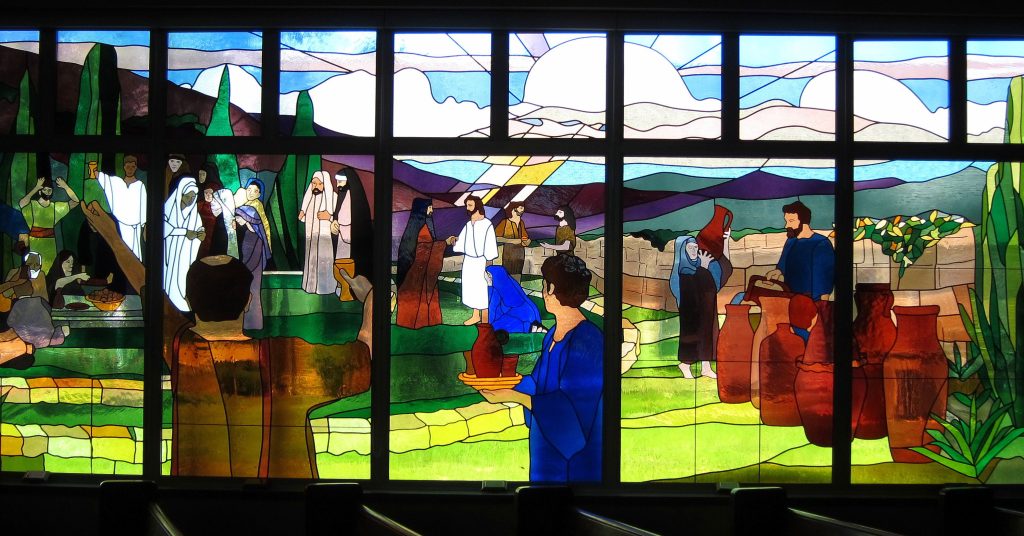
Source: Art in the Christian Tradition , a project of the Vanderbilt University Divinity Library, Nashville, TN. Original source: Wikimedia

Stained glass is not just highly decorative, it’s a medium which has been used to express important religious messages for centuries. Literacy was not widespread in the medieval and Renaissance periods and the Church used stained glass and other artworks to teach the central beliefs of Christianity. In Gothic churches, the windows were filled with extensive narrative scenes in stained glass — like huge and colorful picture storybooks — in which worshipers could ‘read’ the stories of Christ and the saints and learn what was required for their religious salvation. (Source: Victoria and Albert Museum )

Stephen

The term that is transliterated as “Stephen” in English is translated in American Sign Language with a sign that combines “S” and the sign for “stoned” or “rocks,” referring to Acts 7:58. (Source: Ruth Anna Spooner, Ron Lawer)


“Stephen” in American Sign Language, source: Deaf Harbor

In Spanish Sign Language it is translated with a signs for “see” + “heaven” + “open,” referring to Acts 7:55. (Source: Steve Parkhurst)


“Stephen” in Spanish Sign Language, source: Sociedad Bíblica de España

See also the stoning of Stephen (image) and more information about Saint Stephen .

For more information on translations of proper names with sign language see Sign Language Bible Translations Have Something to Say to Hearing Christians .

The following is a contemporary stained glass window from the Messiah Episcopal Church in St. Paul, Minnesota by Peter Dohmen. Individual glass pieces were made in Germany in accordance with Dohmen’s design, using a technique first developed by Irish monks in the 9th and 10th centuries.

Source for the image and description below: The Stained Glass Windows of Messiah Episcopal Church

“This window on the east wall of the sanctuary shows us St. Stephen, the first martyr to give his life for Christ. Faith and loyalty are symbolized in the top panel by the cross. You will notice that Stephen’s eyes are turned toward heaven and we recall his words: ‘I see the heavens opened and the Son of Man standing at the right hand of God!’ The bottom section depicts the martyrdom of this great saint who was only in deacon’s orders when he met his death by stoning.”

Stained glass is not just highly decorative, it’s a medium which has been used to express important religious messages for centuries. Literacy was not widespread in the medieval and Renaissance periods and the Church used stained glass and other artworks to teach the central beliefs of Christianity. In Gothic churches, the windows were filled with extensive narrative scenes in stained glass — like huge and colorful picture storybooks — in which worshipers could ‘read’ the stories of Christ and the saints and learn what was required for their religious salvation. (Source: Victoria and Albert Museum )

Mary Magdalene

The term that is transliterated as “Mary Magdalene” in English is translated in American Sign Language with a sign signifying 7 demons having gone out, referring to Luke 8:2. (Source: Ruth Anna Spooner, Ron Lawer)


“Mary Magdalene” in American Sign Language, source: Deaf Harbor

For more information on translations of proper names with sign language see Sign Language Bible Translations Have Something to Say to Hearing Christians .

The following is a stained glass window in the All Saints’ Church, Highgate, London, of the late 19thy century:

Photo by John Salmon, hosted by Wikimedia Common under the Creative Commons Attribution-Share Alike 2.0 Generic license

Stained glass is not just highly decorative, it’s a medium which has been used to express important religious messages for centuries. Literacy was not widespread in the medieval and Renaissance periods and the Church used stained glass and other artworks to teach the central beliefs of Christianity. In Gothic churches, the windows were filled with extensive narrative scenes in stained glass — like huge and colorful picture storybooks — in which worshipers could ‘read’ the stories of Christ and the saints and learn what was required for their religious salvation. (Source: Victoria and Albert Museum )

Learn more on Bible Odyssey: Mary Magdalene and Mary Magdalene in Popular Culture .

See also Mary Magdalene and Mary Magdalene (icon).

Daniel

The term that is transliterated as “Daniel” in English means “judge of God (i.e., one who delivers judgment in the name of God,” “my judge is God.” (Source: Cornwall / Smith 1997 )

In American Sign Language it is translated with the sign for the letter D and for “lion,” referring to the story in Daniel 6. (Source: Ruth Anna Spooner, Ron Lawer)


“Daniel” in American Sign Language, source: Deaf Harbor

In Hungarian Sign Language it is translated with a sign that refers to Daniel being cast into the lions’ den. (Source: Jenjelvi Biblia and HSL Bible Translation Group)


“Daniel” in Hungarian Sign Language (source )

In Swiss-German Sign Language it is translated with the sign for “prayer” that illustrates Daniel’s close relationship with God.


“Daniel” in Swiss-German Sign Language, source: DSGS-Lexikon biblischer Begriffe , © CGG Schweiz

For more information on translations of proper names with sign language see Sign Language Bible Translations Have Something to Say to Hearing Christians .

The following is a stained glass window depicting Daniel by Endre Odon Hevezi and Gyula Bajo from 1965 for the Debre Libanos Monastery, Oromia, Ethiopia:

Photo by Timothy A. Gonsalves, hosted by Wikimedia Commons under a Creative Commons Attribution-Share Alike 4.0 International license

Stained glass is not just highly decorative, it’s a medium which has been used to express important religious messages for centuries. Literacy was not widespread in the medieval and Renaissance periods and the Church used stained glass and other artworks to teach the central beliefs of Christianity. In Gothic churches, the windows were filled with extensive narrative scenes in stained glass — like huge and colorful picture storybooks — in which worshipers could ‘read’ the stories of Christ and the saints and learn what was required for their religious salvation. (Source: Victoria and Albert Museum )

See also Daniel.

Learn more on Bible Odyssey: Daniel in the Lions’ Den and Daniel .

The Bronze Serpent

Hand colored stencil print on washi by Sadao Watanabe (1979).

Image taken with permission from the SadaoHanga Catalogue where you can find many more images and information about Sadao Watanabe. For other images of Sadao Watanabe art works in TIPs, see here.

The following artwork is part of a series of 56 paintings on biblical themes by Kazakh artist Nelly Bube (born 1949):

Copyright by Norwegian Bible Society , used with permission. For other images of Nelly Bube in TIPs, see here.

The following is a stained glass window from the Three choir windows in the Marienkirche, Frankfurt (Oder), Germany, of the 14th century:

Source: Der gläserne Schatz: Die Bilderbibel der St. Marienkirche in Frankfurt (Oder), Neuer Berlin Verlag, 2005, copyright for this image: Brandenburgisches Landesamt für Denkmalpflege und Archäologisches Landesmuseum

Stained glass is not just highly decorative, it’s a medium which has been used to express important religious messages for centuries. Literacy was not widespread in the medieval and Renaissance periods and the Church used stained glass and other artworks to teach the central beliefs of Christianity. In Gothic churches, the windows were filled with extensive narrative scenes in stained glass — like huge and colorful picture storybooks — in which worshipers could ‘read’ the stories of Christ and the saints and learn what was required for their religious salvation. (Source: Victoria and Albert Museum )

See also other stained glass windows from the Marienkirche in Frankfurt.

The Magi's Dream

Hand colored stencil print on momigami by Sadao Watanabe (1979).

Image taken with permission from the SadaoHanga Catalogue where you can find many more images and information about Sadao Watanabe. For other images of Sadao Watanabe art works in TIPs, see here.

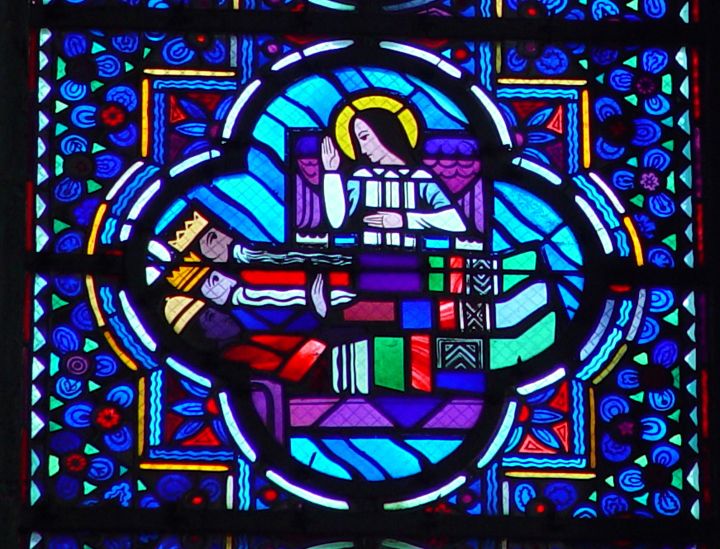
The following is a 1933 stained glass window by J. Le Breton and the glass studio of Gaudin, Paris from the Cathédrale d’Amiens in Amiens, France:

Source: Art in the Christian Tradition , a project of the Vanderbilt University Divinity Library, Nashville, TN. Original source: image donated by Jim Womack and Anne Richardson

Stained glass is not just highly decorative, it’s a medium which has been used to express important religious messages for centuries. Literacy was not widespread in the medieval and Renaissance periods and the Church used stained glass and other artworks to teach the central beliefs of Christianity. In Gothic churches, the windows were filled with extensive narrative scenes in stained glass — like huge and colorful picture storybooks — in which worshipers could ‘read’ the stories of Christ and the saints and learn what was required for their religious salvation. (Source: Victoria and Albert Museum )

The 12-year old Jesus in the temple

Hand colored stencil print on washi by Sadao Watanabe (1982).

Image taken with permission from the SadaoHanga Catalogue where you can find many more images and information about Sadao Watanabe. For other images of Sadao Watanabe art works in TIPs, see here.

Following is an image by He Qi:

He Qi © 2021 All Rights Reserved.

Image taken from He Qi Art . For purchasing prints of this and other artworks by He Qi go to heqiart.com . For other images of He Qi art works in TIPs, see here.

The following is an artwork by Vinayak Shivaram Masoji (1897–1977):

“V.S. Masoji is a Bengali Indian artist who studied at Shantiniketan, an artist’s institution founded by the national poet of Bengal, Rabindranath Tagore.” (Source for this and the image: The Bible Through Asian Eyes by Masao Takenaka and Ron O’Grady 1991)

Following is a 1973 painting of the JESUS MAFA project, a response to New Testament readings from the Lectionary by a Christian community in Cameroon, Africa. Each of the readings was selected and adapted to dramatic interpretation by the community members. Photographs of their interpretations were made, and these were then transcribed to paintings:

Jesus sits in front of some religious leaders listening and asking questions as they listen to him, their astonishment evident in their facial expressions. In the background we see Mary and Joseph approaching, undoubtedly relieved to find their child safe and sound. We are reminded of Jesus’ humanity in this story. He was a child who did not fully consider the feelings of his parents and the consequences of his actions. He grew not only physically, but intellectually and emotionally as well. Through Jesus’ increase in wisdom, we are reminded that we too are called to grow into deeper understanding. And that requires that we ask questions whose answers may challenge our long-held beliefs and theologies.

From Art in the Christian Tradition , a project of the Vanderbilt Divinity Library, Nashville, TN. Image retrieved March 23, 2026. Original source: librairie-emmanuel.fr.

The following is a stained glass window from Mary Lowndes after William Holman Hunt, made by Lowndes and Drury, 1910. From St Martin & All Saints Church, Oxford:

Photo by the wub, hosted by Wikimedia Commons under a Creative Commons CC0 1.0 Universal Public Domain Dedication license

Stained glass is not just highly decorative, it’s a medium which has been used to express important religious messages for centuries. Literacy was not widespread in the medieval and Renaissance periods and the Church used stained glass and other artworks to teach the central beliefs of Christianity. In Gothic churches, the windows were filled with extensive narrative scenes in stained glass — like huge and colorful picture storybooks — in which worshipers could ‘read’ the stories of Christ and the saints and learn what was required for their religious salvation. (Source: Victoria and Albert Museum )
Martha and Mary


Hand colored stencil print on washi by Sadao Watanabe (1984).

Image taken with permission from the SadaoHanga Catalogue where you can find many more images and information about Sadao Watanabe. For other images of Sadao Watanabe art works in TIPs, see here.

The following image is by He Qi:

He Qi © 2021 All Rights Reserved.

Image taken from He Qi Art . For purchasing prints of this and other artworks by He Qi go to heqiart.com . For other images of He Qi art works in TIPs, see here.

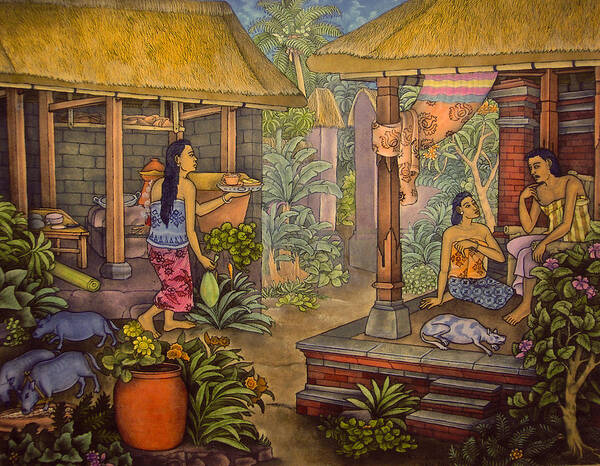
Following is a painting by Ketut Lasia (b. 1945):

Ketut Lasia is one of the last traditional Balinese painters in the Ubud style. As an adult, Lasia converted from Hinduism to Christianity, and he paints primarily biblical scenes. You can find artwork from Ketut Lasia in a variety of formats for sale at Fine Art America .

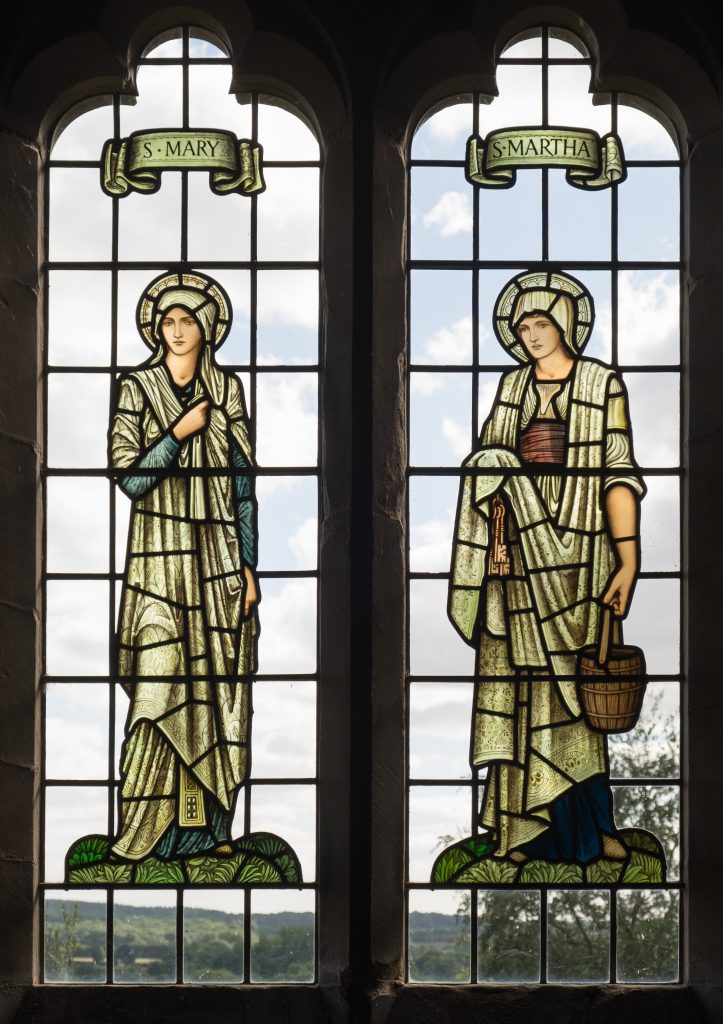
The following is a contemporary stained glass window from All Saints church, Preston Bagot, Warwickshire, England. The windows were designed by Edward Burne-Jones and made by Morris & Co, Birmingham:

Photo by DeFacto, hosted by Wikimedia Commons , Creative Commons Attribution-Share Alike 4.0 International

Stained glass is not just highly decorative, it’s a medium which has been used to express important religious messages for centuries. Literacy was not widespread in the medieval and Renaissance periods and the Church used stained glass and other artworks to teach the central beliefs of Christianity. In Gothic churches, the windows were filled with extensive narrative scenes in stained glass — like huge and colorful picture storybooks — in which worshipers could ‘read’ the stories of Christ and the saints and learn what was required for their religious salvation. (Source: Victoria and Albert Museum )

Learn more on Bible Odyssey: Mary and Martha .