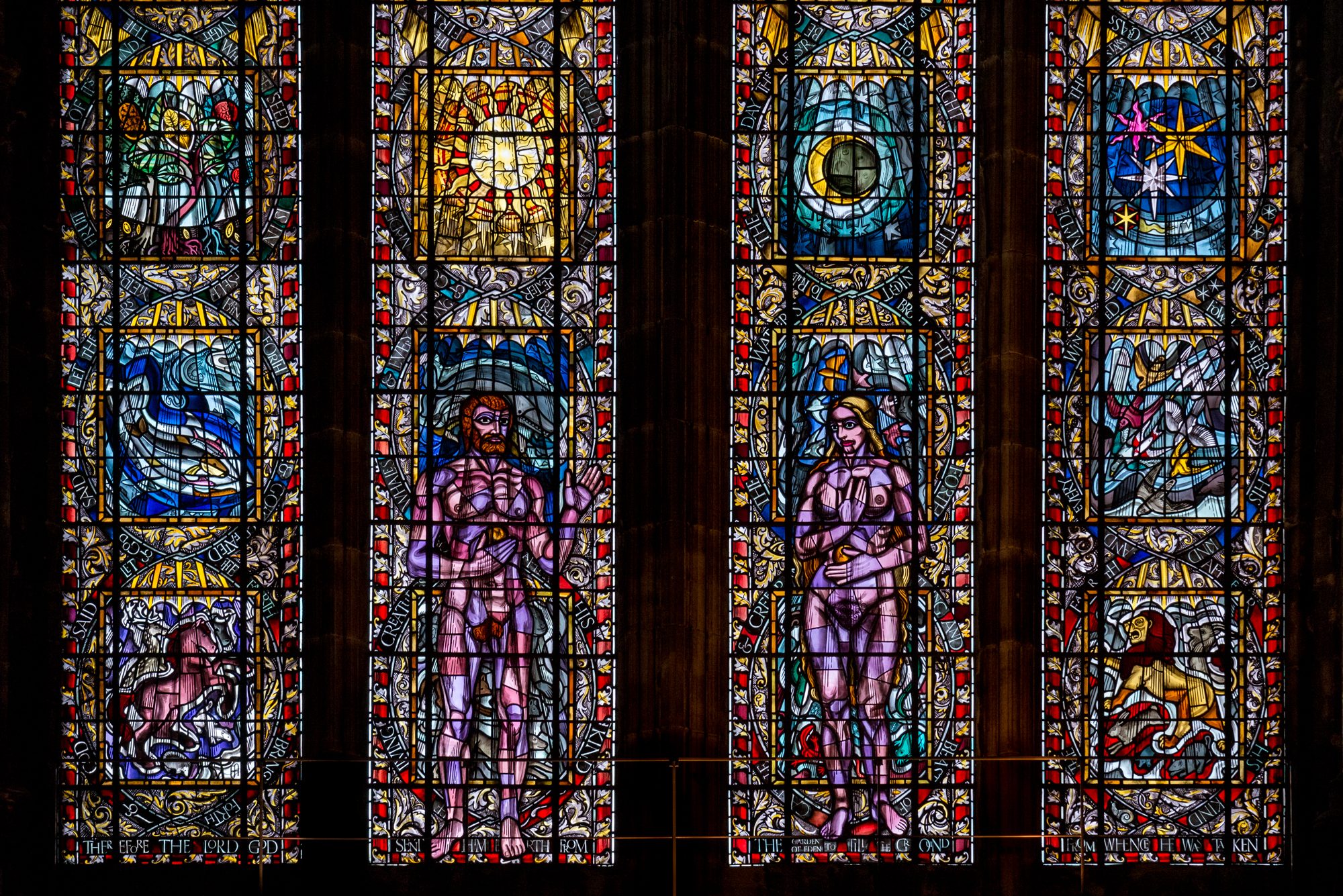
The following is a stained glass window from the Three choir windows in the Marienkirche, Frankfurt (Oder), Germany, of the 14th century, depicting the fall:
Source: Der gläserne Schatz: Die Bilderbibel der St. Marienkirche in Frankfurt (Oder), Neuer Berlin Verlag, 2005, hosted by Wikimedia Commons under a public domain license
Stained glass is not just highly decorative, it’s a medium which has been used to express important religious messages for centuries. Literacy was not widespread in the medieval and Renaissance periods and the Church used stained glass and other artworks to teach the central beliefs of Christianity. In Gothic churches, the windows were filled with extensive narrative scenes in stained glass — like huge and colorful picture storybooks — in which worshipers could ‘read’ the stories of Christ and the saints and learn what was required for their religious salvation. (Source: Victoria and Albert Museum )
The following is a stained glass window showing some of the works of mercy by Lavers, Barraud and Westlake, 1884 for the All Saints’ church, Mountfield, England:
Photo by Julian P Guffogg, hosted by Wikimedia Commons under a Creative Commons Attribution Share-alike license 2.0 license
Stained glass is not just highly decorative, it’s a medium which has been used to express important religious messages for centuries. Literacy was not widespread in the medieval and Renaissance periods and the Church used stained glass and other artworks to teach the central beliefs of Christianity. In Gothic churches, the windows were filled with extensive narrative scenes in stained glass — like huge and colorful picture storybooks — in which worshipers could ‘read’ the stories of Christ and the saints and learn what was required for their religious salvation. (Source: Victoria and Albert Museum )
Stained glass is not just highly decorative, it’s a medium which has been used to express important religious messages for centuries. Literacy was not widespread in the medieval and Renaissance periods and the Church used stained glass and other artworks to teach the central beliefs of Christianity. In Gothic churches, the windows were filled with extensive narrative scenes in stained glass — like huge and colorful picture storybooks — in which worshipers could ‘read’ the stories of Christ and the saints and learn what was required for their religious salvation. (Source: Victoria and Albert Museum
The following is a stained glass window depicting The Parable of the Rich Fool by Arthur J. Dix, 1898. From St John’s church, Bowness-on-Windermere, England:
Hosted by Wikimedia Commons under a Creative Commons CC0 1.0 Universal Public Domain Dedication
Stained glass is not just highly decorative, it’s a medium which has been used to express important religious messages for centuries. Literacy was not widespread in the medieval and Renaissance periods and the Church used stained glass and other artworks to teach the central beliefs of Christianity. In Gothic churches, the windows were filled with extensive narrative scenes in stained glass — like huge and colorful picture storybooks — in which worshipers could ‘read’ the stories of Christ and the saints and learn what was required for their religious salvation. (Source: Victoria and Albert Museum )
Following is a 1973 painting of the JESUS MAFA project, a response to New Testament readings from the Lectionary by a Christian community in Cameroon, Africa. Each of the readings was selected and adapted to dramatic interpretation by the community members. Photographs of their interpretations were made, and these were then transcribed to paintings:
From Art in the Christian Tradition, a project of the Vanderbilt Divinity Library, Nashville, TN. Image retrieved March 23, 2026. Original source: librairie-emmanuel.fr.
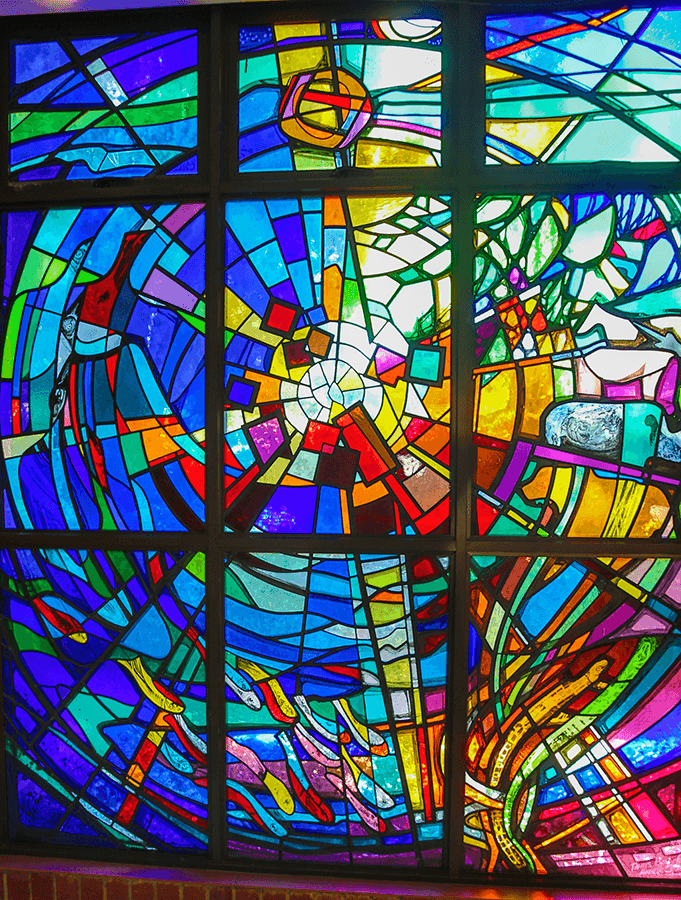
The following is a contemporary stained glass window depicting the prayer of praise and thanksgiving offered by Shadrach, Meshach, and Abednego from the Catholic Church of the Resurrection in Bryanston, New Zealand:
The Hymn of Creation: Bless the Lord all you creatures of Earth — Daniel 3:57 – 88 [or Prayer of Azar 1:29 – 1:67]. In this window all creation is gathered into a great hymn of praise to its Creator. Poet GM Hopkins once wrote ‘The world is charged with the Glory of God!’ Significantly, this window is positioned in the side chapel of the church where each day, Mass is celebrated — Christ’s all-embracing sacrifice, in which we share as priests of creation and which the Creator has entrusted to our care. (Source: Catholic Church of the Resurrection in Bryanston )
Stained glass is not just highly decorative, it’s a medium which has been used to express important religious messages for centuries. Literacy was not widespread in the medieval and Renaissance periods and the Church used stained glass and other artworks to teach the central beliefs of Christianity. In Gothic churches, the windows were filled with extensive narrative scenes in stained glass — like huge and colorful picture storybooks — in which worshipers could ‘read’ the stories of Christ and the saints and learn what was required for their religious salvation. (Source: Victoria and Albert Museum
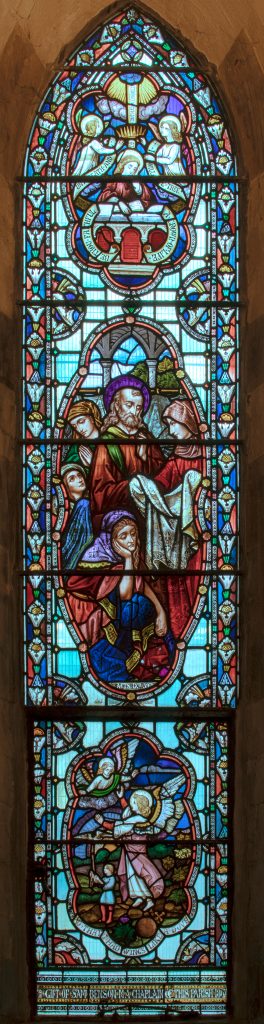
The top scene bears the inscription ‘Be thou faithful unto death and I will give thee a crown of life’; below St Peter is shown healing Tabitha at Joppa, and below again is the inscription ‘O that I had wings like a dove’ (Psalm 55) with a small boy and his kite. (Source: Southwark Cathedral website )
Stained glass is not just highly decorative, it’s a medium which has been used to express important religious messages for centuries. Literacy was not widespread in the medieval and Renaissance periods and the Church used stained glass and other artworks to teach the central beliefs of Christianity. In Gothic churches, the windows were filled with extensive narrative scenes in stained glass — like huge and colorful picture storybooks — in which worshipers could ‘read’ the stories of Christ and the saints and learn what was required for their religious salvation. (Source: Victoria and Albert Museum )
Stained glass is not just highly decorative, it’s a medium which has been used to express important religious messages for centuries. Literacy was not widespread in the medieval and Renaissance periods and the Church used stained glass and other artworks to teach the central beliefs of Christianity. In Gothic churches, the windows were filled with extensive narrative scenes in stained glass — like huge and colorful picture storybooks — in which worshipers could ‘read’ the stories of Christ and the saints and learn what was required for their religious salvation. (Source: Victoria and Albert Museum )
The following is a stained glass window from 1855 by artist H. Beiler over the altar of the Evangelische Stadtkirche Bad Rappenau, Bad Rappenau, Germany:
Photo by Llez, hosted by Wikimedia Commons under a Creative Commons Attribution-Share Alike 3.0 Unported license
Stained glass is not just highly decorative, it’s a medium which has been used to express important religious messages for centuries. Literacy was not widespread in the medieval and Renaissance periods and the Church used stained glass and other artworks to teach the central beliefs of Christianity. In Gothic churches, the windows were filled with extensive narrative scenes in stained glass — like huge and colorful picture storybooks — in which worshipers could ‘read’ the stories of Christ and the saints and learn what was required for their religious salvation. (Source: Victoria and Albert Museum )




,_14th_century.jpg)
.jpg)

