The Greek that is translated as “devour” or similar in English is translated in Elhomwe as “chew,” the term that is used for “eating meat.” (Source: project-specific translation notes in Paratext)
See also eat (meat).

καὶ τὰ δέκα κέρατα ἃ εἶδες καὶ τὸ θηρίον οὗτοι μισήσουσιν τὴν πόρνην καὶ ἠρημωμένην ποιήσουσιν αὐτὴν καὶ γυμνὴν καὶ τὰς σάρκας αὐτῆς φάγονται καὶ αὐτὴν κατακαύσουσιν ἐν πυρί.
16And the ten horns that you saw, they and the beast will hate the whore; they will make her desolate and naked; they will devour her flesh and burn her up with fire.
The Greek that is translated as “devour” or similar in English is translated in Elhomwe as “chew,” the term that is used for “eating meat.” (Source: project-specific translation notes in Paratext)
See also eat (meat).
The Greek, Latin and Hebrew that is translated as “naked” in English is translated in Enlhet with a figure of speech: “(one’s) smoothness.” (Source: Jacob Loewen in The Bible Translator 1969, p. 24ff. )
In Elhomwe the word for “naked” is “shameful to use, and would never be used by a preacher in church.” Therefore “without clothes” is used. (Source: project-specific translation notes in Paratext)
In Cherokee it is translated as “being in a bodily state.” (source: Bender / Belt 2025, p. 30)
In the Catholic Mandarin Chinese Sigao version and the Protestant Union Version, historical Chinese idioms are used: chìshēn lòutǐ (赤身露體 / 赤身露体) or chìshēn luǒtǐ (赤身裸體 / 赤身裸体): “bare and uncovered body.” (Source: Toshikazu S. Foley in Hong Kong Journal of Catholic Studies, 2011, p. 45ff.)
The Greek, Latin, and Hebrew that is typically translated as “prostitute” in English (in some, mostly earlier translation also as “harlot” or “whore”) is translated in the 2024 revision of the inter-confessional Latvian Jauna Pārstrādāta latviešu Bībele as netikle or “hussy.” This replaced the previous translation mauka or “whore.” Nikita Andrejevs, editor of the Bible explains the previous and current translations: “The translators at the time felt that this strong word best described the thought contained in the main text. Many had objections, as it seemed that this word would not be the most appropriate for public reading in church.” (Source: Updated Bible published in Latvia ).
Other translations include:
See also Translation commentary on Genesis 34:31, Rahab, and prostitute oneself / play the prostitute.
Learn more on Bible Odyssey: Prostitution in the Bible .
The Greek and Hebrew that is translated in English as “hate” or a form thereof is translated in Tabasco Chontal as “don’t want to see [the person who is hated].” (Source: John Beekman & Harwood Hess in Notes on Translation, March 1963, p. 1ff.)
See also hate.
Following are a number of back-translations of Revelation 17:16:
The following is a stained glass window by William Wailes from the Cathédrale Notre-Dame in Clermont-Ferrand, France:
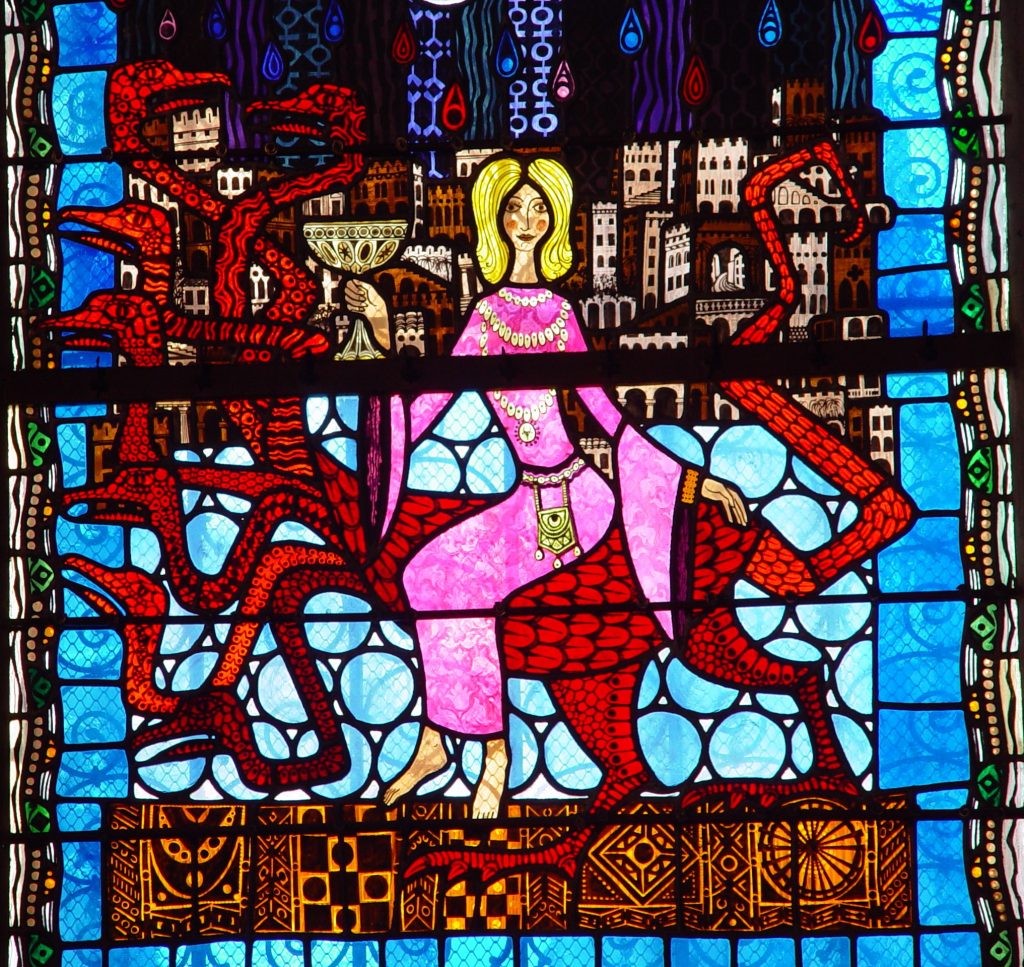
Source: Art in the Christian Tradition , a project of the Vanderbilt University Divinity Library, Nashville, TN. Original source: image donated by Jim Womack and Anne Richardson
Stained glass is not just highly decorative, it’s a medium which has been used to express important religious messages for centuries. Literacy was not widespread in the medieval and Renaissance periods and the Church used stained glass and other artworks to teach the central beliefs of Christianity. In Gothic churches, the windows were filled with extensive narrative scenes in stained glass — like huge and colorful picture storybooks — in which worshipers could ‘read’ the stories of Christ and the saints and learn what was required for their religious salvation. (Source: Victoria and Albert Museum )
The ten horns … and the beast will hate: for some reason the beast and the ten kings who are his allies (verse 13) will turn against the infamous prostitute and attack her. For hate see 2.6.
They will make her desolate and naked: this is better translated “they will take away all her belongings, and will strip her naked” or “They will take … and take off all her clothes so that she is naked.” If the language level allows it, the appropriate verb for make … desolate is “to despoil,” “to plunder.”
Devour her flesh and burn her up with fire: it must be noted that the first and the last of the four actions (make … desolate and burn) apply more naturally to the city (Babylon); the other two actions (make her … naked, and devour her flesh) apply to the prostitute herself. In the translation the plain meaning of all four actions should be clearly represented. For devour her flesh the translation can say “will devour her” (see the figure in Psa 27.2, RSV footnote; Jer 10.25; Micah 3.3). The figure is that of a wild animal that eats its victim as soon as it kills it. The statement will … burn her up with fire means to consume her body with fire. The same verb “to burn up” appears also in 18.8. This phrase may also be expressed as “they will take fire and burn her up (or, destroy her)” or “they will set her on fire….”
Quoted with permission from Bratcher, Robert G. and Hatton, Howard A. A Handbook on The Revelation to John. (UBS Handbook Series). New York: UBS, 1993. For this and other handbooks for translators see here .
17:16a
And the ten horns and the beast that you saw:
The Greek phrase is literally “the ten horns that you saw and the beast.” John had already seen the beast. This phrase emphasizes the fact that John had already seen the ten horns. For example:
the ten horns that you saw, they and the beast (Revised Standard Version)
the ten horns: This phrase refers figuratively here to the ten kings. In some languages a literal translation would wrongly refer only to the beast’s ten horns, not the ten kings. If that is true in your language, you may want to:
• Explain the meaning in your translation. For example:
the ten horns, ⌊namely the ten kings,⌋
• Translate the literal meaning and explain its meaning in a footnote. An example footnote is:
This phrase refers figuratively here to the ten kings.
• Translate the meaning without the figure of speech. For example:
the ten kings
hate: This word means “feel strong dislike toward someone and detest him.”
17:16b
They will leave her desolate and naked: The Greek clause is literally “they will make her desolate and naked” (as in the Revised Standard Version). They will take Babylon’s possessions and her clothes. But it also describes her in a figurative way as being alone and shamed. Other ways to translate this clause are:
They will take all her possessions and clothes from her
-or-
They will strip her naked and leave her destitute (Revised English Bible)
-or-
They will take everything she has and leave her naked (New Century Version)
They will leave her desolate: The Greek phrase that the Berean Standard Bible translates as leave her desolate refers here to being left with nothing. For example:
they will take away everything she has (Good News Translation)
17:16c
and will eat her flesh: This clause refers to the way a fierce animal attacks a person and devours the dead body. For example:
They will eat her body (New Century Version)
This clause refers figuratively to the beast and the ten kings fiercely attacking Babylon and destroying her.
flesh: This word refers to the skin and muscles. But it can also include all the parts of the body that animals can eat.
17:16d
burn her with fire: They burned the parts of the body that they did not eat.
© 2020 by SIL International®
Made available under the terms of a Creative Commons Attribution-ShareAlike 4.0 License (CC BY-SA) creativecommons.org/licenses/by-sa/4.0.
All Scripture quotations in this publication, unless otherwise indicated, are from The Holy Bible, Berean Standard Bible.
BSB is produced in cooperation with Bible Hub, Discovery Bible, OpenBible.com, and the Berean Bible Translation Committee.
No comments yet.
Leave a Reply
You must be logged in to post a comment.