The Greek, Latin, and Hebrew that is typically translated as “prostitute” in English (in some, mostly earlier translation also as “harlot” or “whore”) is translated in the 2024 revision of the inter-confessional LatvianJauna Pārstrādāta latviešu Bībele as netikle or “hussy.” This replaced the previous translation mauka or “whore.” Nikita Andrejevs, editor of the Bible explains the previous and current translations: “The translators at the time felt that this strong word best described the thought contained in the main text. Many had objections, as it seemed that this word would not be the most appropriate for public reading in church.” (Source: Updated Bible published in Latvia ).
Other translations include:
Bariai: “a woman of the road” (source: Bariai Back Translation)
Hiligaynon: “a woman who sells her body” (source: Hiligaynon Back Translation)
Uma: “a woman whose behavior is not appropriate” or “a loose woman” (source: Uma Back Translation)
Yakan: “a bad woman” (source: Yakan Back Translation)
Western Bukidnon Manobo: “a woman who make money through their reputation” (source: Western Bukidnon Manobo Back Translation)
Tagbanwa: “a woman who makes money with her body” (source: Tagbanwa Back Translation)
Kankanaey: “a woman whose womanhood is repeatedly-bought” (source: Kankanaey Back Translation)
Following are a number of back-translations of Revelation 17:15:
Uma: “The angel also said saying to me: ‘The water that you (sing.) saw earlier, on which the woman sat, stands for people from all over the world, people/crowds from many countries and many kinds of languages.” (Source: Uma Back Translation)
Yakan: “The angel yet said to me, ‘The water/river you saw, the place where the bad woman sits, the meaning of that is, the people from all tribes and countries and kingdoms and from all sorts of languages.” (Source: Yakan Back Translation)
Western Bukidnon Manobo: “Then the angel spoke to me again, and he said, ‘the waters which you saw where the woman sits are to be interpreted as kingdoms and races and very many people whose languages are different.” (Source: Western Bukidnon Manobo Back Translation)
Kankanaey: “The angel continued to say to me, ‘The multiple-rivers which you (sing.) saw which is where the woman whose womanhood is repeatedly-bought is seated, they are the nations and groups whose languages and skin are mutually-different.” (Source: Kankanaey Back Translation)
Tagbanwa: “What the angel further said to me was, ‘Those rivers which you saw where that woman is sitting, numerous people are meant by those, of many different nations, blood-clans and languages.” (Source: Tagbanwa Back Translation)
Tenango Otomi: “Then again he said to me: ‘That sea you saw where the woman was seated, that prostitute, stands for the nations all over the earth, for the people who live in their cities, those who speak all kinds of languages.” (Source: Tenango Otomi Back Translation)
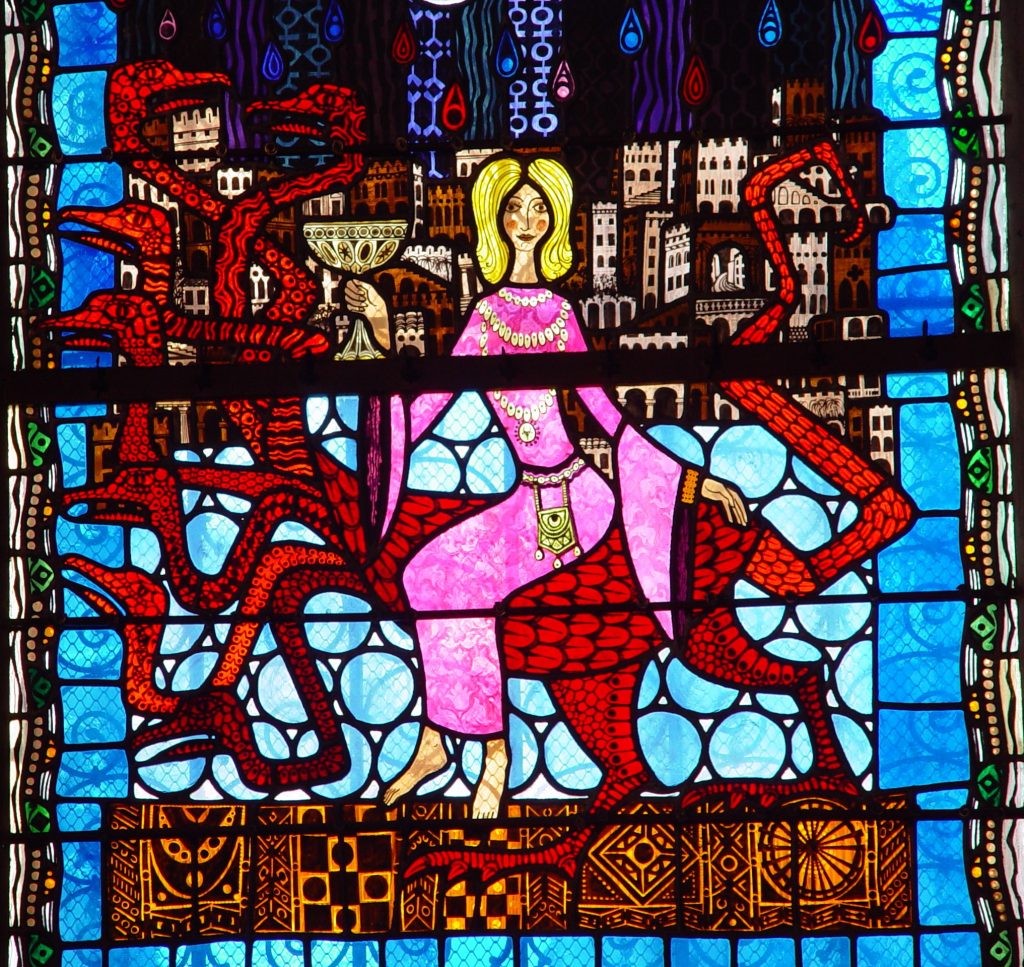
The following is a stained glass window by William Wailes from the Cathédrale Notre-Dame in Clermont-Ferrand, France:
Source: Art in the Christian Tradition , a project of the Vanderbilt University Divinity Library, Nashville, TN. Original source: image donated by Jim Womack and Anne Richardson
Stained glass is not just highly decorative, it’s a medium which has been used to express important religious messages for centuries. Literacy was not widespread in the medieval and Renaissance periods and the Church used stained glass and other artworks to teach the central beliefs of Christianity. In Gothic churches, the windows were filled with extensive narrative scenes in stained glass — like huge and colorful picture storybooks — in which worshipers could ‘read’ the stories of Christ and the saints and learn what was required for their religious salvation. (Source: Victoria and Albert Museum )
He said to me: it is better to specify the speaker: “The angel said to me.” Good News Translation adds “also” because what follows is a continuation of the speech of the same angel in the previous verses.
The waters … where the harlot is seated: the translation here must be the same as in verse 1.
Are: or “represent,” “stand for” (as in verses 9-10, 12).
Peoples and multitudes and nations and tongues: this is the same list that appears in 5.9 and other passages, except that here multitudes (Good News Translation “peoples”) is used instead of “tribes” in the other passages. The explanation of The waters makes it clear that the powerful prostitute rules over all of the world’s nations. In certain languages that do not speak about all these categories of people, this phrase will be rendered more naturally as “represent all the peoples of the world.”
Quoted with permission from Bratcher, Robert G. and Hatton, Howard A. A Handbook on The Revelation to John. (UBS Handbook Series). New York: UBS, 1993. For this and other handbooks for translators see here .
The waters you saw, where the prostitute was seated, are peoples and multitudes and nations and tongues: The phrase peoples and multitudes and nations and tongues explains the symbol of The waters…where the prostitute was seated.
17:15b
waters: This word refers generally to any body of water. It includes rivers, creeks, lakes, ponds, springs of water, and perhaps even oceans. Some languages have a general word for all these. For example:
water/river
But some languages do not have a general word for any body of water. If that is true in your language, you may want to use a list. For example:
rivers, creeks, lakes, and ponds
See how you translated this word in 17:1.
prostitute: This word refers to a woman who has sexual relations for money. A prostitute often entices men to have sexual relations with her. Translate this word as you did in 17:1. But you should not repeat the footnote here.
17:15c
peoples and multitudes and nations and tongues: This list is similar to the lists in 5:9, 7:9, 11:9, 13:7, and 14:6. Here the word multitudes replaces “tribe.”
peoples: In the singular, “people,” the Greek word refers to a whole people group that shares a common culture and language. It can also refer to a whole country, which may have many people groups within it. In the plural, peoples, it refers to a number of those groups. For example:
nations (Good News Translation)
multitudes: This word refers to large groups of people. It is often translated as “crowds.” But probably larger groups are meant here. For example:
populations (Revised English Bible)
nations: This word refers to whole people groups. They may be grouped by culture, language, or nationality. For example:
country
tongues: This word refers to grouping people by what language they speak, their “mother tongue.”
General Comment on 17:15c
The meanings of the three words: “peoples,” “multitudes,” and “nations” are similar. All four words (including “tongues”) are used to emphasize that the “waters” represent people from every kind of people group. Some languages do not have three similar words like “peoples,” “multitudes,” and “nations.” If that is true in your language, you may want to:
• Use fewer words. For example:
peoples and languages and nations
• Use slightly different words to represent the different categories of people. For example:
peoples and regions/lands and nations and languages
Living Water is produced for the Bible translation movement in association with Lutheran Bible Translators. Lyrics derived from the ESV® Bible (The Holy Bible, English Standard Version®).

Leave a Reply
You must be logged in to post a comment.