12And the ten horns that you saw are ten kings who have not yet received a kingdom, but they are to receive authority as kings for one hour, together with the beast.
Following are a number of back-translations of Revelation 17:12:
Uma: “The ten horns that you (sing.) saw earlier stand-for ten kings who have not-yet begun to rule. Those ten kings are allowed to rule together with that animal, but their ruling will only be one hour in length.” (Source: Uma Back Translation)
Yakan: “‘The ten horns that you saw, the meaning is ten kings who are not yet reigning. And these ten kings are given authority to reign together with the creature. But they will reign only for a short while.” (Source: Yakan Back Translation)
Western Bukidnon Manobo: “Now those ten horns, the interpretation of them is ten kings who have not yet ruled. Those ten kings and the beast, they will be given authority to rule for a short time only.” (Source: Western Bukidnon Manobo Back Translation)
Kankanaey: “‘The ten horns which you (sing.) saw, they are ten kings that have not yet ruled, but they will be given authority to rule-with the fearsome animal for only-one hour.” (Source: Kankanaey Back Translation)
Tagbanwa: “As for those ten horns of his which you saw, they are ten kings who haven’t yet gotten to reign. But they will govern along with this animal, only not for long for you could say it was just for half an hour.” (Source: Tagbanwa Back Translation)
Tenango Otomi: “Concerning the ten horns you saw, these mean ten rulers. Now they still have not received the position to govern. But when they receive their position to govern, they will rule along with the terrible animal. And just one hour will they govern.” (Source: Tenango Otomi Back Translation)
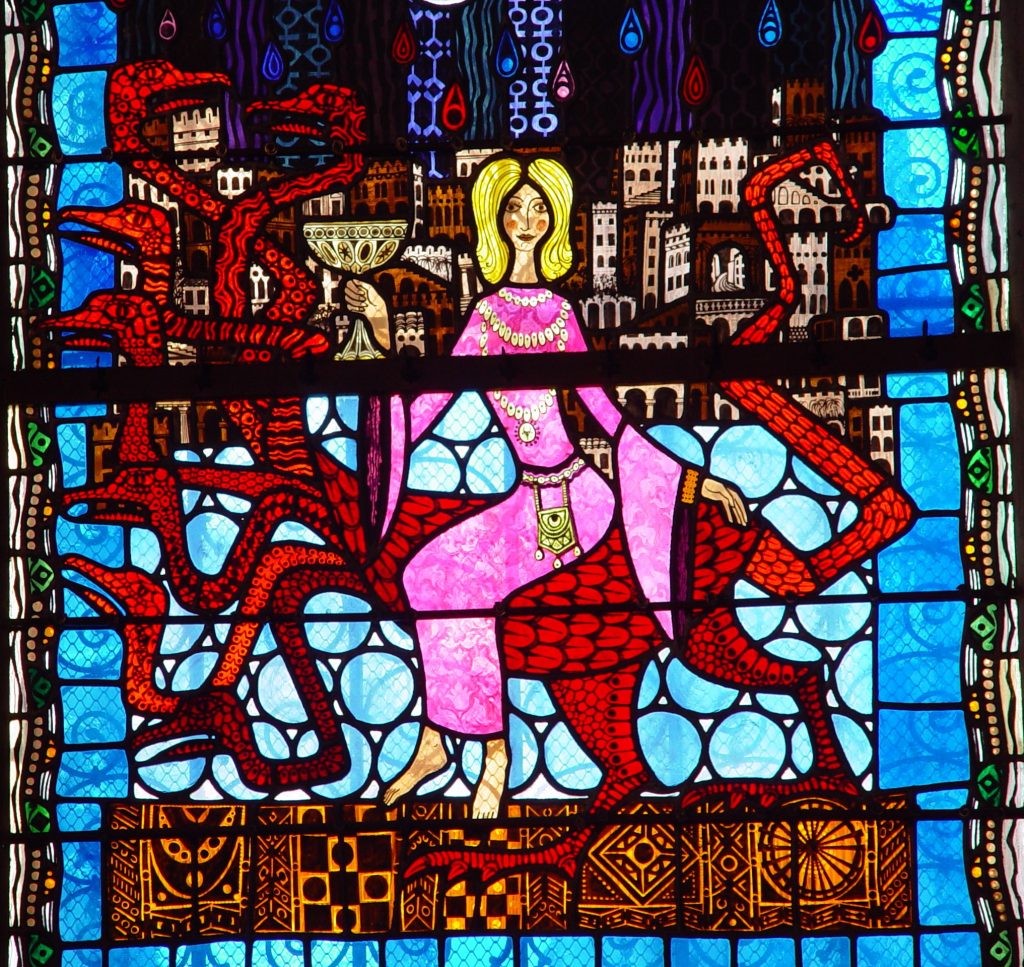
The following is a stained glass window by William Wailes from the Cathédrale Notre-Dame in Clermont-Ferrand, France:
Source: Art in the Christian Tradition , a project of the Vanderbilt University Divinity Library, Nashville, TN. Original source: image donated by Jim Womack and Anne Richardson
Stained glass is not just highly decorative, it’s a medium which has been used to express important religious messages for centuries. Literacy was not widespread in the medieval and Renaissance periods and the Church used stained glass and other artworks to teach the central beliefs of Christianity. In Gothic churches, the windows were filled with extensive narrative scenes in stained glass — like huge and colorful picture storybooks — in which worshipers could ‘read’ the stories of Christ and the saints and learn what was required for their religious salvation. (Source: Victoria and Albert Museum )
Some languages do not have a concept of kingship and therefore no immediate equivalent for the Greek, Hebrew, Ge’ez, Aramaic, and Latin that is translated as “king” in English. Here are some (back-) translations:
Ninia Yali: “big brother with the uplifted name” (source: Daud Soesilio in Noss 2007, p. 175)
Nyamwezi: mutemi: generic word for ruler, by specifying the city or nation it becomes clear what kind of ruler (source: Pioneer Bible Translators, project-specific translation notes in Paratext)
Ghomála’: Fo (“The word Fo refers to the paramount ruler in the kingdoms of West Cameroon. He holds administrative, political, and religious power over his own people, who are divided into two categories: princes (descendants of royalty) and servants (everyone else).” (Source: Michel Kenmogne in Theologizing in Context: An Example from the Study of a Ghomala’ Christian Hymn))
Faye Edgerton retells how the term in Navajo (Dinė) was determined:
“[This term was] easily expressed in the language of Biblical culture, which had kings and noblemen with their brilliant trappings and their position of honor and praise. But leadership among the Navajos is not accompanied by any such titles or distinctions of dress. Those most respected, especially in earlier days, were their headmen, who were the leaders in raids, and the shaman, who was able to serve the people by appealing for them to the gods, or by exorcising evil spirits. Neither of these made any outward show. Neither held his position by political intrigue or heredity. If the headman failed consistently in raids, he was superceded by a better warrior. If the shaman failed many times in his healing ceremonies, it was considered that he was making mistakes in the chants, or had lost favor with the gods, and another was sought. The term Navajos use for headman is derived from a verb meaning ‘to move the head from side to side as in making an oration.’ The headman must be a good orator, able to move the people to go to war, or to follow him in any important decision. This word is naat’áanii which now means ‘one who rules or bosses.’ It is employed now for a foreman or boss of any kind of labor, as well as for the chairman of the tribal council. So in order to show that the king is not just a common boss but the highest ruler, the word ‘aláahgo, which expresses the superlative degree, was put before naat’áanii, and so ‘aláahgo naat’áanii ‘anyone-more-than-being around-he-moves-his-head-the-one-who’ means ‘the highest ruler.’ Naat’áanii was used for governor as the context usually shows that the person was a ruler of a country or associated with kings.”
The ten horns … are ten kings who have not yet received royal power: these are ten men who will in the future become kings. These are not the same kind of kings as those represented by the seven heads; these are kings of ten different countries who will rule at the same time. The Greek “they receive authority as kings” does not indicate who will give them this authority. It is doubtful that divine activity is implied. The ten kings will rule for a very short time (one hour) and be under the control of the beast. And they will be destroyed when he is destroyed (19.19-21). Hour: in languages that do not talk about a precise period of sixty minutes, one may say “a very short period of time” or “the length of time it takes to…” (filling in some activity like cooking brown rice and so on).
An alternative translation model for this verse in languages that do not use the passive is:
• The ten horns that you saw represent ten kings who have not yet begun to rule, but they will receive authority (or, power) to rule as kings for one hour (or, very short period of time) with the beast.
Quoted with permission from Bratcher, Robert G. and Hatton, Howard A. A Handbook on The Revelation to John. (UBS Handbook Series). New York: UBS, 1993. For this and other handbooks for translators see here .
The ten horns you saw are ten kings who have not yet received a kingdom: This clause indicates that the ten horns represent ten future kings. For example:
The ten horns you saw are ten kings who have not yet begun to rule (Good News Translation)
17:12b
received a kingdom: This phrase probably indicates that someone would make each of these ten people a ruler over a region or country. Other ways to translate this phrase are:
received royal power (Revised Standard Version) -or-
come into power (Contemporary English Version)
17:12c
will receive one hour of authority: This phrase will receive…authority implies that someone will give these kings the authority to rule. Probably the dragon will give the authority and God will allow it as part of his plan. Your translation should not imply that the ten kings took the authority themselves. For example:
who for one hour will be given authority -or-
to whom the ⌊dragon⌋ will give authority for one hour
one hour: Here the phrase one hour refers to a short time, not a literal hour. It might be the same length of time that the beast reigns (42 months) or it might be less than that time. You should:
• Use a word or phrase in your language that can refer figuratively to a short amount of time. For example:
an hour -or-
a day
• Use a word or phrase that refers generally to a short time. For example:

Leave a Reply
You must be logged in to post a comment.