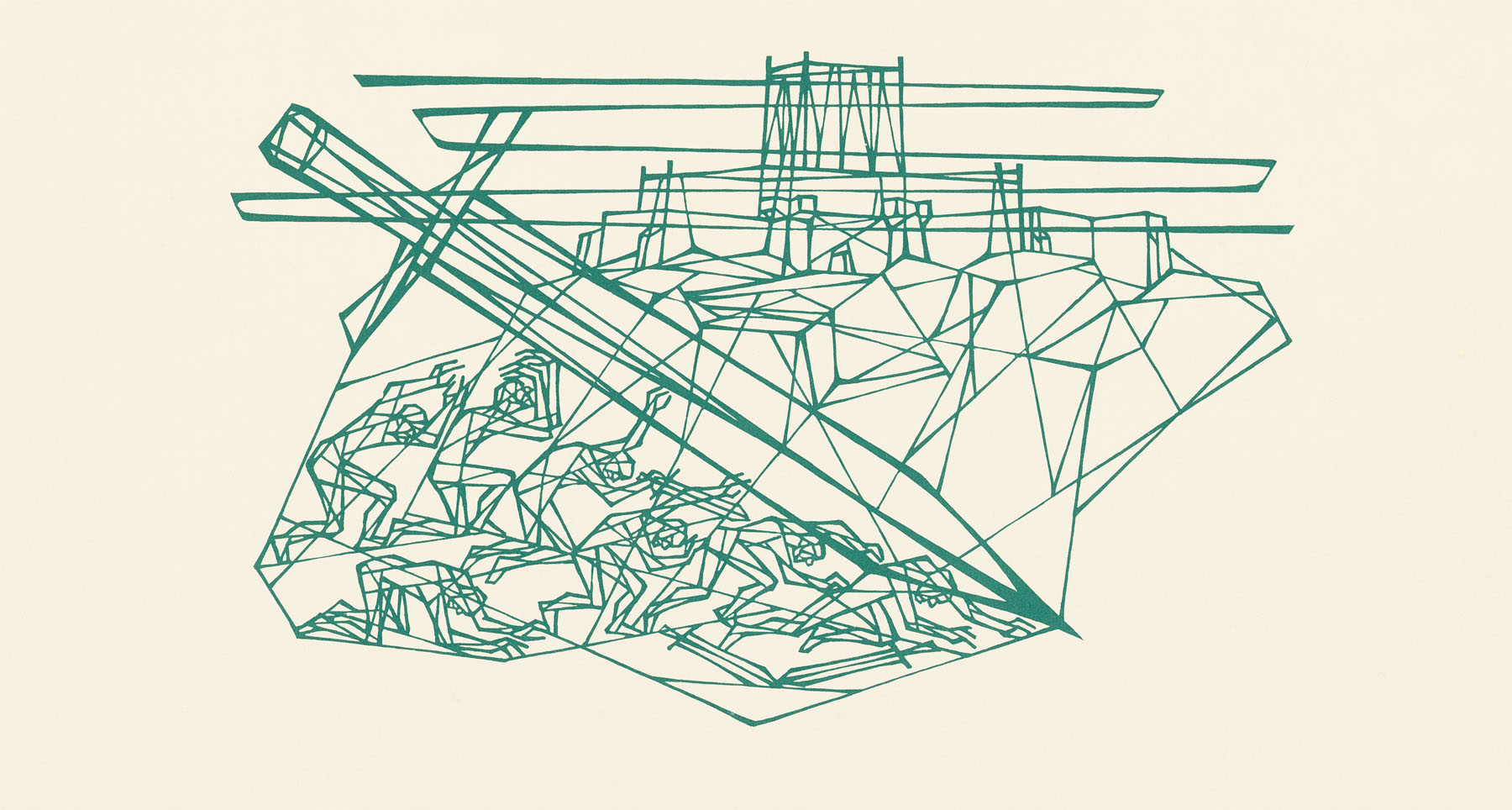
Drawing by Ismar David from The Psalms: A new English translation, linked with permission from Ismar David Archive .
For other images of Ismar David drawings, see here.

תְּ֭רֹעֵם בְּשֵׁ֣בֶט בַּרְזֶ֑ל כִּכְלִ֖י יוֹצֵ֣ר תְּנַפְּצֵֽם׃
9You shall break them with a rod of iron
and dash them in pieces like a potter’s vessel.”
Drawing by Ismar David from The Psalms: A new English translation, linked with permission from Ismar David Archive .
For other images of Ismar David drawings, see here.
The Hebrew in Psalm 2:9 that is translated as “iron rod” or similar in English is translated in the Contemporary Chichewa translation (2002/2016) as ndodo yaufumu or “yokes.” In Chewa culture, this is a rod that is carried by a chief or king. It is a symbol of power and authority. It can either be wooden or metal. Sometimes it is decorated with some ornaments. (Source: Mawu a Mulungu mu Chichewa Chalero Back Translation)
In the 1852 translation of the Psalms into Javanese by Johann F.C. Gericke, the translator attempted to highlight the different voices and sections of the psalm by using different language styles or sociolects of Javanese. Ngoko , a “top-down” register, was used when senior people communicated to people junior in age or rank, and kromo , a “bottom-up” and more ornate register, was used to address superiors and elders. According to Gericke (quoted in Solleveld, cited below) “If one sought to use one and the same language in the entire Psalm, no Javanese would understand it. The difference between Kromo and Ngoko is often as big as between Dutch and Polish.”
(Source: Floris Solleveld in A Tale of Two Translators from the Global Bible project)
Source for Javanese language registers and the different sections of Psalm 2.
Following is a translation of Psalm 2 into song in Koti, by Tarikhi Ya Haakhi. The Koti text is translated into English within the video.
Following is another rendition only verses 1 and 2 by the same team in the same language:
℗ 2025 Wycliffe Bible Translators South Africa NPC. Used with permission. Part of the Psalms that Sing project.
Following are a number of back-translations as well as a sample translation for translators of Psalm 2:9:
You shall break them … and dash them in pieces: both statements describe how the king of Israel will defeat and destroy the Gentile nations. The second verb implies a more thorough destruction than the first one; so Good News Translation “break” and “shatter … in pieces.” One of the most common techniques to achieve intensification in biblical parallelism is the use of the simile in the second clause. The intensification of poetic effect is made here also by the contrast of breaking with an iron rod and the shattering of a fragile clay pot. The translator’s ability to maintain the degree of contrast will depend on the verbs used and the existence of clay pots, well known for their tendency to be easily smashed. It may not be natural to use this figurative language, and so the following may be better: “You will defeat (or, subdue) them … you will destroy them completely.” The verb in line a of the Masoretic text is “break”; but the same consonants of the Masoretic text, with different vowels, which are given in the margin of the text, mean “to rule,” and this is how the Septuagint, Syriac, and Vulgate translate it (also New American Bible, New International Version, and Bible en français courant). And this is the form also in which the text is used in Revelation 2.27; 12.5; 19.15.
A rod of iron is a figure of the ruthless power the king will use to defeat the pagan nations (New Jerusalem Bible “with an iron mace”). In some languages it is unnatural to speak of “breaking” nations with an instrument. Other figures of speech which are natural in the language may be found which will symbolize despotic rule; for example, “to trample with the feet” or “to strike with the fist.”
A potter’s vessel: “pottery” (New International Version), “a clay pot” (Good News Translation, New English Bible), “pots” (New Jerusalem Bible). This was easily broken and could not be put back together. Here it is a figure of complete and permanent destruction.
In most areas of the world, potter’s vessel can be translated as a “clay pot.” However, where clay pots are not made and known, a substitute, breakable article of local manufacture may be used.
Quoted with permission from Bratcher, Robert G. and Reyburn, William D. A Handbook on the Book of Psalms. (UBS Helps for Translators). New York: UBS, 1991. For this and other handbooks for translators see here .
The following are presentations by the Psalms: Layer by Layer project, run by Scriptura . The first is an overview, the second an introduction into the poetry and the third an introduction into the exegesis of Psalm 2.
Copyright © Scriptura
Copyright © Scriptura
Copyright © Scriptura
Copyright © Scriptura
Copyright © Scriptura
The following is an English translation of Psalm 2 into song by linguists & professional musicians under the auspices of The Spoken English Bible , an oral Bible translation designed to reach Americans who may not yet engage with Scripture and to serve as a model for Bible translation in minority languages.
Creative Commons Attribution license
No comments yet.
Leave a Reply
You must be logged in to post a comment.