8When Moses went into the tent of the covenant on the next day, the staff of Aaron for the house of Levi had sprouted. It put forth buds, produced blossoms, and bore ripe almonds.
“The rod was described as a dead piece of stick cut from a certain tree. The informant wanted to know what kind of tree, and when told that it was an almond tree, he asked what color the blossoms were. The encyclopedia disclosed that almond trees in the Middle East bear yellow blossoms. He had to know this before he could give the proper term for “budded,” since the color of the bud is incorporated in the word. The translation is: . . . Éran bigish ch’il nahalingo bilátah da’iichiihée “Aaron his-stick plant it-being-like its-top-along plural-something- (unidentified subject) -were-becoming-yellowish-red-the-former-one.” (Source: Faye Edgerton in The Bible Translator 1962, p. 25ff. )
The Hebrew, Latin and Greek that is transliterated as “Levi” in English is translated in Spanish Sign Language with a sign that signifies a menorah referring to the temple service of the tribe of the Levites. The same sign is also used for the tribe. (Source: Steve Parkhurst)
The almond is one of a group of fruit-bearing trees (Prunus) that also includes plums, cherries, peaches, and apricots. There are fifteen species of wild almond in Iran, two wild species in Israel, and one cultivated one (Prunus dulcis, also called Amygdalus communis). They are plentiful now in the hills of Israel, and probably were so in Bible times, even in the hot, dry Negev.
The almond tree grows to around 4 meters (13 feet) tall. It loses its leaves in winter and then, before the new leaves appear in spring, a profusion of white or pink flowers appears. The flowers are quite flat, with oval petals. The fuzzy fruit, about the size of a date palm fruit, comes about ten weeks later. The seed (“nut” in English) is fifty percent oil, and can be eaten raw but is usually roasted.
Three passages make reference to physical features of the almond tree. In Exodus 25:33f. and 37:19f. 20 we find the Hebrew word meshuqad (“almond-like”) referring to the shape of the almond blossom. The flat almond flower made a reasonable model for the lamp holders at the top of the branches of the lampstand in the Tabernacle.
The writer of Ecclesiastes 12:5 uses the profusion of white blossoms on the almond tree as a symbol of old age. The comparison is of course to the white hair of the elders.
In Jeremiah 1:11 the author makes use of the similarity of the Hebrew name shaqed (“almond”) to the word shoqed (“watching” or “wakeful”) to emphasize that Yahweh is “watching” over Israel (see almond tree / watching). Some commentators add to this that since the almond is the first of the trees to blossom in the spring—even before the leaves emerge — it was “waking up early,” and God, likewise, is an “early help” in time of trouble.
The Prunus family has members in various parts of the world, such as Prunus salicina in China and Prunus munsoniana in eastern North America. However, the branches and fruit of many of these are so different from the true almond that in non-figurative passages local names will not really be usable. In a passage such as Genesis 30:37, a transliteration from a major language is recommended; for example, shaked/lus (Hebrew), lawus (Arabic), amande (French), amendoa (Portuguese), almendra (Spanish), and alimondi. In English the “l” is not pronounced, so “almond” may be transliterated amond. Elsewhere, where the tree is used figuratively, as in Exodus and Ecclesiastes (see below), translators can use a blossom with a similar shape and color.
Almond tree, photo by Gloria SuessAlmond flowers, photo by Ray Pritz
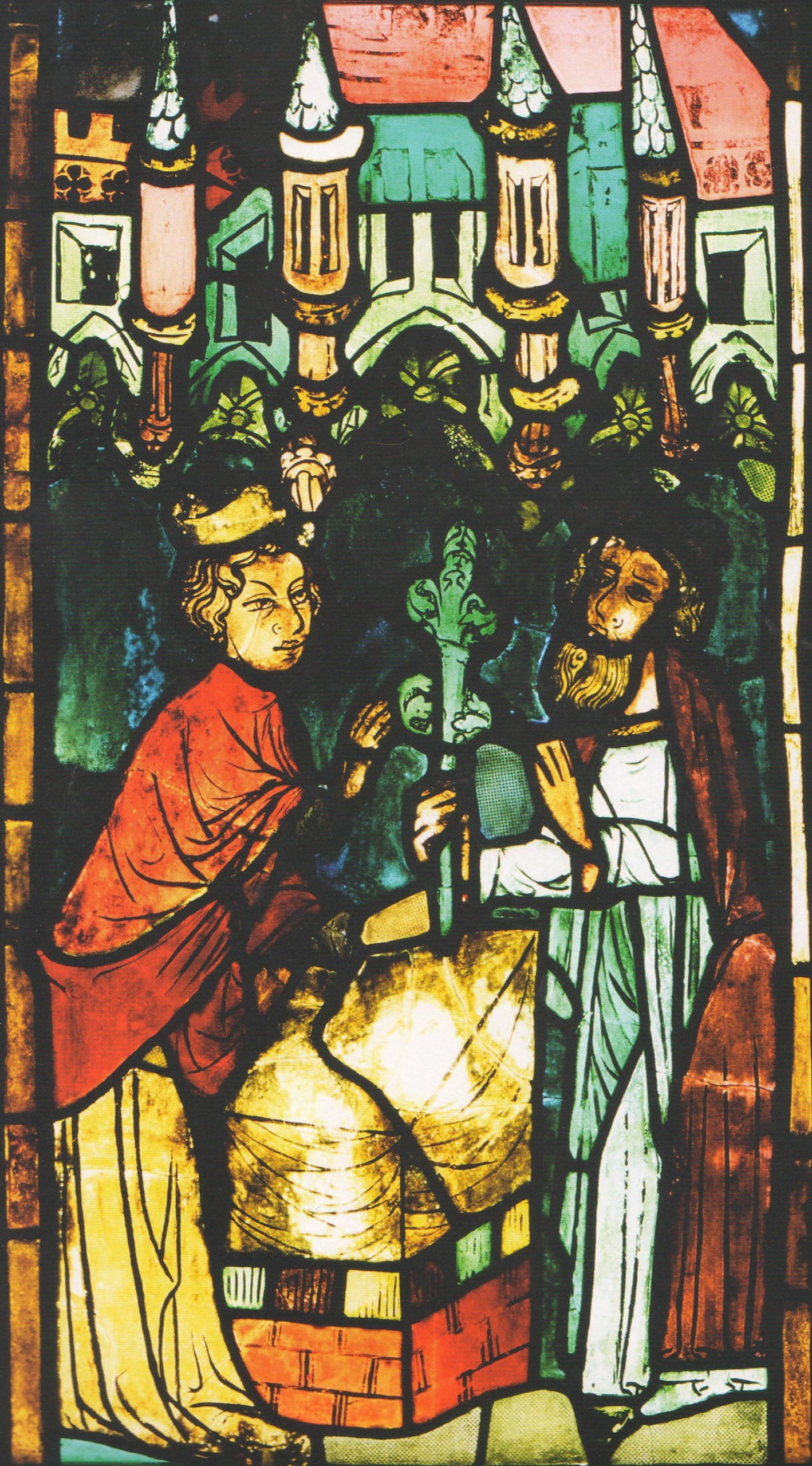
The following is a stained glass window from the Three choir windows in the Marienkirche, Frankfurt (Oder), Germany, of the 14th century, depicting the budding of Aaron’s rod:
Source: Der gläserne Schatz: Die Bilderbibel der St. Marienkirche in Frankfurt (Oder), Neuer Berlin Verlag, 2005, copyright for this image: Brandenburgisches Landesamt für Denkmalpflege und Archäologisches Landesmuseum
Stained glass is not just highly decorative, it’s a medium which has been used to express important religious messages for centuries. Literacy was not widespread in the medieval and Renaissance periods and the Church used stained glass and other artworks to teach the central beliefs of Christianity. In Gothic churches, the windows were filled with extensive narrative scenes in stained glass — like huge and colorful picture storybooks — in which worshipers could ‘read’ the stories of Christ and the saints and learn what was required for their religious salvation. (Source: Victoria and Albert Museum )
Following are a number of back-translations as well as a sample translation for translators of Numbers 17:8:
Kupsabiny: “And the next morning, Moses went to the Tent of God. As he saw the sticks, the stick of Aaron had sprouted a flower and produced ripe almond fruits.” (Source: Kupsabiny Back Translation)
Newari: “The next day Moses went into the Most Holy Place and he saw that blossoms had come out from Aaron’s rod, which had been put there for the tribe of Levi. Not only had it budded, and produced blossoming flowers, it had also borne almonds.” (Source: Newari Back Translation)
Hiligaynon: “The next day, Moises entered into the Tent where the Law was-placed-put. And he saw there that the staff/cane of Aaron, which represents the tribe of Levi, had-sprouted, budded, flowered/blossomed, and still bore- ripe -fruit which (are) almendras.” (Source: Hiligaynon Back Translation)
English: “The following morning, when he/I went into the tent, he/I saw that Aaron’s stick, which represented the tribe of Levi, had sprouted, it had produced leaves and blossoms, and it had also produced almonds that were ripe!” (Source: Translation for Translators)
The name that is transliterated as “Moses” in English means “taken out of the water,” “saved out of the water,” “a son.” (Source: Cornwall / Smith 1997 )
American Sign Language also uses the sign depicting the horns but also has a number of alternative signs (see here ).
In French Sign Language, a similar sign is used, but it is interpreted as “radiance” (see below) and it culminates in a sign for “10,” signifying the 10 commandments:
The horns that are visible in Michelangelo’s statue are based on a passage in the Latin Vulgate translation (and many Catholic Bible translations that were translated through the 1950ies with that version as the source text). Jerome, the translator, had worked from a Hebrew text without the niqquds, the diacritical marks that signify the vowels in Hebrew and had interpreted the term קרו (k-r-n) in Exodus 34:29 as קֶ֫רֶן — keren “horned,” rather than קָרַו — karan “radiance” (describing the radiance of Moses’ head as he descends from Mount Sinai).
In Swiss-German Sign Language (and Hungarian Sign Language) it is translated with a sign depicting holding a staff. This refers to a number of times where Moses’s staff is used in the context of miracles, including the parting of the sea (see Exodus 14:16), striking of the rock for water (see Exodus 17:5 and following), or the battle with Amalek (see Exodus 17:9 and following).
In Vietnamese (Hanoi) Sign Language it is translated with the sign that depicts the eye make up he would have worn as the adopted son of an Egyptian princess. (Source: The Vietnamese Sign Language translation team, VSLBT)
“Moses” in Vietnamese Sign Language, source: SooSL
In Korean Sign Language it is translated with the sign that depicts the arms held up by Moses to assure the Israelites victory over the Amalekites (see Exodus 17:11).
And on the morrow Moses went into the tent of the testimony: Good News Bible renders And on the morrow as “The next day” (compare 16.41). For the tent of the testimony, see the previous verse.
And behold …: As in 12.10, the Hebrew word for behold (hinneh) introduces a dramatic revelation. There is usually some idiomatic way of bringing out the emphasis of this Hebrew word and the dramatic verb-packed report that follows it. Good News Bible attempts it by beginning a new sentence after “sprouted” and by putting an exclamation mark at the end of the verse. Revised English Bible uses some repetition and the word “Indeed.”
The rod of Aaron for the house of Levi: The staff of Aaron represented the Levites (see verse 3). Good News Bible renders the house of Levi as “the tribe of Levi,” which is appropriate in this context since the whole tribe is in view.
Had sprouted means Aaron’s staff put out new shoots (see verse 5).
And put forth buds: The Hebrew noun for buds comes from the same root as the verb for sprouted. This noun is singular, but it has a collective sense here.
And produced blossoms renders a verb and noun from the same root. The Hebrew word for blossoms is singular, but it has a collective sense here, referring to “flowers” (Contemporary English Version).
And it bore ripe almonds: The almond tree is the first of the fruit trees in Israel to come into blossom at the end of January or the beginning of February. Its blossoms are pink or white (see Eccl 12.5). Images of its bud and flower decorated the Tabernacle lampstand (see 8.4; see also Exo 25.31, 33-34; 37.17, 19-20). Ripe almonds is simply “almonds” in the Hebrew text, so there is no need to add ripe, unless such an addition is needed to indicate the end of the growth sequence on the plant. New Jewish Publication Society Version makes clear the progressive growth of the plant by rendering the last half of this verse as “and there the staff of Aaron of the house of Levi had sprouted: it had brought forth sprouts, produced blossoms, and borne almonds,” and so does Revised English Bible with “he found that Aaron’s staff, the staff for the tribe of Levi, had budded. Indeed, it had put forth buds, blossomed, and produced ripe almonds.”
Quoted with permission from de Regt, Lénart J. and Wendland, Ernst R. A Handbook on Numbers. (UBS Helps for Translators). Miami: UBS, 2016. For this and other handbooks for translators see here .





Leave a Reply
You must be logged in to post a comment.