The Greek πρασιαὶ πρασιαὶ (prasiai prasiai) that is typically not directly translated in English (the UBS Handbook says: prasia (only here in the N.T.) meant originally ‘a garden plot’; when used as here it means ‘in orderly groups,’ ‘in rows,’ ‘in ranks’) is translated as “looking like flower beds set side to side” by Pakaluk (2019) (the complete verse: And they sat down in groups of a hundred and groups of fifty, looking like flower beds set side to side).
Palaluk explains (p. 108f.): “These are fascinating lines [verses 39 and 40]. Mark uses two idioms that occur only here in recorded Greek literature: “dinner parties, side by side” and “looking like flower beds set side to side.” The phrase for the first is sumposia sumposia. A symposium is literally a drinking party, though we would say dinner party. The phrase for the second is prasiai prasiai. A prasia is a flower bed. Mark repeats each word so that the position of the words in the sentence, side by side, is like the position of the things represented by the words, side by side. It is very clever. But notice this. Jesus commands the disciples to seat everyone in groups like dinner parties. But in following the command, the disciples seat everyone in groups of fifty or one hundred, in rectangular formations. The first sentence records the Lord’s command; the second is Peter’s [Mark’s assumed source for the gospel] vivid description of how it looked after the fact. The contrast between the two expressions shows that Jesus would leave the details to the disciples’ discretion as they followed his command. The apostles are given scope to set down definite realizations of what the Lord intends.”
Wuest (1961) and Blakwelder (1980) offer similar translations. While Ruden (2021) does not, she explains in a footnote (p. 23): “To depict this unconventional feast, outdoor terms are whimsically combined with terms for an ordinary indoor social gathering. The arrangement of the diners here is literally ‘drinking parties drinking parties,’ ‘on the green greenery,’ and ‘garden plots garden plots.’ Two are expressions like the modern Greek plai plai for ‘side by side.'”
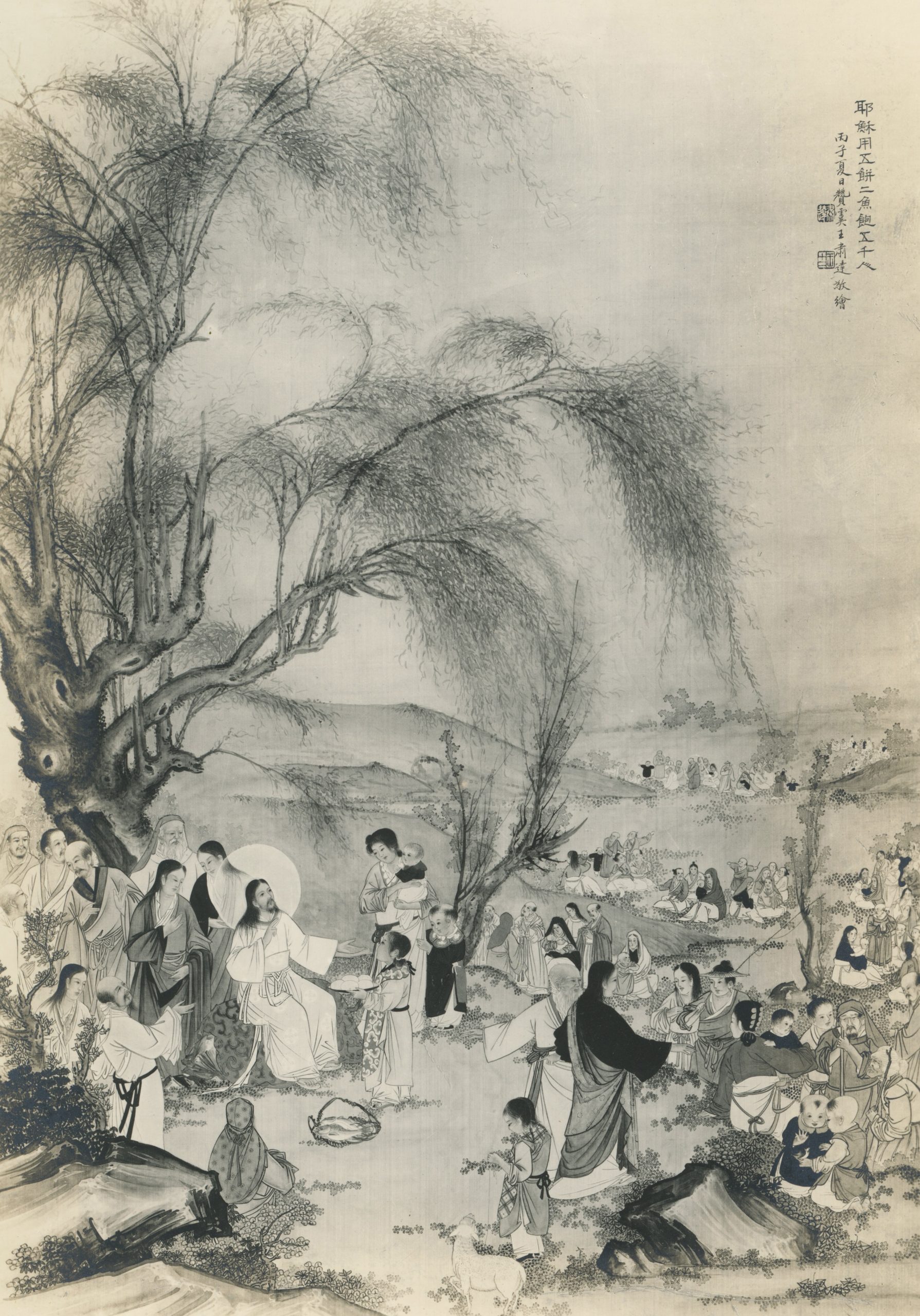
1936 painting by Wang Suda 王肅達 (1910-1963),
Housed in the Société des Auxiliaires des Missions Collection – Whitworth University
(click image to enlarge)
Image taken from Chinese Christian Posters . For more information on the “Ars Sacra Pekinensis” school of art, see this article , for other artworks of that school in TIPs, see here.
Following is a 1973 painting of the JESUS MAFA project, a response to New Testament readings from the Lectionary by a Christian community in Cameroon, Africa. Each of the readings was selected and adapted to dramatic interpretation by the community members. Photographs of their interpretations were made, and these were then transcribed to paintings:
Jesus stands in the center inspecting the baskets of leftover food the disciples are bringing to him. All around him are content crowds of people who have just been fed. The miracle of this story rests in Jesus’ taking the resources people shared and breaking (read dividing) them among all in attendance that day. Christians are called to live and follow Christ in his example—this means sharing what we have with those around us, especially those in need. In this world, there is plenty to go around. Rather than projecting a gospel of prosperity, we should radiate a gospel of giving.
From Art in the Christian Tradition, a project of the Vanderbilt Divinity Library, Nashville, TN. Image retrieved March 23, 2026. Original source: librairie-emmanuel.fr.
Retrotraducciones en español (haga clic o pulse aquí)
Jesús y los discípulos fueron y entraron al barco y el barco zarpó a un lugar en el campo donde no había gente.
Todas las personas que veían a Jesús (decían): “Vamonos”, y caminaban al lugar rural y lo esperaban.
El barco estaba zarpando y Jesús veía (a la gente) alrededor y dijo en si mismo: ‘No hay otra persona para ayudarlos, estas personas que me están esperando son como ovejas sin pastor. ¿Quién ayuda y cuida a los ovejas?’
Jesús sentía compasión y cuando habían salido del barco Jesús empezó a enseñar por un tiempo largo.
Después los discípulos vinieron y dijeron: “Jesús, aquí ya es tarde y no hay nada de comer, mejor que tú les digas adios, y se vayan a donde haya pueblos y compren para la comida.”
Jesús (respondió): “Uds les repartan comida.”
Los discípulos dijeron: “Si nosotros vamos y compramos un montón de pan pagamos doscientas (monedas) de plata.” Jesús (dijo): “Mira allá, ¿cuánto pan hay?” Los discípulos miraban alrededor y dijeron: “Hay cinco panes y dos peces.”
Jesús (dijo): “Por favor, diles a las personas que se senten en el suelo, en las plantas verdes, en grupos”
Los discípulos llamaban a la gente que vinieran y se sentaban en grupos de 50 y grupos de 100, 50 aquí, 100 allí.
Cuando todo estaba en órden Jesús tomó los cinco panes y los dos peces y miró hacia arriba y dijo una bendición.
Tomó el pan, lo rompía en pedazos y los echaba en una canasta y cuando estaba llena una canasta la dio a los discípulos, y ellos la recibieron y repartían el pan a la gente.
Jesús tomó los peces, los cortaba en pedazos y los echaba en una canasta, y cuando estaba llena la dio a los discípulos y ellos la tomaron y repartían los peces a la gente.
¿Cuántos había? Cinco mil hombres y además mujeres y niños, todos juntos.
Los panes y los peces que sobraban, los discípulos los ponían en canastas hasta llenarlas y contaban doce canastas de sobras.
Jesus and the disciples went and got in a boat and the boat set sail to a rural place where there were no people.
All the people who saw Jesus (said): “Let’s go”, and they walked over to the rural place and waited for him to come.
The boat was sailing and Jesus looked around (at the people) and said to himself: ‘There is no-one else to help them, these people that are awaiting me are like sheep without a shepherd. Who will help and take care of the sheep?’
Jesus felt compassion and after they had got off the boat Jesus began to teach for a long time.
Afterwards the disciples came to him and said: “Jesus, it’s late here, and there is nothing to eat, it’s better you tell them goodbye and they go to where there are villages and buy something to eat.”
Jesus (responded): “You hand out food to them.”
The disciples said: “If we go and buy a heap of bread we will pay 200 silver (coins).” Jesus (said): “Look over there, how much bread is there?” The disciples looked around and said: “There are five loaves of bread and two fish.”
Jesus (said): “Please, tell the people that they sit down on the ground, in the green plants, in groups.”
The disciples called the people to come and they sat down in groups of 50 and groups of 100, 50 here, 100 there.
When everything was done, Jesus took the five loaves of bread and the two fish, looked up and said a blessing.
He took the bread, broke it in pieces and threw the pieces in a basket and when the basket was full he gave it to the disciples and they took it and handed out the bread to the people.
Jesus took the fish and cut them in pieces and threw them in a basket and when the basket was full he gave it to the disciples and they took it and handed out the fish to the people.
How many were there? Five thousand men plus women and children, all together.
The bread and the fish that was left over the disciples put in baskets that they filled up, and they counted twelve baskets of leftovers.
Jesus sent the disciples out two by two to preach in different places. When the disciples came back, they told stories. Some said:
— We taught a lot!
Others said:
— We cast out demons!
Others said:
— We healed the sick!
The disciples told all these things. Jesus listened to them and said:
— You haven’t even had time to eat. Let’s go to a deserted place and you can rest there for a while.
The disciples went and got on a boat and sailed away secretly so that no one would know. But as they sailed away, the people around them saw Jesus sailing there. The people began to call out to each other, and a great multitude gathered. And they waited for Jesus on the shore. The boat came to a place, and Jesus left the boat and saw a great multitude of people gathered around.
Jesus felt sorry for them. He said:
— You are like sheep without a shepherd! There is no one to take care of you. Without a shepherd the sheep wander, and so do you.
Jesus began to teach them. As Jesus taught and taught them, it was nearing evening. The disciples came to Jesus and said:
— It’s getting evening. Let’s let the people go home. There are some who live in the surrounding villages. Let them buy food for themselves there.
Jesus said:
— No, you must feed them all.
Disciples:
— How? Where are we going to get so much bread? There are many people here, it would take about 200 denarii. That’s a lot of bread it will take.
Jesus:
— See if anyone has some food.
The disciples began to look and found some bread and fish. They came up to Jesus and said:
— Here are five loaves and two fish.
Jesus told the people to all spread out in rows — 50 rows, with 100 people in each row. The disciples went and helped the people to sit in 50 rows. Jesus took the bread and two fish. He lifted his eyes to heaven and said:
— I thank God for this food. He broke the bread and began to pass it on to the disciples so that the disciples could pass it on to the people. He did the same with the fish — Jesus passed the fish to the disciples, and the disciples passed it to the people. All the people ate and were filled, there were even pieces of bread left over. There were about 5,000 people in all. They were all full. The disciples gathered the leftover bread. They collected one full basket, then another, then another, then another, then another, and in all they collected 12 full baskets.
Original Russian back-translation (click or tap here):
Иисус отправлял учеников по двое проповедовать по разным местам. Когда ученики возвращались, они рассказывали. Одни говорили:
— Мы много учили!
Другие говорили:
— Мы бесов изгоняли!
Третьи говорили:
— Мы больных исцеляли!
Ученики рассказывали все это. Иисус слушал их и сказал:
— У вас даже не было времени поесть. Давайте перейдем в безлюдное место, и вы можете там немного передохнуть.
Ученики пошли, сели на лодку и отплыли тайно, чтобы никто не знал. Но когда они отплыли, люди вокруг увидели, что там плывет Иисус. Люди стали звать друг друга, и собралось великое множество народа. И они ждали Иисуса на берегу. Лодка приплыла на место, Иисус покинул лодку и увидел множество людей, которые собрались вокруг.
Иисусу стало жаль их. Он сказал:
— Вы — словно овцы без пастуха! Нет никого, кто может позаботиться о них. Без пастуха овцы блуждают, так же и вы.
Иисус стал их учить. Иисус учил-учил их, время уже близилось к вечеру. Ученики подошли к Иисусу и сказали:
— Уже вечереет. Давай отпустим народ домой. Тут есть такие, которые живут в окрестных селениях. Пусть они там себе купят еды.
Иисус сказал:
— Нет, вы должны накормить их всех.
Ученики:
— Как? Где мы возьмем столько хлеба? Тут множество народа, нужно примерно 200 динариев. Очень много хлеба потребуется.
Иисус:
— Поищите, может быть, у кого-нибудь найдется немного еды.
Ученики начали искать и нашли немного хлеба и рыбы. Они подошли к Иисусу и сказали:
— Вот есть пять хлебов и две рыбины.
Иисус сказал людям, чтобы все расселись по рядам — 50 рядов, в каждом — по 100 человек. Ученики пошли и помогли людям рассесться по 50 рядов. Иисус взял хлеб и две рыбы. Поднял глаза к небу сказал:
— Благодарю Бога за эту еду. Преломил хлеб и начал передавать ученикам, чтобы ученики передавали дальше людям. Так же и с рыбой он делал — Иисус передавал рыбу ученикам, ученики передавали народу. Весь народ поел, насытился, и даже остались еще куски хлеба. Всего было около 5000 человек. Они все наелись. Ученики собрали остатки хлеба. Собрали одну полную корзину, потому вторую, третью, всего собрали полных 12 корзин.
Following are a number of back-translations of Mark 6:40:
Uma: “They sat in groups, every groups was about a hundred, there were also some that were around fifty.” (Source: Uma Back Translation)
Yakan: “Therefore they sat down in groups, some in groups of one hundred each and some in groups of fifty each.” (Source: Yakan Back Translation)
Western Bukidnon Manobo: “And then they sat down, and there were a hundred or fifty people in each group.” (Source: Western Bukidnon Manobo Back Translation)
Kankanaey: “And they sat-down in-multiple-groups, some by-hundreds and (some) by-fifties.” (Source: Kankanaey Back Translation)
Tagbanwa: “Their seating was by hundreds and by fifty people.” (Source: Tagbanwa Back Translation)
Barclay Newman, a translator on the teams for both the Good News Bible and the Contemporary English Version, translated passages of the New Testament into English and published them in 2014, “in a publication brief enough to be non-threatening, yet long enough to be taken seriously, and interesting enough to appeal to believers and un-believers alike.” The following is the translation of Mark 6:30-44:
One day, Jesus and his closest followers
were surrounded by so many spectators
that they didn’t even have a chance to eat.
Jesus said, “Let’s leave here and find a place
where we can be alone and get some rest.”
So they jumped in a boat and rowed away,
but people found out and walked there
before the boat arrived.
As Jesus stepped ashore, he noticed the crowd —
it was like a scattering of sheep without a shepherd.
He felt sorry for the people and started teaching them.
That evening his followers came to him and said,
“It’s getting dark in this desert-like place.
Stop teaching and release the crowds,
so they can start searching for somewhere to buy food.”
“You give them something to eat,” replied Jesus
“Don’t you know,” they questioned, “a year’s wages
would barely be enough to feed this crowd?”
“Find out how much bread is available,” commanded Jesus.
They found out and reported,
“Five small loaves and two little fish.”
Jesus instructed his followers to tell the people to
sit down on the green grass
in groups of a hundred and in groups of fifty.
Looking up toward heaven, Jesus blessed
both the bread and the fish.
Then he broke the bread and handed it to his followers,
who distributed it among the crowd.
He also divided the fish, so everyone could have some.
After everyone had eaten and was satisfied,
the followers of Jesus gathered enough leftovers
to fill twelve large baskets.
Living Water is produced for the Bible translation movement in association with Lutheran Bible Translators. Lyrics derived from the ESV® Bible (The Holy Bible, English Standard Version®).
anepesan prasiai prasiai ‘they reclined in ranks.’
anapiptō (8.6) ‘lie down,’ ‘recline’ to eat.
prasia (only here in the N.T.) meant originally ‘a garden plot’; when used as here it means ‘in orderly groups,’ ‘in rows,’ ‘in ranks’ (cf. Moulton & Milligan). The element of order is stressed in the use of the word: the multitude formed orderly rows which could be easily and quickly served by the disciples.
kata hekaton kai kata pentēkonta ‘by the hundreds and by the fifties’: so most translations and commentaries. Manson, however, has ‘a hundred rows of fifty each’ (“a great rectangle, a hundred by fifty …: ‘one side of the rectangle was reckoned at a hundred, and the other at fifty.’”): this, however, has not commended itself to many (cf. Lagrange “bien mathématique!”).
Translation:
In groups, by hundreds and by fifties is a very compact phrase, and one which must in certain languages be somewhat expanded, e.g. ‘different groups; some groups had one hundred people and other groups had fifty people’ (Southern Subanen); Toraja-Sa’dan expresses it ‘in groups there were hundreds, there were fifties.’
Quoted with permission from Bratcher, Robert G. and Nida, Eugene A. A Handbook on the Gospel of Mark. (UBS Handbook Series). New York: UBS, 1961. For this and other handbooks for translators see here .


Leave a Reply
You must be logged in to post a comment.