
birds of the air

The Greek and Hebrew phrases that are often translated as “birds of the air” in English “refer to the undomesticated song birds or wild birds, to be distinguished in a number of languages from domesticated fowl. In Tzeltal these former are ‘field birds’.” (source: Bratcher / Nida)

Q’anjob’al also uses an established term for non-domesticated birds. Newberry and Kittie Cox (in The Bible Translator 1950, p. 91ff. ) explain: “Qʼanjobʼal has two distinct terms, one to identify domesticated birds and the other non-domesticated birds. The additional descriptive phrase ‘of the air’ seemed entirely misleading, for Qʼanjobʼal speakers had never heard of such creatures. Actually, of course, all that was necessary was the term for non-domesticated birds, for that is precisely the meaning of the Biblical expression.”

In Elhomwe they are just translated as “birds” or “birds of the bush” (i.e., wild birds) to “not give the impression that these are special type of birds.” (Source: project-specific translation notes in Paratext)

See also birds of the air / fish of the sea and birds or four-footed animals or reptiles.
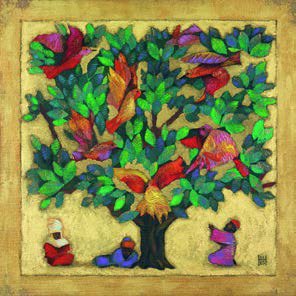
greatest of all shrubs

The Greek that is translated as “the greatest of all shrubs” or similar in English is translated in Chuj as “larger than all the plants we plant each year,” and in Shuar as “larger than all weeds” (Some “weeds” grow to over ten feet.) (Source: B. Moore / G. Turner in Notes on Translation 1967, p. 1ff.)

Mark 4:30-32 in Russian Sign Language

Following is the translation of Mark 4:30-32 into Russian Sign Language with a back-translation underneath:


Source: Russian Bible Society / Российское Библейское Общество

Jesus also gave an explanation of what the Kingdom of God is like. For example, there are different kinds of seeds. There are bigger seeds and there are smaller seeds. There is the smallest seed, and if you plant it in the ground, it will grow into a big plant. Birds will make nests on it. And so is the Kingdom of God.

Original Russian back-translation (click or tap here):

Иисус еще дал такое объяснение, чему подобно Царство Божье. Например, есть разные семена. Бывают семена побольше, а бывают совсем маленькие. Есть одно самое маленькое семя, а если посадить его в землю, из него вырастет большое растение. Птицы будут вить гнезда на нем. Вот так же и Царство Божье.

Back-translation by Luka Manevich

<< Mark 4:26-29 in Russian Sign Language
Mark 4:33-34 in Russian Sign Language >>

Mark 4:26-33a in Mexican Sign Language

Following is the translation of Mark 4:26-33a into Mexican Sign Language with back-translations into Spanish and English underneath:


© La Biblia en LSM / La Palabra de Dios

Retrotraducciones en español (haga clic o pulse aquí)

Jesús dijo: “Otro ejemplo, en la tierra de un campo un hombre sembró semillas, y cuando estaba listo el hombre se fue. ¿El hombre sabe hacer las plantas? No, él no sabe.

Las semillas sólas hacen la planta crecer, el hombre duerme y al día siguiente se despierta, y duerme y al día siguiente etc. La planta crece y después el hombre viene y ve que está listo y cosecha.

Eso parece a uds, la gente que cree que v a estar junto con Dios en su reino.

Oigan, otro ejemplo, dejame ver, mira, hay muchas diferentes semillas, pero la más pequeña es la mostaza, pero cuando cae en la tierra la planta crece fuerte y vence las otras plantas, y en la planta los pájaros pueden sentarse en sus nidos.

Eso es parecido a uds que creen en Dios, que ya están junto con Él en su reino.”

Jesús siguió a contar otras historias y muchos diferentes ejemplos.


Jesus said: “Another example, in de ground of a field a man sowed seeds and when he was ready the man went away. Does the man know how to make the plants? No, he does not know.

“The seeds on their own make the plant grow, the man sleeps and wakes up the next day, and sleeps and the next day… and so on. The plant grows and afterwards the man comes and sees that it is ready and harvests.

“This is like you people who believe that you will be together with God in his kingdom.

“Listen, another example, let me see, look here, there are many different kinds of seeds but the smallest is the mustard. But when it falls in the soil a strong plant grows, stronger than other plants, and in it birds can sit on their nests.

“This is like you people who believe in God who are already together with him in his kingdom.”

Jesus went on to tell other stories and many different examples.

Source: La Biblia en LSM / La Palabra de Dios

<< Mark 4:26-33a in Mexican Sign Language
Mark 4:33b-34 in Mexican Sign Language >>

complete verse (Mark 4:32)

Following are a number of back-translations of Mark 4:32:

  • Uma: “Those seeds are very tiny, smaller than all the seeds that are in the world. But when it is planted and grows, it is bigger than other vegetables. Its branches are branched and long, to the point that birds make-nests-in-them and they are used-for-shade.'” (Source: Uma Back Translation)
  • Yakan: “But when it has been planted already, it grows and it becomes bigger than all the plants. Its branches become big, therefore the birds can make their nests there and be in its shade there.'” (Source: Yakan Back Translation)
  • Western Bukidnon Manobo: “It sprouts and grows larger and becomes the largest of all the plants. It has large branches and the birds can nest there.'” (Source: Western Bukidnon Manobo Back Translation)
  • Kankanaey: “But if/when it is planted, it grows to become the tallest of all vegetables. It grows-long -branches and the birds can nest in its shaded branches.'” (Source: Kankanaey Back Translation)
  • Tagbanwa: “But when it has taken-root/been-planted, on sprouting it will grow, becoming bigger than the other vegetables. It will spread large branches. Without anything further, it will then be a nested in by birds.'” (Source: Tagbanwa Back Translation)

Translation commentary on Mark 4:32

Exegesis:

kai ‘and’ (the first word): here with the meaning ‘but,’ ‘yet.’

anabainei (cf. 4.7) ‘it grows.’

meizon pantōn tōn lachanōn ‘bigger than all the shrubs’: as in the previous verse the comparative ‘bigger than’ is used with the meaning ‘biggest of.’ The neuter meizon ‘bigger’ is due either to spermathe seed is bigger’ implied in the statement, or to tōn lachanōn ‘of the shrubs’ which follows.

lachanōn (only here in Mark) ‘vegetable,’ ‘edible garden herb’ .

poiei kladous megalous ‘it makes large branches.’

poieō here means ‘produce,’ ‘send out.’

klados (13.28) ‘branch,’ ‘limb.’

hōste dunasthai … kataskēnoun (for the construction see 1.27) ‘so that they (the birds) are able to live.’

kataskēnoō (only here in Mark) ‘live,’ ‘dwell,’ ‘settle’: of birds, ‘nest.’ The saying about the birds nesting in the shade reflects O.T. passages such as Dan. 4.12 (cf. Ezek. 17.23; 31.6; Ps. 104.12).

tēn skian autou ‘its shade,’ i.e. of the grown mustard plant.

skia (only here in Mark) ‘shadow,’ ‘shade.’

Translation:

The Greek term translated here as shrubs refers primarily to large annuals. One should not render this as ‘trees of the forest’ (as in some translations, merely in order to emphasize the extent of growth of the plant). Where a language possesses a generic term for annuals (a not infrequent classification), one can make ready use of this word. In some instances, however, in order to use some relatively satisfactory equivalent, translators have used ‘plants that grow for a year’ (Highland Totonac).

For birds of the air see 4.4. A literal translation of this expression can be quite misleading. In one language in Latin America this phrase was taken to refer to the Holy Spirit, for it was understood to mean ‘doves from heaven,’ and since the dove is employed in Roman Catholic ritual as a symbol for the Holy Spirit, the meaning of the passage was entirely misconstrued. The meaning here is simply ‘field birds,’ ‘birds of the forest,’ or ‘undomesticated fowl.’

Nests in its shade must in some instances be more precise, i.e. ‘nests in its branches under its shade,’ or the use of ‘shade’ would imply nests on the ground beneath the plant.

Quoted with permission from Bratcher, Robert G. and Nida, Eugene A. A Handbook on the Gospel of Mark. (UBS Handbook Series). New York: UBS, 1961. For this and other handbooks for translators see here .