
The Greek in Mark 16:1 that is translated as “anoint him” in English is translated in Matumbi as “applied burial oil.” (Source: Pioneer Bible Translators, project-specific notes in Paratext)
Mary Magdalene (icon)
Following is a contemporary Ukrainian Orthodox icon of Mary Magdalene by Kateryna Shadrina.

Orthodox Icons are not drawings or creations of imagination. They are in fact writings of things not of this world. Icons can represent our Lord Jesus Christ, the Virgin Mary, and the Saints. They can also represent the Holy Trinity, Angels, the Heavenly hosts, and even events. Orthodox icons, unlike Western pictures, change the perspective and form of the image so that it is not naturalistic. This is done so that we can look beyond appearances of the world, and instead look to the spiritual truth of the holy person or event. (Source )
For purchasing artworks by Kateryna Shadrina go to IconArt Gallery .
anoint
The Greek. Ge’ez, and Hebrew that is translated in English as “anoint” is translated in Lakota with azilyA: “to smudge.”
Steve Berneking (in Beerle-Moor / Voinov, p. 121) tells the story of that translation:
“During one visit with the Lakota team, we were reading texts and discussing key biblical terms and how they are best rendered into Lakota. Reference was made to the ritual we label ‘anointing.’ When the Lakota word that had been glossed as ‘anoint’ was read aloud, I heard giggling among the reviewers. Knowing that this reaction called for some explanation, I asked.
“The people there told me that the Lakota verb that was used to translate ‘anoint’ was funny in that context. It is not that the verb is an uncommon one; quite the contrary. Lakota uses that verb frequently, but almost exclusively as a verb of food preparation; the verb belongs to the culinary domain. In other words, the Lakota verb used for ‘anoint’ actually referred to rubbing oil on something that was to be cooked or grilled, in this case, the apostles. The Lakota verb ipáṫaŋṫtaŋ ‘to apply oil on something’ was used quite innocently by the missionaries. The linguistic transfer was understandable: the missionaries needed a verb to translate ‘putting oil on something’; Lakota has a verb; they used that verb. The result was comical. So, during that conversation with the Lakota community, I encouraged the translators to come up with a Lakota verb that is used not simply in ‘the application of oil,’ but more pointedly in the consecration of something or somebody for a special task, or in the appointment of someone for a special purpose. Their response was almost immediate: azilyA or wazílyA ‘to smudge.’ That is how, they told me, warriors and messengers and tribal leaders have always been consecrated (or blessed) before being sent out on a special mission. Sage grass was burned, and the smoke was waved over the person or object. The trans-cultural process of using the traditional Lakota verb azilyA for the biblical notion of ‘anoint’ became, at that moment, part of the Lakota Bible.”
In Bashkir, it is translated as masekhlay (мәсехләү), when used in a ritual context. Masekhlay has the same root than masikh (мәсих), which is used both for “anointed one” in the Old Testament and in its capitalized form (Мәсих) for Μεσσίας (engl. “Messiah”) and Χριστός (engl. “Christ”) in the New Testament. For more information about this, see anointed one.
In Vidunda it is translated as “smear oil.” (Source: Pioneer Bible Translators, project-specific translation notes in Paratext)
Click or tap here to see a short video clip showing how anointing was done in biblical times (source: Bible Lands 2012)
See also anoint (chrió) and anointing of David (image).
spices
The Greek that is translated as spices in English is translated in Tabasco Chontal as “medicine/spices which pertained to rubbing on the body” and in Seri as “a substance that smelled like perfume. It was for pouring on the dead, one to keep his body from stinking.” (Source: B. Moore / G. Turner in Notes on Translation 1967, p. 1ff.)
Mary Magdalene
The term that is transliterated as “Mary Magdalene” in English is translated in American Sign Language with a sign signifying 7 demons having gone out, referring to Luke 8:2. (Source: Ruth Anna Spooner, Ron Lawer)
“Mary Magdalene” in American Sign Language, source: Deaf Harbor
For more information on translations of proper names with sign language see Sign Language Bible Translations Have Something to Say to Hearing Christians .
The following is a stained glass window in the All Saints’ Church, Highgate, London, of the late 19thy century:

Photo by John Salmon, hosted by Wikimedia Common under the Creative Commons Attribution-Share Alike 2.0 Generic license

Stained glass is not just highly decorative, it’s a medium which has been used to express important religious messages for centuries. Literacy was not widespread in the medieval and Renaissance periods and the Church used stained glass and other artworks to teach the central beliefs of Christianity. In Gothic churches, the windows were filled with extensive narrative scenes in stained glass — like huge and colorful picture storybooks — in which worshipers could ‘read’ the stories of Christ and the saints and learn what was required for their religious salvation. (Source: Victoria and Albert Museum )
Learn more on Bible Odyssey: Mary Magdalene and Mary Magdalene in Popular Culture .
See also Mary Magdalene and Mary Magdalene (icon).
The women arriving at the tomb (image)
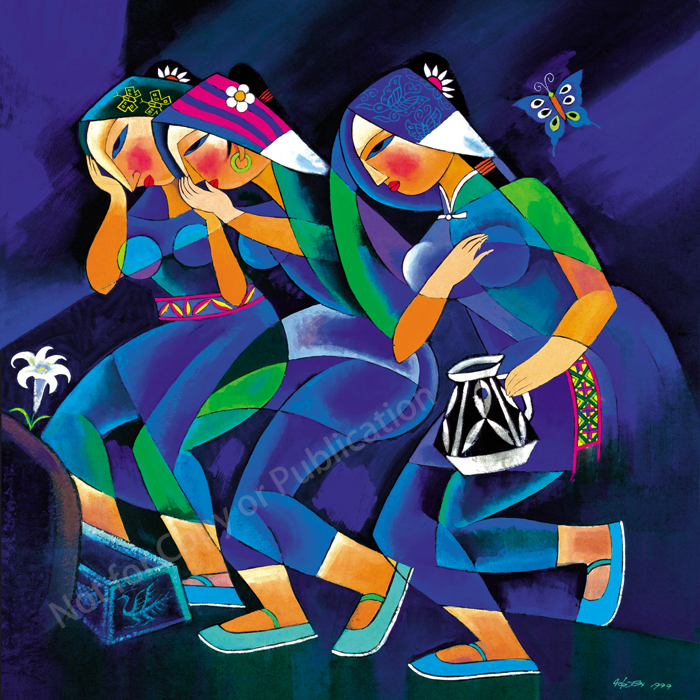
He Qi © 2021 All Rights Reserved.
Image taken from He Qi Art . For purchasing prints of this and other artworks by He Qi go to heqiart.com .
For other images of He Qi art works in TIPs, see here.
Sabbath
The Hebrew, Ge’ez, and Greek that is translated as “Sabbath” in English is rendered as “day we rest” in Tzotzil, in Mairasi as “Jew’s Rest Day,” in Quiotepec Chinantec as “day when people of Israel rested,” in Shilluk as “day of God,” in Obolo as Usen Mbuban or “Holy Day,” and in Mandarin Chinese as ānxírì (安息日) or “rest day” (literally: “peace – rest – day”). (Sources: Tzotzil: Marion Cowan in Notes on Translation with Drill, p. 169ff; Mairasi: Enggavoter 2004; Quiotepec Chinantec: B. Moore / G. Turner in Notes on Translation 1967, p. 1ff.; Shilluk: Nida 1964, p. 237; Obolo: Enene Enene; Chinese: Jost Zetzsche)
In Matumbi it is translated as Sabato ya Ayahudi or “Sabbath of the Jews,” to distinguish it from the Islamic Sabbath (which is Friday) or the Christian Sabbath (which is Sunday). (Source: Pioneer Bible Translators, project-specific notes in Paratext)
In the old Khmer version as well as in the first new translation this term was rendered as “day of rest” (Thngai Chhup Somrak / ថ្ងៃឈប់សំរាក). Considered inadequate to convey its religious meaning (not only about cessation of work, but also in honor of Yahweh as the Creator), the committee for the Today’s Khmer Version (publ. 2005) decided to keep the Hebrew word and use its transliterated form Thgnai Sabath (ថ្ងៃសប្ប័ទ). “The Buddhist word Thngai Seil ‘day of merits’ used by some Catholics was once under consideration but was rejected because it did not receive unanimous support.” (Source: Joseph Hong in The Bible Translator 1996, p. 233ff. )
In Spanish, the translation is either día de reposo (“day of rest”) or sábado (usually: “Saturday,” derived from the Greek and Hebrew original). Nida (1947, p. 239f.) explains that problem for Spanish and other languages in its sphere of influence: “In translation ‘Sabbath’ into various aboriginal languages of Latin America, a considerable number of translators have used the Spanish sábado, ‘Saturday,’ because it is derived from the Hebrew sabbath and seems to correspond to English usage as well. The difficulty is that sábado means only ‘Saturday’ for most people. There is no religious significance about this word as the is with ‘Sabbath’ in English. Accordingly the [readers] cannot understand the significance of the persecution of Jesus because he worked on ‘Saturday.’ It has been found quite advantageous to use the translation ‘day of rest,’ for this accurately translated the Hebrew meaning of the term and resolves the problem in connection with the prohibitions placed upon some types of activities.”
In the Nueva traducción viviente translation (2010) it día de descanso al mantenerlo santo (“day of rest to keep it holy”). (Source: Lénart de Regt in The Bible Translator 2017, p. 131ff. )
In French Sign Language it is translated with a sign that depicts closing of the blinds of a store:
“Sabbath” in French Sign Language (source: La Bible en langue des signes française )
Learn more on Bible Odyssey: Sabbath .
Mark 16:1-8 in Russian Sign Language
Following is the translation of Mark 16:1-8 into Russian Sign Language with a back-translation underneath:
Source: Russian Bible Society / Российское Библейское Общество
The Sabbath had already ended, and the next day had come. Three women — Mary Magdalene, another Mary, she has a son James, and the third Salome, they went to the market and bought aromatic oils. They planned to go to the tomb of Jesus to anoint his body. This was the custom of the Jews — to rub the body of the dead with aromatic oils. Early in the morning, on Sunday, when the sun had just risen, they went to the tomb. On the way, they talked among themselves:
— There is such a big stone blocking the entrance to the tomb! We cannot move it! Who will help us? We ourselves do not have enough strength to move it!
So they talked among themselves. But when they came to the tomb, they saw that this huge stone was lying to the side, and the passage was open. They entered the tomb and were very afraid, seeing that there was a young man there. He was dressed in snow-white clothes and was sitting on the right side. The women were very afraid. The young man said:
— Do not be afraid! I know you are looking for Jesus from the city of Nazareth. Jesus was crucified, buried in this place, but now he is not here! Jesus has risen from the dead, he is alive. You go and tell his disciples and Peter that Jesus has already gone to Galilee, and there you will see him.
Those three women were very afraid, trembled with fear and quickly ran from that place. They could not tell the disciples anything, they were so afraid.
Original Russian back-translation (click or tap here):
Суббота уже закончилась, наступил следующий день. Три женщины — Мария Магдалина, еще одна Мария, у нее сын Иаков, и третья Саломея, они пошли на рынок и купили ароматных масел. Они планировали пойти к гробнице Иисуса, чтобы намазать его тело. Такой был обычай у иудеев — натирать тело умершего ароматными маслами. Ранним утром, в воскресенье, когда только взошло солнце, они пошли к гробнице. По пути они между собой разговаривали:
— Там такой большой камень закрывает вход в гробницу! Мы не можем его отодвинуть! Кто нам поможет? У нас самих нет столько сил, чтобы его отодвинуть!
Так они говорили между собой. Но когда они пришли к гробнице, то увидели что этот огромный камень лежит в стороне, а проход открыт. Они вошли в гробницу, и очень испугались, увидев, что там был юноша. Он был в белоснежной одежде и сидел с правой стороны. Женщины испугались очень сильно. Юноша сказал:
— Не бойтесь! Я знаю, вы ищете Иисуса из города Назарета. Иисус был распят, погребен вот на этом месте, но сейчас его здесь нет! Иисус воскрес из мёртвых, он живой. Вы же идите и скажите его ученикам и Петру, что Иисус уже отправился в Галилею, и там вы его увидите. Те три женщины очень сильно испугались, задрожали от страха и быстро побежали из этого места. Они не смогли ничего рассказать ученикам, так сильно они боялись.
Back-translation by Luka Manevich
<< Mark 15:33-47 in Russian Sign Language
Mark 16:9-20 in Russian Sign Language >>
Leave a Reply
You must be logged in to post a comment.