The Greek, Hebrew, Aramaic, Ge’ez, and Latin that is translated as “justice” in English is translated in American Sign Language with a sign that describes the quality or principle of fairness, righteousness, and impartiality in treating other people. A literal back-translation of the signs are “FOLLOW(God is implied) ACTIONS, DECISIONS JUST-RIGHT”. A more idiomatic back-translation would be: “actions and decisions are right/fitting/just in accordance to God’s will.” The movement in the signs itself helps to indicate that this is a noun, not a verb. (Source: Ruth Anna Spooner, Ron Lawer)
“Justice” in American Sign Language, source: Deaf Harbor
The Hebrew, Ge’ez, and Greek that is translated as “widow” in English is translated in West Kewa as ona wasa or “woman shadow” (source: Karl J. Franklin in Notes on Translation 70/1978, pp. 13ff.) and in Newari as “husband already died ones” or “ones who have no husband” (source: Newari Back Translation).
In Cherokee the term is gender neutral and translates to “one who has lost someone.” (Source: Bender / Belt 2025, p. 100)
The etymological meaning of the Hebrewalmanah (אַלְמָנָה) is likely “pain, ache,” the Greekchéra (χήρα) is likely “to leave behind,” “abandon,” and the Englishwidow (as well as related terms in languages such as Dutch, German, Sanskrit, Welsh, or Persian) is “to separate,” “divide” (source: Wiktionary).
Following are a number of back-translations of Luke 18:3:
Noongar: “A widow was also living in that place. She always went to the judge. She begged the judge to help her to get what she should get, saying, ‘You help me fight this bad man!'” (Source: Warda-Kwabba Luke-Ang)
Uma: “In that town also, there was a widow. She had gone many times before that judge bringing her case, she said: ‘Please help me confront my enemy.'” (Source: Uma Back Translation)
Yakan: “In that place there was also a widow woman who had a problem/a case. This woman always went to the judge asking for help and begged that he would show her truth/that she was in the right. She said, ‘Do help me so that my opponent will not win.'” (Source: Yakan Back Translation)
Western Bukidnon Manobo: “And in that town, there was also a widow-woman who always went to the judge because she begged his help. She said to the judge, ‘Help me so that my enemy will not take away my possessions.'” (Source: Western Bukidnon Manobo Back Translation)
Kankanaey: “There was also a widow in that town who kept-going to him to beg for her legal-rights saying, ‘Please help-me so that my enemy doesn’t defeat-me.'” (Source: Kankanaey Back Translation)
Tagbanwa: “Also in that city there was a woman who was a widow who kept going to that judge, for she was asking for straightness/justice because of someone who was causing her hardship/suffering.” (Source: Tagbanwa Back Translation)
Click or tap here to see the rest of this insight.
Like a number of other East Asian languages, Japanese uses a complex system of honorifics, i.e. a system where a number of different levels of politeness are expressed in language via words, word forms or grammatical constructs. These can range from addressing someone or referring to someone with contempt (very informal) to expressing the highest level of reference (as used in addressing or referring to God) or any number of levels in-between.
One way Japanese shows different degree of politeness is through the choice of a benefactive construction as shown here in the widely-used Japanese Shinkaiyaku (新改訳) Bible of 2017. Here, mamotte (守って) or “protect” is used in combination with kudasaru (くださる), a respectful form of the benefactive kureru (くれる). A benefactive reflects the good will of the giver or the gratitude of a recipient of the favor. To convey this connotation, English translation needs to employ a phrase such as “for me (my sake)” or “for you (your sake).”
Vindicate me against my adversary, i.e. take a just decision in the law-suit I have with my opponent, implying that the decision would be in the favour of the speaker. Various idiomatic or descriptive renderings are used, e.g. ‘arrange the matter between my adversary and me’ (Tzeltal), ‘please make-straight for us this affair’ (Toraja-Sa’dan); or, making more explicit the favourable connotation, ‘make-me-true before my enemy’ (Fulah), ‘cause-to-win(-out) me against my enemy’ (Kituba), ‘take my case and make justice against my legal opponent’ (Marathi), ‘judge for me, let me get my right against my enemy’ (Sranan Tongo), and, distributing direct and indirect discourse differently, “pleading for her rights: ‘Help me against my opponent’ ” (Good News Translation).
Quoted with permission from Reiling, J. and Swellengrebel, J.L. A Handbook on the Gospel of Luke. (UBS Handbook Series). New York: UBS, 1971. For this and other handbooks for translators see here . Make sure to also consult the Handbook on the Gospel of Mark for parallel or similar verses.
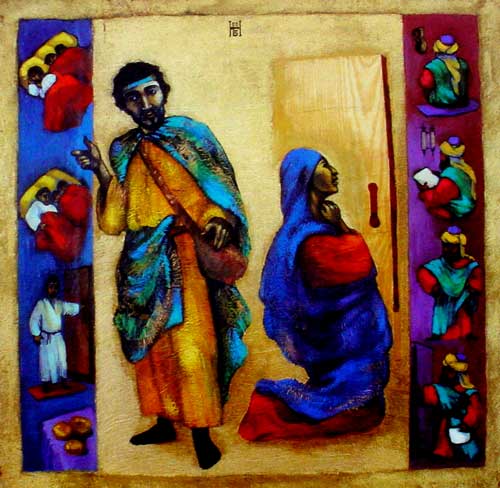
And there was a widow in that town: The clause And there was a widow in that town introduces the other main character in the story. Other ways to introduce her are:
In that same town there was also a widow -or-
And a certain widow also lived in that town
Introduce her in a natural way in your language.
widow: A widow is a woman whose husband has died. In that culture, when a woman’s husband died, she often had no one to provide for her financially. She also usually had no one to defend her or make sure that people treated her justly. Another way to translate widow here is:
a woman whose husband had died
in that town: The phrase in that town means “in the town where the judge lived.” In some languages it may be possible to translate this as:
in the same town ⌊as the judge⌋
General Comment on 18:2a–3a
In some languages it may be more natural to not mention the town where the judge lived until 18:3a. For example:
2aThere once was a judge 2bwho neither feared God nor respected people. 3aA widow lived in the same town as he did…
18:3b–c
who kept appealing to him: The phrase that the Berean Standard Bible translates as who kept appealing to him is literally “and she was coming to him saying.” It implies that the widow came many times to present her request to the judge. There was probably a certain place where the judge heard such requests. In some languages there may be a special term to refer to bringing a formal request to a judge. Other ways to translate this are:
She often came before him to present her request/petition -or-
She often came to him to plead with him -or-
A widow of that city came to him repeatedly, saying (New Living Translation (2004))
appealing: The Greek uses the word “saying” to introduce what the widow said to the judge. Versions such as the Good News Translation translates this word literally. Several versions join this word with the phrase “kept coming to him.” For example:
a widow in that city who kept coming to him and saying (English Standard Version)
Here is another way to translate this:
with the plea (New International Version)
The Berean Standard Bible combines the meaning of “coming” and “saying” into the term appealing.
Give me justice against my adversary: This request indicates that the widow wanted the judge to make her enemy treat her fairly. It was common in that culture for people to cheat widows and take their money or property. Some other ways to translate the request are:
Give me justice in this dispute with my enemy (New Living Translation (2004)) -or-
Make my opponent do what is right toward me -or-
Please help me so that my enemy does not treat me unfairly/wrongly
This widow probably spoke respectfully, in a way that was proper for a poor person to present a request to an important official. Introduce and translate her words in a way that is natural in your language for such a request. For example:
begging him, “Please grant me justice…” -or-
saying, “⌊Honorable Judge,⌋ I beg you to grant me justice…”
In some languages it may be necessary to introduce the adversary before presenting the request. For example:
An enemy is treating me unfairly. Please help me.
against my adversary: An adversary is an enemy or opponent. In this context it refers to a specific enemy. That enemy was the person who was against her in the dispute that she wanted the judge to settle.
General Comment on 18:3a–c
In this verse the widow’s request is a direct quote. In some languages it may be more natural to translate it as indirect speech:
…and in the same city there was a widow who kept coming before him to demand justice against her opponent. (Revised English Bible) -or-
A widow of that city came to him repeatedly, appealing for justice against someone who had harmed her. (New Living Translation (1996))

Leave a Reply
You must be logged in to post a comment.