
The Greek that is translated as “bill” or similar in English is translated by the Panjabi in Persian script as ashtam. “Ashtam is derived from the English term ‘stamped’ (paper). The Indian Stamp Act was introduced in 1899 in order to collect revenue for the government. As a result, a stamped paper came to represent a legal document for any financial transactions. It could be produced in a court of law as a document of evidence. The stamped paper was commonly referred to as ashtam or ashtam paper among villagers in Punjab. The use of ashtam in context signaled the seriousness of the matter to readers and listeners — the shrewd manager was committing an illegal act by telling his master’s debtors to put false amounts on an ashtam paper in order to cause financial loss to his master. Although ashtam was an adapted loanword, its function and legal importance was understood by the people. The translators made a wise decision to use it in the translation.” (Source: Yousaf Sadiq in The Bible Translator 2021, p. 189ff.)
The Parable of the Dishonest Manager who Acted Wisely
The following artwork is part of a series of 56 paintings on biblical themes by Kazakh artist Nelly Bube (born 1949):
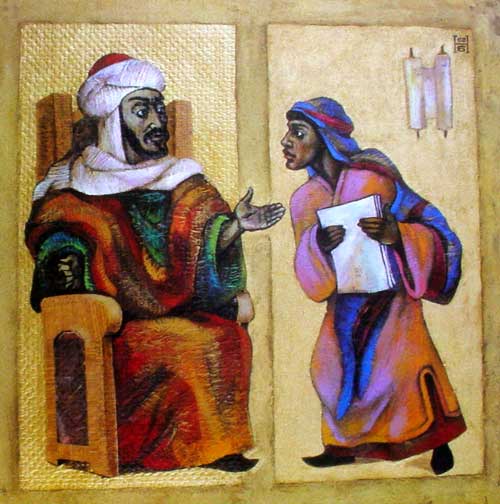
Copyright by Norwegian Bible Society , used with permission.
For other images of Nelly Bube in TIPs, see here.
fat, oil
The different Hebrew, Ge’ez, and Greek terms that are translated as “(olive) oil” and “(animal) fat” in English are translated in Kwere with only one term: mavuta. (Pioneer Bible Translators, project-specific translation notes in Paratext)
complete verse (Luke 16:6)
Following are a number of back-translations of Luke 16:6:
- Noongar: “‘100 containers of olive oil’, he said. The worker told him, ‘Here is your account. Sit down and write 50.'” (Source: Warda-Kwabba Luke-Ang)
- Uma: “That person answered: ‘Three thousand liters of oil.’ That servant said: ‘Here is your (sing.) letter of debt. Sit down, quickly write, just one thousand five hundred liters!'” (Source: Uma Back Translation)
- Yakan: “‘One hundred cans (5 gallon size) of oil,’ he answered. Then he said to him, ‘Here is your account (receipt). Quickly sit down and write here fifty cans only.'” (Source: Yakan Back Translation)
- Western Bukidnon Manobo: “And that one he asked answered, ‘A hundred cans of oil.’ And that servant said, ‘Here’s the list of the things you owe. Sit down here and change the list of the amount you owe to fifty cans only.'” (Source: Western Bukidnon Manobo Back Translation)
- Kankanaey: “‘One-hundred cans of vegetable-oil,’ he answered. ‘Here is your (sing.) receipt. Sit right down and write fifty,’ said that employee.” (Source: Kankanaey Back Translation)
- Tagbanwa: “The one he questioned answered, ‘It’s a big one,’ he said, ‘for it’s one hundred jars of oil.’ ‘Well, here is your piece-of-writing where your debt is written,’ said the manager. ‘Now sit down quickly and write what we (incl.) will exchange for it, only fifty being what you will write.'” (Source: Tagbanwa Back Translation)
Sung version of Luke 16
Translation commentary on Luke 16:6
Exegesis:
hekaton batous elaiou ‘a hundred bats of (olive) oil,’ with opheilō ‘I owe’ understood.
batos ‘bat,’ a Hebrew liquid measure of capacity, about 8 gallons, or 37 litres. 800 gallons of olive oil appears to be a great debt.
dexai sou ta grammata ‘take your bill,’ implying that the manager handed it to him.
grammata (also v. 7) plural, ‘written agreement,’ here ‘bill,’ ‘account.’
kathisas tacheōs grapson pentēkonta ‘sit down and write quickly fifty.’ tacheōs goes with both grapson and kathisas. grapson is best understood as referring to writing a new account.
Translation:
On hundred cf. 15.4. For “hundred” and “fifty” (here) and “hundred” and “eighty” (v. 7) Ekari has to say, ‘sixty’ and ‘thirty,’ ‘sixty’ and ‘fifty,’ respectively.
Measure, preferably to be rendered by the designation of a common local measure for liquids, e.g. “barrel” (Good News Translation), ‘jar’ (Bahasa Indonesia 1968), ‘jug’ (Batak Toba), ‘bottle’ (Tae’ 1933). Where the quantity designated considerably differs from that of Gr. batos, one may adjust the renderings of “hundred” and “fifty” in such a way that the sum total approximately agrees with the original.
Take, or, ‘here is,’ ‘this here (is),’ or whatever phrase is idiomatically used when handing over something.
Bill, or, ‘debt letter’ (some Indonesian languages), ‘paper on which your payment is written’ (Sranan Tongo), ‘evidence of your debt’ (Kekchi), ‘small paper of agreement’ (Shona 1963), ‘letter-to-acknowledge your-debt’ (Tae’).
Fifty. The measure may have to be added, e.g. ‘fifty barrels/jars’ (Sranan Tongo, Bahasa Indonesia 1968).
Quoted with permission from Reiling, J. and Swellengrebel, J.L. A Handbook on the Gospel of Luke. (UBS Handbook Series). New York: UBS, 1971. For this and other handbooks for translators see here . Make sure to also consult the Handbook on the Gospel of Mark for parallel or similar verses.
SIL Translator’s Notes on Luke 16:6
16:6a
A hundred measures of olive oil: This phrase is an ellipsis. The full form is:
I owe him a hundred measures of olive oil
Many languages use similar types of ellipsis in normal conversation. If it is not natural in your language in this context, you may supply the full form.
The Greek phrase that the Berean Standard Bible translates as A hundred measures is “one hundred baths.” A “bath” was a liquid measure of between eight and ten gallons, or thirty to forty liters. Scholars are uncertain of the exact quantity. Some ways to translate this quantity are:
• Use a standard liquid measure. For example:
Nine hundred gallons (New International Version)
For areas that use liters instead of gallons you may say:
3,700 liters (Translator’s Reference Translation)
• Use a commonly known local container or unit of measure for cooking oil. For example:
One hundred barrels (Good News Translation)
-or-
A hundred jars (Revised English Bible)
-or-
one hundred cans/measures
You may adjust the number of containers so that the total contents are approximately equal to 100 Greek “baths.” But the exact quantity is not in focus in this passage. Consider whether it will be important in your language area to use the same number as a national or trade language translation.
olive oil: Fruit from the olive tree is used to make olive oil. If in your culture olive oil is unknown, you could translate this with a general word that refers to cooking oil.
he answered: The Berean Standard Bible has placed the words he answered at the end of the quotation. You should place them where it is natural in your language.
16:6b
Take your bill: The manager had the bill that showed how much the man owed. He now handed this written agreement to the man. The manager could not change the bill himself, because it was handwritten by the borrower. Any change would need to be made in the borrower’s handwriting. Other ways to translate this clause are:
Here is your account (Good News Translation)
-or-
Here, take your original contract
16:6c
Sit down quickly, and write fifty: In this clause the Greek word that means quickly may describe both the verbs Sit down and write or one of these actions. The manager wanted the debtor to act quickly. The manager probably wanted to make changes to the bills before the master could stop him. Express this desire for haste in a natural way in your language. For example:
Quick! Sit down, and write “four hundred!” (God’s Word)
The text does not say that the debtor did as the manager told him to. However, this information is implied. In some languages it may be necessary to make it explicit:
Quickly sit down and write four hundred. ⌊The man did this.⌋
Sit down: The manager told the debtor to Sit down in order to be able to quickly and easily write down the new figures.
write fifty: There are two ways to interpret the command that the Berean Standard Bible translates as write fifty:
(1) It means to write a new bill for half the amount. For example:
Here is your promissory note. Sit down and quickly write one for fifty. (New American Bible)
(2) It means to change the figures on the old bill to half the amount. For example:
Take the bill and quickly change it to 400 gallons. (New Living Translation (2004))
Most English versions are ambiguous. If possible, translate this command so that it could have either meaning. If that is not possible, it is recommended that you follow interpretation (1), along with several scholars who comment on this issue.
fifty: The suggested figure of fifty measures was half of the total amount. So whatever expression you used in 16:6a, you should divide it in half in 16:6c. For example, if you translated “one hundred barrels” in 16:6a, you should translate “fifty barrels” in 16:6c.
© 2009, 2010, 2013 by SIL International®
Made available under the terms of a Creative Commons Attribution-ShareAlike 4.0 License (CC BY-SA) creativecommons.org/licenses/by-sa/4.0.
All Scripture quotations in this publication, unless otherwise indicated, are from The Holy Bible, Berean Standard Bible.
BSB is produced in cooperation with Bible Hub, Discovery Bible, OpenBible.com, and the Berean Bible Translation Committee.
Leave a Reply
You must be logged in to post a comment.