The following artwork is part of a series of 56 paintings on biblical themes by Kazakh artist Nelly Bube (born 1949):
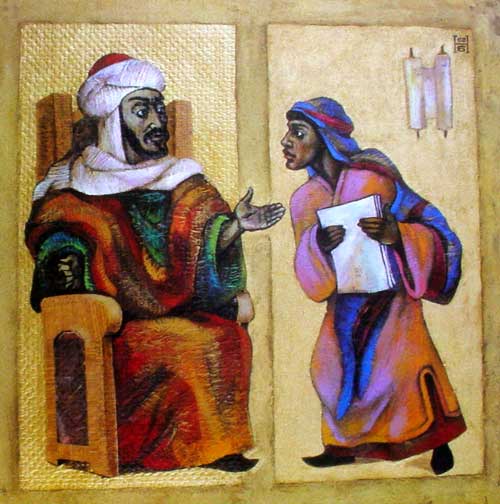
Copyright by Norwegian Bible Society , used with permission.
For other images of Nelly Bube in TIPs, see here.

καὶ προσκαλεσάμενος ἕνα ἕκαστον τῶν χρεοφειλετῶν τοῦ κυρίου ἑαυτοῦ ἔλεγεν τῷ πρώτῳ, Πόσον ὀφείλεις τῷ κυρίῳ μου;
5So, summoning his master’s debtors one by one, he asked the first, ‘How much do you owe my master?’
The following artwork is part of a series of 56 paintings on biblical themes by Kazakh artist Nelly Bube (born 1949):
Copyright by Norwegian Bible Society , used with permission.
For other images of Nelly Bube in TIPs, see here.
Following are a number of back-translations of Luke 16:5:
Exegesis:
kai proskalesamenos hena hekaston tōn chreopheiletōn tou kuriou heautou ‘after summoning each of his master’s debtors,’ i.e. he called all of them one by one. For proskaleō cf. on 7.18. chreopheiletēs (cf. on 7.41) refers here either to tenants who are behind with the rent, or, to merchants who are behind in settling their accounts, preferably the former.
poson opheileis tō kuriō mou ‘how much do you owe my master?’ opheilō (also 7.41) refers to what one has to pay, not what one has purchased, and hence, to pay for.
Translation:
Summoning, or, ‘having called’ (cf. v. 2).
His master’s debtors, or, ‘those (who were) in debt, or, who had to pay (something) to his master’; or, following the interpretation preferred in Exegesis, “his employer’s tenants” (The Four Gospels – a New Translation).
The first, or, ‘the one who came first’ (e.g. in Batak Toba).
How much do you owe, cf. 7.41; or, “what rent do you have to pay” (The Four Gospels – a New Translation).
Quoted with permission from Reiling, J. and Swellengrebel, J.L. A Handbook on the Gospel of Luke. (UBS Handbook Series). New York: UBS, 1971. For this and other handbooks for translators see here . Make sure to also consult the Handbook on the Gospel of Mark for parallel or similar verses.
Paragraph 16:5–7
16:5a
And: The Greek conjunction that the Berean Standard Bible translates as And introduces what the manager did as a result of his decision in 16:4b. The Contemporary English Version translates it as “Then.” The manager began to do what he had planned in 16:4. In some languages it may be helpful to make this more explicit. For example:
So ⌊he began to do what he had planned.⌋
he called in each one of his master’s debtors: The clause he called in each one of his master’s debtors implies that he sent a message to each person who owed something to the rich man. The manager arranged for these men to come and talk with him about their debts, one at a time. Other ways to translate this clause are:
Then one by one he called in the people who were in debt to his master. (Contemporary English Version)
-or-
So he invited each person who owed money to his employer to come and discuss the situation. (New Living Translation (2004))
See how you translated the similar phrase “called him in” in 16:2a.
debtors: The Greek word that the Berean Standard Bible translates as debtors can refer to people who owe debts of any kind. The debtors mentioned here may have been tenants who paid their rent with produce rather than money. They may also have been traders who bought goods from the rich man on credit. There were probably other debtors not mentioned here who owed money. If possible, use a term that could refer to any kind of debtor.
16:5b
How much do you owe my master?: The manager already knew how much each man owed his employer. He wanted the man to say the amount. He knew that he was about to offer to greatly reduce the man’s debt, and he wanted the man to appreciate it.
he asked the first: For natural English style, the Berean Standard Bible has placed this phrase after the quotation. In Greek, it comes before the quotation. Place it where it would be natural in your language.
the first: The phrase the first refers to the first man who came to see the manager about his debt.
© 2009, 2010, 2013 by SIL International®
Made available under the terms of a Creative Commons Attribution-ShareAlike 4.0 License (CC BY-SA) creativecommons.org/licenses/by-sa/4.0.
All Scripture quotations in this publication, unless otherwise indicated, are from The Holy Bible, Berean Standard Bible.
BSB is produced in cooperation with Bible Hub, Discovery Bible, OpenBible.com, and the Berean Bible Translation Committee.
No comments yet.
Leave a Reply
You must be logged in to post a comment.