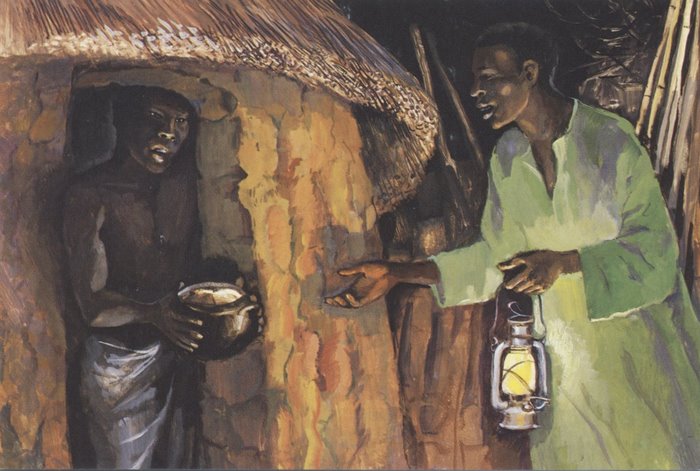
The Greek in Luke 11:8 that is translated as “persistence” or similar in English is translated in Bijago with the idiomatic expression “stiff-necked.” (Source: David Frank, quoted in Nicoleti 2012, p. 78)
complete verse (Luke 11:8)
Following are a number of back-translations of Luke 11:8:
- Noongar: “Now what then? I tell you, if he will not get up and give you the bread because you are his friend, yet he will get up and give you everything you need because you are not ashamed to ask again and again.” (Source: Warda-Kwabba Luke-Ang)
- Uma: “His answer will not be like that. Even if our friend does not want to get up and give us anything, but because we do not let-up/give-up and we are not ashamed to request-of him, he will certainly get up and give us what we need.” (Source: Uma Back Translation)
- Yakan: “I tell you,’ said Isa, ‘eventually that friend of yours will get up and give you all you need, not because you are friends but because you do not stop asking.” (Source: Yakan Back Translation)
- Western Bukidnon Manobo: “That’s the way it is,’ says Jesus, ‘even though he does not want to get up and help his friend, if his friend does not stop begging, he will force himself to get up and give him everything he needs.” (Source: Western Bukidnon Manobo Back Translation)
- Kankanaey: “If for-example that’s what happened, what then will take-place? I tell you, even though your (sing.) friend will not be persuaded to get up because of your (pl.) friendship, yet because you (sing.) insisted on repeatedly-requesting, he will get up anyway to give you (sing.) all you (sing.) need.” (Source: Kankanaey Back Translation)
- Tagbanwa: “This which I will tell you is true, that even if he doesn’t want to get up because of their friendship, however because that one requesting is really persisting, that’s why his friend will indeed get up and give him what he came for.” (Source: Tagbanwa Back Translation)
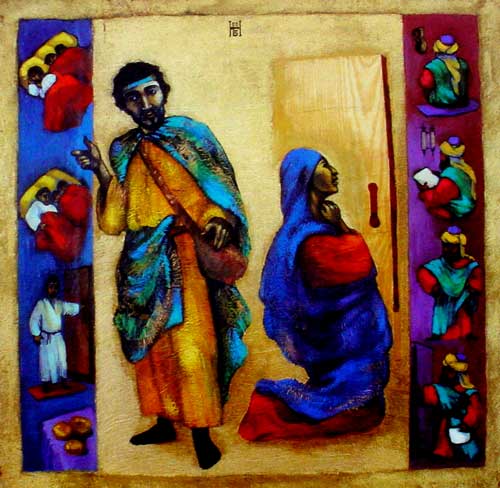
formal pronoun: Jesus addressing his disciples and common people
Like many languages (but unlike Greek or Hebrew or English), Tuvan uses a formal vs. informal 2nd person pronoun (a familiar vs. a respectful “you”). Unlike other languages that have this feature, however, the translators of the Tuvan Bible have attempted to be very consistent in using the different forms of address in every case a 2nd person pronoun has to be used in the translation of the biblical text.
As Voinov shows in Pronominal Theology in Translating the Gospels (in: The Bible Translator 2002, p. 210ff. ), the choice to use either of the pronouns many times involved theological judgment. While the formal pronoun can signal personal distance or a social/power distance between the speaker and addressee, the informal pronoun can indicate familiarity or social/power equality between speaker and addressee.
Here, Jesus is addressing his disciples, individuals and/or crowds with the formal pronoun, showing respect.
In most Dutch translations, Jesus addresses his disciples and common people with the informal pronoun, whereas they address him with the formal form.
formal 2nd person plural pronoun (Japanese)
Click or tap here to see the rest of this insight.
Like a number of other East Asian languages, Japanese uses a complex system of honorifics, i.e. a system where a number of different levels of politeness are expressed in language via words, word forms or grammatical constructs. These can range from addressing someone or referring to someone with contempt (very informal) to expressing the highest level of reference (as used in addressing or referring to God) or any number of levels in-between.
One way Japanese shows different degree of politeness is through the choice of a formal plural suffix to the second person pronoun (“you” and its various forms) as shown here in the widely-used Japanese Shinkaiyaku (新改訳) Bible of 2017. In these verses, anata-gata (あなたがた) is used, combining the second person pronoun anata and the plural suffix -gata to create a formal plural pronoun (“you” [plural] in English).
(Source: S. E. Doi, see also S. E. Doi in Journal of Translation, 18/2022, p. 37ff. )
Sung version of Luke 11
Translation commentary on Luke 11:8
Exegesis:
legō humin ‘I tell you,’ cf. on 3.8.
ei kai ou dōsei autō anastas ‘even if he will not get up and give him.’ For anastas cf. on v. 7. Strictly speaking ei kai ou here is not introducing a supposition since it is clear from v. 7 that he will not give his friend because of their friendship.
dia to einai philon autou ‘because of (his) being his friend,’ articular infinitive.
dia ge tēn anaideian autou ‘because of his persistence.’ ge emphasizes the substantive which follows, i.e. anaideian.
anaideia lit. ‘shamelessness,’ or, ‘persistence,’ preferably the latter.
egertheis dōsei autō hosōn chrēzei ‘he will get up and give him whatever he needs.’ egertheis is equivalent to anastas. The phrase hosōn chrēzei may imply that he gave more than was asked for at first. chrēzō also 12.30.
Translation:
When vv. 5-7 have been rendered by conditional or suppositional clauses they are virtually elliptical; then the transition to v. 8 can best be made by indicating the ellipsis (e.g. by dots, Bahasa Indonesia RC), or by some phrase like, “Well, what then?” (Good News Translation). To take v. 8 as the apodosis of vv. 5-7 results in a construction that is usually too heavy to be a practical solution.
It is important to keep straight the pronominal references, i.e. to the one outside who has asked (A), and the one within who has been asked (B), respectively: B will not … give A anything because A is B’s friend, yet because of A’s importunity B will … give A whatever A needs. Probably the most practical way to do so is to refer to A by pronouns of the second person (as done by Moffatt, The Four Gospels – a New Translation, cf. also on vv. 5ff). — The structure of the two clauses in this verse differs in the position of the two causal phrases; this is done in order to emphasize the contrast between them. Where a more parallel clause structure is required the emphasis must be brought out by other means.
Not goes with both ‘to get-up/rise’ and ‘to give.’
Because he is his friend, or, ‘because of their friendship,’ or with a reciprocal form, e.g. ‘under name-of their being-friends-together’ (Trukese, similarly Batak Toba, Tae’ 1933).
Because of his importunity may be better rendered as a verbal construction, ‘because he (A) kept asking him (B),’ ‘because he insisted (or, asked persistently).’
He will rise may require an emphasizer, e.g. ‘he will certainly rise’ (Balinese), ‘he just has to rise’ (Batak Toba).
Whatever he needs, or, ‘all things he needs/wants/asks.’
Quoted with permission from Reiling, J. and Swellengrebel, J.L. A Handbook on the Gospel of Luke. (UBS Handbook Series). New York: UBS, 1971. For this and other handbooks for translators see here . Make sure to also consult the Handbook on the Gospel of Mark for parallel or similar verses.
SIL Translator’s Notes on Luke 11:8
11:8a
I tell you: Jesus used the phrase I tell you to emphasize what he was saying. Jesus used these same words in 10:12.
I: The pronoun I here refers to a different person than the “I” in 11:7d. Here Jesus himself was speaking. He was no longer quoting the man who was unwilling to get out of bed. In some languages, it may be necessary to supply a phrase that clarifies this meaning. For example:
⌊Then Jesus said/added,⌋ “I tell you…”
you: The pronoun you here means “you disciples.”
11:8b
even though he will not get up to provide for him because of his friendship: You will need to consider several issues as you translate this complex phrase:
Issue 1—Pronouns
You will need to pay attention to the pronouns here. Notice that if you changed the “he” in 11:5b to “you,” here you will need to:
(a) change the word him to “you”
(b) change the word his to “your”
For example:
even if he will not get up and give you(sing) the bread because he is your friend
Issue 2—Meaning and restructuring
This complex phrase is literally “even if he will not get up and give him bread because he is his friend.” This means that friendship may not be a good enough reason for the man to get out of bed. The man may not be willing to get out of bed just because the man who asked for bread was his friend. Some other ways to translate this are:
• Reorder the phrases and put because of his friendship first. For example:
even if their friendship will not cause the man to get up and give him the bread
-or-
even though they are friends, this will not make the man get up and give him the bread
• Omit the word though and make the clause a complete sentence. For example:
He may not get up and give you the bread, just because you are his friend (Contemporary English Version)
Translate this in a way that is natural in your language.
because of his friendship: The phrase that the Berean Standard Bible translates as because of his friendship is literally “because he is his friend” in Greek. This probably means “the man in bed is a friend of the man at the door.” However, in some languages it may be best to say:
they were friends
-or-
you(dual) are friends
11:8c
yet because: Verse 11:8c introduces the reason why the man will get up. This reason contrasts with the reason in 11:8b. Even if friendship does not make the man get up, there is another reason why he will certainly get up. The Berean Standard Bible introduces this contrasting reason with the words yet because. Another way to translate this is:
But (Contemporary English Version)
In some languages you may not need a specific word to connect the contrasting reasons in these verse parts. For example:
What will cause him to get up to give you(sing) what you need is…
the man’s persistence: The Greek word that the Berean Standard Bible translates as the man’s persistence is literally “his shamelessness.” There are two ways to interpret this phrase:
(1) It refers to the shamelessness of the man in bed. According to this interpretation, the man in bed will get up so that people will not consider him to be shameless. He will get up because he wants to avoid shame and embarrassment. For example:
he will get up and give you what you want so his reputation won’t be damaged (New Living Translation (1996))
(New Living Translation (1996))
(2) It refers to the shamelessness of the man at the door. According to this interpretation, the word “shamelessness” in this context includes the ideas of both boldness and persistence. The man at the door was bold enough to go to his friend in the middle of the night and repeatedly ask for bread. For example:
he will get up and give you everything you need because you are not ashamed to keep on asking (Good News Translation)
(Berean Standard Bible, Good News Translation, King James Version, Revised Standard Version, New International Version, New American Standard Bible, English Standard Version, Revised English Bible, New Jerusalem Bible, New American Bible, New Century Version, God’s Word, New Living Translation (2004), NET Bible, Contemporary English Version)
Although most English versions and commentaries support interpretation (2), it is recommended that you follow interpretation (1) for the following reasons:
(a) Interpretation (1) best fits the cultural context. In that culture, everyone would expect a man to feed his guest. If he had no food, he would go and borrow food, even in the middle of the night. Such an action would not be considered “shameless.” In contrast, someone who refused to provide food for a neighbor’s guest would be considered a shameless person.
(b) This interpretation best fits the meaning of the Greek word that is literally “shamelessness.” Many English versions translate this word as “persistence” or “boldness.” But the word is not used in this sense elsewhere, nor does the context explicitly indicate that the man at the door repeatedly called out or knocked.
persistence: The Greek word that the Berean Standard Bible translates as persistence means “lack of sensitivity to what is proper,” “shamelessness.” In the cultural context described in this parable, this word contains implied information. The man would get up and give his friend some food because his neighbors might consider him shameless if he did not give him the food. The man needed to do what was culturally appropriate and show hospitality to a guest in the village.
Some other ways to translate this phrase are:
his ⌊desire to avoid⌋ shame
-or-
⌊his desire⌋ to protect his honor/reputation
-or-
he does not want to lose face
-or-
he does not want to be criticized
-or-
he does not want his name destroyed
General Comment on 11:8a–c
In some languages, it may be helpful to say what motivated the man to get up before saying what did not motivate him to get up. One way to reorder 11:8a–c is:
8aI tell you(plur), 8cbecause of his ⌊desire to avoid⌋ shame, he will get up and give you the bread. 8bFriendship by itself may not get him up!
-or-
8aListen, 8cthat man will get up and give you as much as you need to avoid shame/embarrassment. 8bHe may not get up just because you and he are friends!
© 2009, 2010, 2013 by SIL International®
Made available under the terms of a Creative Commons Attribution-ShareAlike 4.0 License (CC BY-SA) creativecommons.org/licenses/by-sa/4.0.
All Scripture quotations in this publication, unless otherwise indicated, are from The Holy Bible, Berean Standard Bible.
BSB is produced in cooperation with Bible Hub, Discovery Bible, OpenBible.com, and the Berean Bible Translation Committee.

Leave a Reply
You must be logged in to post a comment.