The following artwork is part of a series of 56 paintings on biblical themes by Kazakh artist Nelly Bube (born 1949):
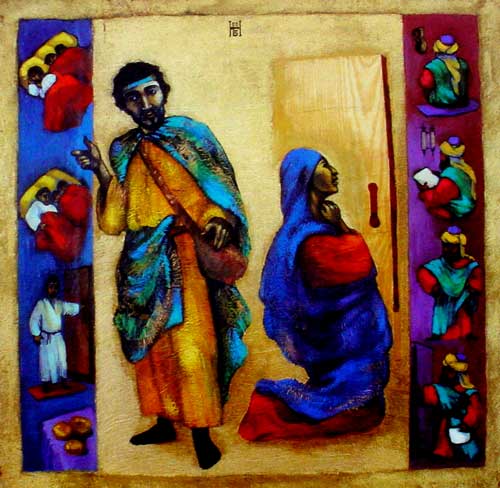
Copyright by Norwegian Bible Society , used with permission.
For other images of Nelly Bube in TIPs, see here.

κἀκεῖνος ἔσωθεν ἀποκριθεὶς εἴπῃ, Μή μοι κόπους πάρεχε· ἤδη ἡ θύρα κέκλεισται καὶ τὰ παιδία μου μετ᾽ ἐμοῦ εἰς τὴν κοίτην εἰσίν· οὐ δύναμαι ἀναστὰς δοῦναί σοι.
7And he answers from within, ‘Do not bother me; the door has already been locked, and my children are with me in bed; I cannot get up and give you anything.’
The following artwork is part of a series of 56 paintings on biblical themes by Kazakh artist Nelly Bube (born 1949):
Copyright by Norwegian Bible Society , used with permission.
For other images of Nelly Bube in TIPs, see here.
Following is a 1973 painting of the JESUS MAFA project, a response to New Testament readings from the Lectionary by a Christian community in Cameroon, Africa. Each of the readings was selected and adapted to dramatic interpretation by the community members. Photographs of their interpretations were made, and these were then transcribed to paintings:
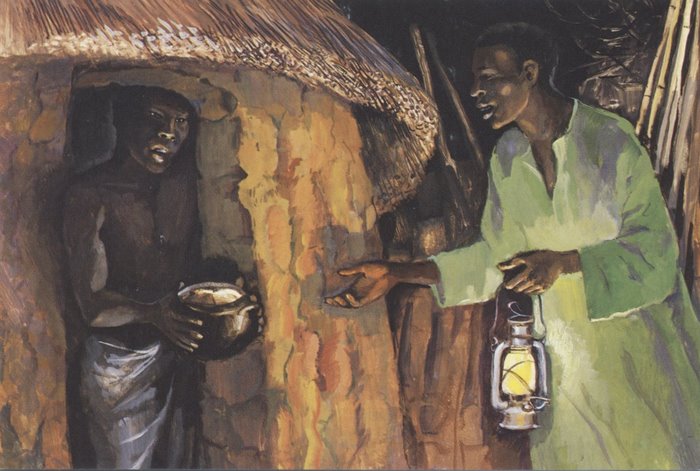
From Art in the Christian Tradition , a project of the Vanderbilt Divinity Library, Nashville, TN. Image retrieved March 23, 2026. Original source: librairie-emmanuel.fr.
Following are a number of back-translations of Luke 11:7:
Exegesis:
kai eipen pros autous ‘and he said to them,’ or, ‘he also said to them,’ preferably the former.
tis ex humōn … kai poreusetai … kai eipē … kakeinos … eipē ‘who of you will have…, and go … and say … and he will say.’ The clause starts as an interrogative clause in the indicative of the future (hexei, poreusetai) but the question is never brought to an end, nor is a direct answer given. Instead mood and tense shift to eipē (aorist subjunctive, twice), as if ean ‘if’ preceded and the two clauses were conditional. To these conditional clauses v. 8 might be considered to be the main clause.
tis ex humōn hexei philon kai poreusetai pros auton ‘which of you will have a friend and go to him,’ or, with change of subject, ‘and he (i.e. the friend) will go to him,’ preferably the former. tis ex humōn usually introduces questions to which the obvious answer is, ‘nobody’ (cf. 12.25; 14.28; 15.4; 17.7). Also the future tense points to a self-answering question.
mesonuktiou ‘at midnight,’ ‘in the middle of the night.’ mesonuktion.
chrēson moi treis artous ‘lend me three loaves.’
kichrēmi ‘to lend,’ i.e. ‘to allow the use of.’
(V. 6) epeidē here adverbial particle, ‘for’ (cf. on 7.1).
philos mou ‘a friend of mine,’ undetermined as shown by the absence of the article.
paregeneto ex hodou pros me ‘has come to me from a journey.’ For paraginomai cf. on 7.4. ex hodou means that he interrupts his journey.
ouk echō ho parathēsō autō lit. ‘I do not have (anything) which I may set before him,’ i.e. ‘I have nothing to set before him.’ For paratithēmi cf. on 9.16.
(V. 7) kakeinos esōthen apokritheis eipē ‘and (if) he, or, that one, replies from inside.’ kakeinos is contraction of kai and the demonstrative pronoun ekeinos.
esōthen (also vv. 39f) ‘from inside,’ ‘from within.’
mē moi kopous pareche lit. ‘do not cause me troubles,’ hence ‘do not bother me.’
kopos (also 18.5) ‘trouble,’ ‘difficulty.’
ēdē hē thura kekleistai ‘already the door has been locked.’ The perfect tense denotes a situation which is the result of the act of shutting. thura also 13.24f. kleiō, cf. on 4.25.
ta paidia mou met’ emou eis tēn koitēn eisin lit. ‘my children are with me in bed’ i.e. ‘my children and I have gone to bed.’ eis is here equivalent to en.
koitē ‘bed.’
ou dunamai anastas dounai soi ‘I cannot get up and give you.’ anastas dounai represents one event, hence anastas is also rendered as an infinitive. dounai is used without object, but a reference to treis artous ‘three breads’ may be understood with it.
Translation:
To imitate the irregular structure of these verses is usually undesirable. If it has to be straightened out some of the possibilities are the following. (1) The use of one interrogative sentence all through the three verses (cf. e.g. Translator’s New Testament, Marathi), or divided over two sentences, e.g. ‘which of you … would go … and say, “… (v. 6) …”; (v. 7) and would he answer then, “…”?’ Such a rendering may require that the anticipated answer be added, i.e. ‘no one (would have so bad a friend),’ ‘no (real) friend would answer thus.’ (2) A shift to one or two affirmative clauses or sentences, introduced by ‘if,’ ‘suppose (that),’ cf. e.g. The Four Gospels – a New Translation, Good News Translation; also Tzeltal, which introduces the conditional clause by ‘is there anyone who does this?’ (3) A combination of a suppositional sentence in vv. 5-6 with a rhetorical question in v. 7, to which v. 8 forms the reply, cf. e.g. ‘For-example, you have a friend … you go and call, “… (v. 6) …”. (v. 7) Would it be possible that he replied, “…”?’ (cf. Balinese, Leyden, Tae’ 1933).
Which of you who has a friend will go to him, often better in the second person, cf. e.g. “suppose you have a friend and … you go to him…” (The Four Gospels – a New Translation), ‘would you go to a friend of yours….’
For friend see on 7.6. Shona 1966 uses a term denoting a ritual friend to whom one would turn in an emergency in vv. 5bc, 8, but another one in v. 6. The use of the former term puts the refusal in a very bad light; similarly in East Nyanja and Yao, which throughout the four verses use a term implying acceptance of reciprocal obligation. In v. 5c, however, where “friend” is used as a form of address, the usual rendering often has to be possessed (e.g. in Ekari), or is idiomatically unacceptable and, therefore, has to be replaced, e.g. by ‘brother’ (Tzeltal), ‘elder-brother’ (Balinese, which also uses ‘elder’ and ‘younger brother’ as substitutes for the pronouns of the first and second person in v. 7), ‘nephew’ (Javanese), or to be omitted (Batak Toba).
For lend see on 6.34, sub (1), and cf. ‘exchange’ (Tzeltal). In some cultures, however, it is regarded highly improper to hint at restitution, so that a phrase like ‘please, give me,’ or, ‘I ask you for,’ is the normal thing to say.
Three loaves, or, more generically ‘some food’; and see on 4.3.
(V. 6) Has arrived, or a more specific word or phrase used in case of an unexpected, short visit, e.g. ‘has-dropped-in-with me’ (Javanese); cf. also “has just come to (or, turned up at) my house” (An American Translation, New English Bible).
On a journey, or, ‘from his travels,’ “who is travelling through” (The Four Gospels – a New Translation), ‘travelling around’ (Toraja-Sa’dan).
Set before him is sometimes rendered by, ‘to give him as a meal,’ or a causative form of the verb rendering ‘eat.’
(V. 7) He will answer from within, shifting to another subject, as indicated by ‘answer’ and ‘from within.’ Yet further specification of the pronoun has been found necessary, e.g. ‘the other one’ (Bible de Jérusalem), ‘that friend-of-his’ (Bahasa Indonesia), ‘that person’ (cf. the Greek). Such specification is superfluous, however, if v. 5 has been shifted to the second person.
Do not bother me. The verb is slightly stronger than “to trouble” in 7.6; Tzeltal says, ‘don’t come and disturb my sleep.’
The door is now shut, or, ‘I have shut the door’ (Shona 1966); elsewhere one has to say, ‘the doorway is blocked’ (East Nyanja, Yao), ‘the fence of the entrance has been shut’ (Tae’), ‘my house is already closed’ (Tzeltal, where huts have no doors but planks are set up and tied in the doorway); cf. also The Four Gospels – a New Translation‘s “I locked up long ago”.
Are with me in bed, or, ‘are with me in the (bed) room (Sundanese), or, in the place where we sleep’; or, ‘are lying down with me’ (cf. Trukese, Marathi, Batak Toba), similarly in Tzeltal, which takes ‘I’ as subject, cf. also ‘I and the children have gone to bed’ (Shona 1966). For bed see on 8.16.
Anything, or, ‘what (or, the things) you want/ask’ (cf. New English Bible), ‘them’ (i.e. the loaves), ‘it’ (i.e. the bread/food).
Quoted with permission from Reiling, J. and Swellengrebel, J.L. A Handbook on the Gospel of Luke. (UBS Handbook Series). New York: UBS, 1971. For this and other handbooks for translators see here . Make sure to also consult the Handbook on the Gospel of Mark for parallel or similar verses.
11:7a
And suppose the one inside answers: As mentioned above, 11:5–7 is a long, complex rhetorical question. To make this long rhetorical question more understandable, you can translate 11:5–6 as a statement and begin the rhetorical question here in 11:7a. For example:
Would the one inside answer…?
-or-
Does the person inside the house answer in this way?
(See the note on 11:5–7 above for other ways to translate the rhetorical question.)
Translate this clause in a natural way in your language for keeping track of the participants in the story. For example, it may not be necessary to specify that the man is inside the house, if that is already clear from the context.
Do not bother me: The phrase Do not bother me means, “Do not disturb me by making me get out of bed.” The man in the house would have to get out of bed, get the bread, and unlock the door. He did not want to do that in order to give the bread to his friend. Some other ways to translate this are:
Do not disturb me
-or-
Do not cause me trouble/problems
11:7b
My door is already shut: The Greek verb that the Berean Standard Bible translates as is…shut is literally “has been shut.” It indicates here that the door had been shut for the night. This involved fastening a bar or bolt across the inside of the door to keep it closed. If you have a term in your language for barring, bolting, or locking a door from the inside, you may use it here.
The verb is…shut is a passive verb. Some ways to translate this verb are:
• As a passive verb. For example:
The door is locked for the night (New Living Translation (2004))
-or-
The door is bolted (Contemporary English Version)
• As an active verb. For example:
I have already barred/bolted the door ⌊for the night⌋
Translate this verb in a way that is most natural in your language.
11:7c
my children and I are in bed: There are at least two ways to interpret the Greek clause that the Berean Standard Bible translates as my children and I are in bed:
(1) The children and the father had already gone to bed. They were probably asleep. The children may or may not have been on the same bed or mat as the father. For example:
my children and I are in bed (New Century Version)
(Berean Standard Bible, New American Standard Bible, Revised English Bible, New Jerusalem Bible, New Century Version, God’s Word, New Living Translation (2004), Contemporary English Version, Good News Translation)
(2) The children were all sleeping in the same bed as the father. This was probably a mat or a raised sleeping platform at one end of the room on which the whole family slept. For example:
my children are with me in bed (Revised Standard Version)
(New International Version, Revised Standard Version, English Standard Version)
It is recommended that you follow interpretation (1), because it allows for a variety of sleeping arrangements. The point of the passage is not whether the family slept in one or many beds. The point is that everyone had already gone to bed. If the father had to get up and look for food supplies, this would probably wake up the other members of the family.
If the situation is not clear to readers in your area, you may want to add a footnote. For example:
This was probably a one-room house where everyone slept in one area. It would disturb everyone’s sleep to get up and open the door. (Translator’s Reference Translation)
Some other ways to translate interpretation (1) are:
My children and I already went to bed/sleep
-or-
My children and I have already lain down
The man did not mention his wife. If that seems unusual for people in your area, you may want to translate in a more general way. For example:
my family and I are all in bed (New Living Translation (2004))
-or-
All of us(excl) already went to sleep
11:7d
I cannot get up to give you anything: In this context the clause I cannot get up means “I am not willing to get up.” Obviously the man was physically able to get out of bed. He just was not willing to do so. In some languages it may not be necessary to state all the information in this verse part explicitly. For example:
I can’t help you (New Living Translation (2004))
Think of a natural way in your language for a person to give this kind of excuse to his friend.
General Comment on 11:5–7
As the note on 11:5–7 stated, in Greek these verses are one rhetorical question. In some languages it may be more natural to translate most of 11:5–7 as a statement and to put a shorter question at the end of 11:7d. See the Display for 11:7d for some examples. See also the note on 11:5–7 above for more information.
© 2009, 2010, 2013 by SIL International®
Made available under the terms of a Creative Commons Attribution-ShareAlike 4.0 License (CC BY-SA) creativecommons.org/licenses/by-sa/4.0.
All Scripture quotations in this publication, unless otherwise indicated, are from The Holy Bible, Berean Standard Bible.
BSB is produced in cooperation with Bible Hub, Discovery Bible, OpenBible.com, and the Berean Bible Translation Committee.
No comments yet.
Leave a Reply
You must be logged in to post a comment.