
Image taken from the Wiedmann Bible. For more information about the images and ways to adopt them, see here .
For other images of Willy Wiedmann paintings in TIPs, see here.

וַיֹּ֣אמֶר הָאָטָד֮ אֶל־הָעֵצִים֒ אִ֡ם בֶּאֱמֶ֣ת אַתֶּם֩ מֹשְׁחִ֨ים אֹתִ֤י לְמֶ֨לֶךְ֙ עֲלֵיכֶ֔ם בֹּ֖אוּ חֲס֣וּ בְצִלִּ֑י וְאִם־אַ֕יִן תֵּ֤צֵא אֵשׁ֙ מִן־הָ֣אָטָ֔ד וְתֹאכַ֖ל אֶת־אַרְזֵ֥י הַלְּבָנֽוֹן׃
15And the bramble said to the trees,
‘If in good faith you are anointing me king over you,
then come and take refuge in my shade,
but if not, let fire come out of the bramble
and devour the cedars of Lebanon.’
In the fable of the trees in Judges 9:14, all the trees come to ‘atad (in English Bible translations: thornbush or bramble) and ask it to become their king. Most scholars have generally agreed that this is probably a reference to the Boxthorn Lycium europaeum. Zohary (Plants of the Bible, Cambridge University Press, 1982) holds that it is more likely the Christ Thorn Ziziphus spina-christi. Both are thorny trees that are plentiful in the Near East, especially near Samaria in northern Israel, where Jotham, the teller of the fable, lived. The name “Christ thorn” (French couronne-du-Christ) reflects the tradition that this tree must also have been the source of the thorns that are referred to in the account of Christ’s crucifixion. The topic is widely debated, and there is little to confirm whether the “crown of thorns” came from this tree, or from one of many other prickly plants such as the thorny burnet, which is more common in the Jerusalem area. We advocate the majority opinion here, which is boxthorn (French lycie d’Europe).
The boxthorn tree grows to 5 meters (17 feet) tall, has small leaves forming an oval crown, and has very sharp thorns. The yellowish green flowers give way to edible fruits about the size of grapes or cherries.
The word associations in Jotham’s fable are by no means clear, but he appears to use the ’atad as a tree that is neither attractive nor very useful. Indeed, its fruit is barely edible, and it does not produce usable wood, or even effective shade, since the leaves are fairly small and sparse. The ’atad is thorny, but whether that is significant in the fable is not clear. If the tree represents Abimelech (see Abimelech’s downfall), most readers would probably agree that he was a thorny character.
Jotham’s fable, being an allegory, allows the option for translators to substitute rhetorically equivalent species for the olive, fig, grapevine, and boxthorn. However, there may be no single word for “boxthorn” in the receptor language, so translators will end up using a generic phrase like “thorn tree” or substituting a thorny local tree or shrub, probably the most common one in their area. A common problem is that languages often do not have names for plants that are not useful. If transliterations are needed, ‘atad can be used from Hebrew, or translators can use a transliteration from a major language for a related type of tree.
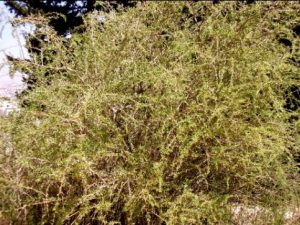

Source: Each According to its Kind: Plants and Trees in the Bible (UBS Helps for Translators)
Following are a number of back-translations as well as a sample translation for translators of Judges 9:15:
(Click or tap here to see details)
Faye Edgerton retells how the term in Navajo (Dinė) was determined:
“[This term was] easily expressed in the language of Biblical culture, which had kings and noblemen with their brilliant trappings and their position of honor and praise. But leadership among the Navajos is not accompanied by any such titles or distinctions of dress. Those most respected, especially in earlier days, were their headmen, who were the leaders in raids, and the shaman, who was able to serve the people by appealing for them to the gods, or by exorcising evil spirits. Neither of these made any outward show. Neither held his position by political intrigue or heredity. If the headman failed consistently in raids, he was superceded by a better warrior. If the shaman failed many times in his healing ceremonies, it was considered that he was making mistakes in the chants, or had lost favor with the gods, and another was sought. The term Navajos use for headman is derived from a verb meaning ‘to move the head from side to side as in making an oration.’ The headman must be a good orator, able to move the people to go to war, or to follow him in any important decision. This word is naat’áanii which now means ‘one who rules or bosses.’ It is employed now for a foreman or boss of any kind of labor, as well as for the chairman of the tribal council. So in order to show that the king is not just a common boss but the highest ruler, the word ‘aláahgo, which expresses the superlative degree, was put before naat’áanii, and so ‘aláahgo naat’áanii ‘anyone-more-than-being around-he-moves-his-head-the-one-who’ means ‘the highest ruler.’ Naat’áanii was used for governor as the context usually shows that the person was a ruler of a country or associated with kings.”
(Source: Faye Edgerton in The Bible Translator 1962, p. 25ff. )
See also king (Japanese honorifics).
Like a number of other East Asian languages, Japanese uses a complex system of honorifics, i.e. a system where a number of different levels of politeness are expressed in language via words, word forms or grammatical constructs. These can range from addressing someone or referring to someone with contempt (very informal) to expressing the highest level of reference (as used in addressing or referring to God) or any number of levels in-between.
One way Japanese shows different degree of politeness is through the choice of a formal plural suffix to the second person pronoun (“you” and its various forms) as shown here in the widely-used Japanese Shinkaiyaku (新改訳) Bible of 2017. In these verses, anata-gata (あなたがた) is used, combining the second person pronoun anata and the plural suffix -gata to create a formal plural pronoun (“you” [plural] in English).
(Source: S. E. Doi, see also S. E. Doi in Journal of Translation, 18/2022, p. 37ff. )
Long ago the majestic cedars of Lebanon (Cedrus libani) completely covered the upper slopes of the Lebanon Mountains on the western and northern sides. Now only a few pockets of these mighty cedars remain. At that time they were mixed, as they are today, with other trees such as Cilician fir, Grecian juniper, cypress, and Calabrian pine.
We know from 1 Kings that Solomon used cedar wood in his palace and in the Temple. Cedar was used for beams, boards, pillars, and ceilings. Historians tell us that the Assyrians also hauled cedars to their land for use in buildings. Nebuchadnezzar of Babylon also imported cedars from Lebanon. In some versions of Isaiah we read that people made idols of cedar and oak (44:14-20). Finally, when the Temple was rebuilt by the returning exiles (Ezra 3:7), they again cut down cedar trees to grace the house of God.
In 2 Samuel, 1-2 Kings, 1-2 Chronicles and Ezra, when Lebanon is specifically mentioned, there can be no doubt that ’erez is Cedrus libani, the “cedar of Lebanon,” although it is possible that sometimes the word was used loosely to include various evergreen trees.
In the description of the purification rituals (Leviticus 14:4 at al.), the word ’erez probably refers to the Phoenician juniper tree, since that was the only cedar-like tree in the Sinai Desert.
Cedar trees can reach 30 meters (100 feet) high with a trunk more than 2 meters (7 feet) in diameter. The leaves of true cedars are not flat like those of most trees, but consist of tufts of dark green, shiny spines. (The cedars in North America have a flatter type of spine than the biblical cedar.) The wood is fragrant and resistant to insects. Cedars bear cones and can live to be two or three thousand years old.
The cedar of Lebanon is famous for its large size (see Isaiah 2:13 et al.), and for the fragrance of its wood. Psalm 92:12 links the cedar to righteousness, that is, presumably, to its straightness and height above other trees. The cedar is the national emblem of Lebanon.
Cedrus species are found in the mountains of North Africa, in the Himalayas, in India, and in North America. Translators in these places, should, of course, use the local name in nonfigurative references. In sub Saharan Africa, translators can transliterate from Hebrew (’erez), Greek (kedar), English (sedar), or another major language, or they can take a generic solution such as “large, beautiful tree.” In poetic passages (wisdom literature and prophecy), some translators may wish to use a cultural equivalent with these traits. In Africa, according to Burkhill (The Useful Plants of West Tropical Africa, volume 4. Kew: Royal Botanic Gardens, 1985), the Pink Mahogany Guarea cedrata is also called the pink African cedar because of the cedar-like scent of its timber. Likewise, some people in India and Australia use “cedar” to refer to the toon because of its reddish wood. I do not recommend such substitutes in historical passages, since the ’erez is not related to these trees. In some figurative passages, however, the substitution could be effective, since all are large trees with reddish wood. However, each passage has to be evaluated to determine the intended effect of the image.

Source: Each According to its Kind: Plants and Trees in the Bible (UBS Helps for Translators)
Jotham expresses strong irony here. While the three noble plants refuse to become king, only the lowest of the low accepts, which is a veiled reference to Abimelech. The bramble gives a lengthy response of acceptance. Its remarks mark the climax of this fable, but more importantly, prefigure what is going to happen later in the Abimelech story. Much of the vocabulary from the fable finds its way into the description of actual events in verse 9.16-20. The bramble’s response comes in two sets of condition-consequence statements, one positive and one negative.
And the bramble said to the trees may be rendered “And the thorn bush responded to the trees, saying” or simply “Then the bramble replied.”
If in good faith you are anointing me king over you: This is the condition of the first condition-consequence statement. In good faith is literally “in truth.” Treating people in good faith speaks of sincerity, honesty, and integrity. It is the kind of treatment people expect, but in this fable Jotham accuses the people of Shechem of not acting in good faith. They mistreated his family, the descendants of Gideon (see verse 9.16, verse 19). The use of a conditional statement evokes doubt. Though the bramble seems arrogant, he is at the same time unsure about the support of others. It is as if the bramble does not believe in the good faith of those making him king. This phrase is well expressed in Revised English Bible, which begins the conditional statement with “If you really mean to….” Good News Translation is similar with “If you really want to….” You are anointing me king over you refers to the ritual of anointing kings with olive oil to consecrate them in their new task (see comments on verse 9.8). The Hebrew pronoun for you is plural, referring to the trees. The Hebrew verb rendered are anointing is a participle. Participles in Hebrew often convey the idea that something is about to happen, which is true here. In many languages it will be better to render this participle as “wish to anoint” (New American Bible) or “intend to anoint.” In languages where the practice of anointing kings is unknown, a simpler expression can be used. For example, Contemporary English Version says “If you really want me to be your king.” In some languages this clause may be reordered by saying “If you want to anoint me as your king and are really sincere about it.”
Then come and take refuge in my shade: There is strong irony in this statement of consequence. The bramble has small leaves and is generally a low shrub, so it could not possibly offer shade to the other trees. Further, a plant with thorns cannot be a refuge. Come and take refuge translate plural imperative verbs in Hebrew. Take refuge may be rendered “take shelter” (Good News Translation), “find refuge,” or “find safety.” The bramble is offering to “protect” the other trees, so we might say “then come and I will protect you.”
But if not: This is the condition of the second condition-consequence statement, this time in the negative. But renders the Hebrew waw conjunction, which introduces a contrast here. If not is an ellipsis for “if you are not anointing me as your king in good faith.” We may say “if you’re not serious about making me king.” Contemporary English Version has “if you’re deceiving me.”
Let fire come out of the bramble …: In this consequence the bramble threatens the other trees, saying it will burn them down. Though thorn bushes are not a good source of firewood, they can easily catch fire and thus constitute a menace to the whole forest. The generic Hebrew word for fire may be rendered “flames.” The Hebrew verb translated Let … come out could be a jussive form expressing a threat (so Revised Standard Version) or an imperfect form; for example, Revised English Bible begins this clause with “fire will come out…” (similarly Good News Translation). Either way, the bramble is threatening the neighboring trees. Come out refers to the first burst of the fire, so we may say “blaze out” (Good News Translation) or “burst forth.” This verb is associated with much evil action in later episodes in Judges (verse 20.21; verse 21.21). In this consequence the thorn bush suddenly speaks of itself in the third person by saying out of the bramble. Some manuscripts of the ver Septuagintver* change the text to read “out of me,” which is probably done for naturalness. However, in many languages people can speak of themselves in the third person so this phrase will not pose a problem. Translators can use whichever form is appropriate. Contemporary English Version renders this whole clause as “I’ll start a fire that will spread out.”
And devour the cedars of Lebanon: The Hebrew verb for devour (ʾakal) is literally “eat.” This verb is regularly used with fire to denote its destructive power (compare verse 6.21, where it is translated “consumed”). We may also say “burn up” (Good News Translation, Revised English Bible), “destroy” (Contemporary English Version), or “devastate.” The cedars of Lebanon refers to the most famous and largest forest in the Mediterranean region. The mountains of Lebanon were famous for their huge cedar trees, which can reach 30 meters (100 feet) high with a trunk more than 2 meters (7 feet) in diameter. In some languages the word cedar is transliterated, but if the word is not known, it may be better to render this whole phrase as “the huge trees of the Lebanese forest.” For Lebanon see verse 3.3. The irony of the fable continues here, since the lowly bramble claims that it can burn up a huge forest of trees—a foolish and arrogant claim.
Some translation models for this verse are:
• Then Bramble replied, ‘If you really want to make me your king, then come and enjoy my shade and protection. But if you do not want me as your king, then I will start a fire that will completely destroy the tall trees of Lebanon.’
• Then the bramble said to the trees, ‘If you are serious about making me your king, then come and I will shade and protect you. But if you are not serious, then I will blaze forth and burn up [even] the cedars of Lebanon.’
Quoted with permission from Zogbo, Lynell and Ogden, Graham S. A Handbook on Judges. (UBS Helps for Translators). Miami: UBS, 2019. For this and other handbooks for translators see here .
9:15a But the thornbush replied,
And the thornbush answered them,
-or-
The thornbush said to the trees,
9:15b ‘If you really are anointing me as king over you,
‘If you wish to make me your king,
-or-
‘If you really want me to be your king,
9:15c come and find refuge in my shade.
come and take shelter under my shade.
-or-
come and put yourselves under my shade.
9:15d But if not, may fire come out of the thornbush
If you don’t, fire will spring from me
-or-
If you don’t want to do that, ⌊I hope that⌋ fire will come out of my thorns.
9:15e and consume the cedars of Lebanon.’
and burn the cedar trees of Lebanon country.’
-or-
May it burn up all the ⌊large⌋ cedar trees of the land of Lebanon.’”
© 2023 by SIL International®
Made available under the terms of a Creative Commons Attribution-ShareAlike 4.0 License (CC BY-SA) creativecommons.org/licenses/by-sa/4.0.
All Scripture quotations in this publication, unless otherwise indicated, are from The Holy Bible, Berean Standard Bible.
BSB is produced in cooperation with Bible Hub, Discovery Bible, OpenBible.com, and the Berean Bible Translation Committee.
No comments yet.
Leave a Reply
You must be logged in to post a comment.