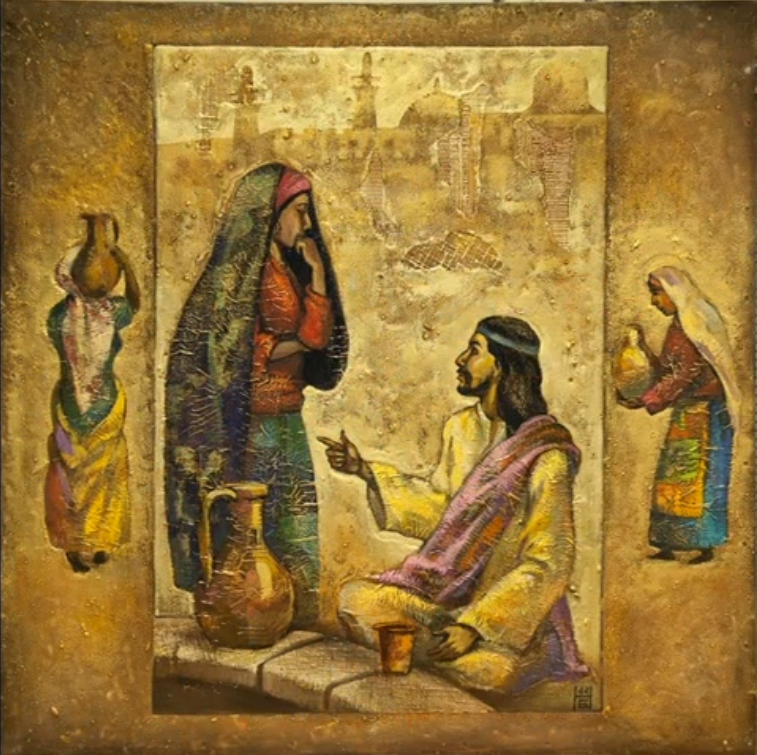
The woman at the well


Following is a painting in the Hamzanama style:

The woman at the well, 2017-2018, Paul Abraham with Manish Soni, Opaque watercolour and natural pigments on hand-made paper, © Sarmaya Arts Foundation. (2018.33.5)

Following is a painting by Ketut Lasia (b. 1945):

Ketut Lasia is one of the last traditional Balinese painters in the Ubud style. As an adult, Lasia converted from Hinduism to Christianity, and he paints primarily biblical scenes. You can find artwork from Ketut Lasia in a variety of formats for sale at Fine Art America .

See also He deliberately took time to draw near to social outcasts (image).

complete verse (John 4:38)

Following are a number of back-translations of John 4:38:

  • Uma: “I command you to harvest what you did not plant. Other people planted, you harvest the fruit of their work.'” (Source: Uma Back Translation)
  • Yakan: “I tell you to harvest what you have not worked for. Others have worked-hard but you share-in/profit-from their work.'” (Source: Yakan Back Translation)
  • Western Bukidnon Manobo: “I caused you to harvest there on the land where you did not plant because another person is the one who spreads the word of God, and because of their work you are the ones, to cause people to understand so that they might believe,’ said Jesus.” (Source: Western Bukidnon Manobo Back Translation)
  • Kankanaey: “Because I have sent you to harvest what you didn’t sweat-for, and now you will gain/benefit-from the work of others,’ Jesus said to his disciples.” (Source: Kankanaey Back Translation)
  • Tagbanwa: “I have sent you to harvest where you weren’t the ones who cultivated. Others put-in-the-hard-work and you will harvest what they worked for.'” (Source: Tagbanwa Back Translation)
  • Tenango Otomi: “I send you that you encourage people so they believe in me. But you will go where already has passed through a preacher. The word which he first has given, you will encourage the people who heard it.'” (Source: Tenango Otomi Back Translation)

He deliberately took time to draw near to social outcasts (image)

“Jesus is dressed in a different style of clothing than the style of the woman who is shown as a Lanna Thai northerner. It is unusual for him to talk to a person from a different region, especially a woman. The clothes, the roof of the house in the background, and the dipper for water all indicate that this is in northern Thailand.”

Drawing by Sawai Chinnawong who employs northern and central Thailand’s popular distinctive artistic style originally used to depict Buddhist moral principles and other religious themes; explanation by Paul DeNeui. From That Man Who Came to Save Us by Sawai Chinnawong and Paul H. DeNeui, William Carey Library, 2010. . For more images by Sawai Chinnawong in TIPs see here.

See also The woman at the well (image).

Learn more on Bible Odyssey: Woman at the Well .

formal pronoun: Jesus addressing his disciples and common people

Like many languages (but unlike Greek or Hebrew or English), Tuvan uses a formal vs. informal 2nd person pronoun (a familiar vs. a respectful “you”). Unlike other languages that have this feature, however, the translators of the Tuvan Bible have attempted to be very consistent in using the different forms of address in every case a 2nd person pronoun has to be used in the translation of the biblical text.

As Voinov shows in Pronominal Theology in Translating the Gospels (in: The Bible Translator 2002, p. 210ff. ), the choice to use either of the pronouns many times involved theological judgment. While the formal pronoun can signal personal distance or a social/power distance between the speaker and addressee, the informal pronoun can indicate familiarity or social/power equality between speaker and addressee.

Here, Jesus is addressing his disciples, individuals and/or crowds with the formal pronoun, showing respect.

In most Dutch translations, Jesus addresses his disciples and common people with the informal pronoun, whereas they address him with the formal form.

1st person pronoun referring to God (Japanese)

Click or tap here to see the rest of this insight.

Like a number of other East Asian languages, Japanese uses a complex system of honorifics, i.e. a system where a number of different levels of politeness are expressed in language via words, word forms or grammatical constructs. These can range from addressing someone or referring to someone with contempt (very informal) to expressing the highest level of reference (as used in addressing or referring to God) or any number of levels in-between.

One way Japanese shows different degree of politeness is through the choice of a first person singular and plural pronoun (“I” and “we” and its various forms) as shown here in the widely-used Japanese Shinkaiyaku (新改訳) Bible of 2017. The most commonly used watashi/watakushi (私) is typically used when the speaker is humble and asking for help. In these verses, where God / Jesus is referring to himself, watashi is also used but instead of the kanji writing system (私) the syllabary hiragana (わたし) is used to distinguish God from others.

(Source: S. E. Doi, see also S. E. Doi in Journal of Translation, 18/2022, p. 37ff. )

See also pronoun for “God”.

formal 2nd person plural pronoun (Japanese)

Click or tap here to see the rest of this insight.

Like a number of other East Asian languages, Japanese uses a complex system of honorifics, i.e. a system where a number of different levels of politeness are expressed in language via words, word forms or grammatical constructs. These can range from addressing someone or referring to someone with contempt (very informal) to expressing the highest level of reference (as used in addressing or referring to God) or any number of levels in-between.

One way Japanese shows different degree of politeness is through the choice of a formal plural suffix to the second person pronoun (“you” and its various forms) as shown here in the widely-used Japanese Shinkaiyaku (新改訳) Bible of 2017. In these verses, anata-gata (あなたがた) is used, combining the second person pronoun anata and the plural suffix -gata to create a formal plural pronoun (“you” [plural] in English).

(Source: S. E. Doi, see also S. E. Doi in Journal of Translation, 18/2022, p. 37ff. )

Translation commentary on John 4:38

In the Greek sentence the pronoun I comes first in the sentence, indicating strong emphasis.

A harvest in a field where translates a Greek relative pronoun rendered by Moffatt and New English Bible as “a crop for which.” In the second clause the adverb there is supplied by Good News Translation because of the manner of translating the first half of the verse (in a field where).

A difficulty is presented by the expression where you did not work, since to reap a harvest certainly constitutes work. However, the reference is to the earlier work involved in preparing the ground and planting the seed. This difference in time or activity must be made explicit in some languages, for example, “I have sent you to harvest in a field where you did not previously work” or “… where you did not yourselves prepare the ground” or “… where you did not at an earlier time plow the ground.”

You profit from their work is the meaning of the Greek expression rendered literally in Revised Standard Version: “you have entered into their labor.” Moffatt has “you reap the profit of their toil”; New American Bible “you have come into their gain”; Jerusalem Bible “you have come into the rewards of their trouble”; and New English Bible “come in for the harvest of their toil.” In some languages “profiting from someone else’s work” may be expressed as “you have an advantage because of what others have already worked hard to do” or “you are better off because of what they did” or “you have gained because they worked hard.”

Quoted with permission from Newman, Barclay M. and Nida, Eugene A. A Handbook on the Gospel of John. (UBS Handbook Series). New York: UBS, 1980. For this and other handbooks for translators see here .