Following are a number of back-translations of John 2:16:
Uma: “He said to the dove sellers: ‘Get out, take all that outside! Do not treat/consider my Father’s House a selling house!'” (Source: Uma Back Translation)
Yakan: “And he said to the people trading pigeons, ‘Remove your merchandise from this temple. Don’t make this temple into a market, for this is the house of my Father, God.'” (Source: Yakan Back Translation)
Western Bukidnon Manobo: “And he said to those who sell doves, he said, ‘You get away from there. Don’t make into a market this house of my father God.'” (Source: Western Bukidnon Manobo Back Translation)
Kankanaey: “Then he said to the ones-selling pigeons/doves, ‘Remove those (rebuke particle)! Don’t turn-my Father’s house -into a marketplace!'” (Source: Kankanaey Back Translation)
Tagbanwa: “And then he approached those sellers of pigeons. He said to them, ‘You get these wares of yours out of here also! Don’t make a store of this house of my Father!'” (Source: Tagbanwa Back Translation)
Tenango Otomi: “He told the dove sellers, ‘Take away what you have here. He is my Father’s house. Do not make it into a market place.'” (Source: Tenango Otomi Back Translation)
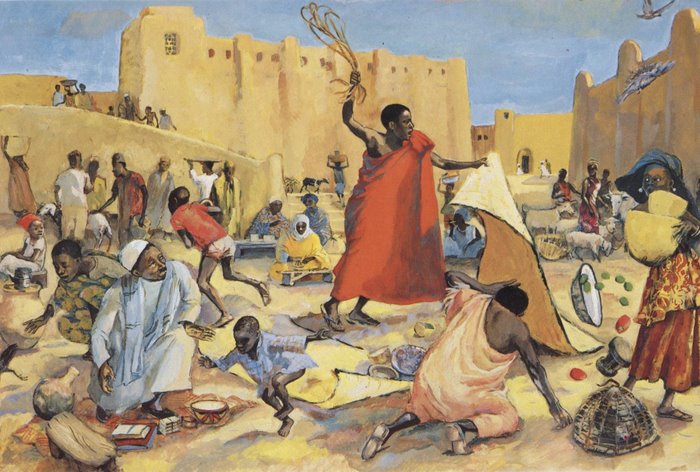
Following is a 1973 painting of the JESUS MAFA project, a response to New Testament readings from the Lectionary by a Christian community in Cameroon, Africa. Each of the readings was selected and adapted to dramatic interpretation by the community members. Photographs of their interpretations were made, and these were then transcribed to paintings:
From Art in the Christian Tradition, a project of the Vanderbilt Divinity Library, Nashville, TN. Image retrieved March 23, 2026. Original source: librairie-emmanuel.fr.
The Hebrew, Latin and Greek that is translated as “dove” or “pigeon” in English is translated in Pijin with the onomatopoeia kurrukurru. (Source: Bob Carter)
In Matumbi is is translated as ngunda, a kind of dove that has the reputation to be monogamous. (Source: Pioneer Bible Translators, project-specific notes in Paratext)
In the fifteenth century the English word “pigeon” meant a young dove, the word “dove” being reserved for the adult birds. In modern English the words are used almost interchangeably. As a general rule, “pigeon” is used for domesticated forms of these birds, and for the larger variety of wild forms, while “dove” is used mainly for wild varieties. However, there are many exceptions to this general rule.
Pigeons and doves are both included in a bird family known scientifically as the Colombidae, consisting of well over two hundred species. In Israel and the Middle East are found the true Colombidae, which are easily distinguished from the genus Stretopelia, that is, the turtle doves.
The most common of the true Colombidae in the Middle East is most certainly the Asiatic Rock Dove Columba livia. This bird was first domesticated around 4500 B.C. in Mesopotamia. By 2500 B.C. it was kept as a domestic bird in Egypt, and by 1200 B.C. there is evidence that its homing abilities were already well known. It is this bird that is the ancestor of the domestic homing pigeons that people keep, some of which have escaped, returned to the wild, and now populate city streets all over the world. The ledges of modern buildings are a good substitute for the rock ledges that were its original nesting sites. It is likely that the Canaanites and the Israelites also kept these birds for both food and sacrifice. It is this bird that is called yonah in the Hebrew Bible and peristera in the Greek New Testament.
There are also three types of turtledove found in the land of Israel, two of which are resident species; the third is a migrant that arrives in spring and spends the summer in Israel. This migrant, the true Turtle Dove Streptopelia turtur, and one of the species now resident, the Collared Dove Streptopelia decaocto, are what the Bible writers called tor in Hebrew and trugōn in Greek. (Both the Hebrew and Greek names are based on the sound the turtledove makes.)
In biblical Hebrew the word gozal generally refers to a nestling of any bird species. In Genesis 15:9 it obviously refers specifically to a young pigeon. Nestling rock pigeons were collected from the rock ledges. Pigeons and doves were kept in cages and dovecotes, and wild ones were trapped in nets. This enabled the Jews to have a handy stock of birds for sacrificial purposes.
The rock pigeon is a blue-gray color with a pinkish sheen to the neck feathers. It has a black tip on its tail. Its call is a repeated moaning oom (the Hebrew name yonah is related to a verb meaning “to moan”) or a rapid cooing coo-ROO-coo-coo, usually repeated two or three times. The call is uttered with the beak closed, into the chest. The male’s sexual display starts with flying wing claps, and then when it lands next to the female, it begins bowing and turning with chest puffed and tail spread.
This type of pigeon lives in large colonies, and when a group is in flight, they maneuver as a single unit, often gliding short distances together with their wings held in a V shape.
The turtledove is a smaller blue-gray bird with a pinkish chest. It arrives in Israel in April, and its rhythmic call yoo-ROO-coo, yoo-ROO-coo, yoo-ROO-coo, repeated for two or three minutes at a time on sunny days, can be heard all over.
Doves are seed eaters, and this fact may be significant in the Flood narrative. The raven, a carrion eater, does not return to the ark, since food is available. The dove returns at first, and when it finally stays away, this is an indication that seeds of some sort are once again available to it, and the earth is again dry.
As seed-eaters, doves and pigeons are ritually clean birds for Jews. Their swift flight means that they are symbolic of speed in some biblical contexts, especially in Psalms. The fact that these birds court, mate, and nest repeatedly throughout the year resulted in their being a symbol of affection, sexuality, and fertility in the ancient Egyptian, Canaanite, and Hebrew cultures. This symbolism is important in the Song of Solomon.
A very ancient belief that the dove has no bile and is therefore devoid of anger led to its becoming a symbol of peace and gentleness. (In actual fact doves and pigeons are aggressive, often attacking other birds, especially at food sources.)
The name yonah for the pigeon and dove is associated with moaning and groaning in pain or sorrow. This is often the symbolism in prophetic poetry.
Pigeons and doves are found worldwide, except in some snow-bound regions and on some remote islands. Almost everywhere they live there is more than one species, and in almost all locations the domestic pigeon is one of these species. As a general rule, the word for the smaller wild dove should be used wherever possible, but in those contexts where both pigeons and doves are mentioned in connection with sacrifices, the word for the domestic pigeon can be used as well as the one for the wild dove.
In 2 Kings 6:25 there is a Hebrew expression that literally means “dove’s dung”. This seems to be a reference to some kind of food that is eaten only in emergencies. Suggestions about what this may refer to have varied from “chickpeas” (which do look somewhat like a dove’s droppings) to “locust-beans”, “wild onions”, and the roots of certain wild flowers. In view of the lack of certainty, it is probably best to translate it literally as “dove’s dung” and include the footnote, “This is probably some kind of wild food eaten only in emergencies.”
Click or tap here to see the rest of this insight.
Like a number of other East Asian languages, Japanese uses a complex system of honorifics, i.e. a system where a number of different levels of politeness are expressed in language via words, word forms or grammatical constructs. These can range from addressing someone or referring to someone with contempt (very informal) to expressing the highest level of reference (as used in addressing or referring to God) or any number of levels in-between.
One way Japanese shows different degree of politeness is through the choice of a first person singular and plural pronoun (“I” and “we” and its various forms) as shown here in the widely-used Japanese Shinkaiyaku (新改訳) Bible of 2017. The most commonly used watashi/watakushi (私) is typically used when the speaker is humble and asking for help. In these verses, where God / Jesus is referring to himself, watashi is also used but instead of the kanji writing system (私) the syllabary hiragana (わたし) is used to distinguish God from others.
Click or tap here to see the rest of this insight.
Like a number of other East Asian languages, Japanese uses a complex system of honorifics, i.e. a system where a number of different levels of politeness are expressed in language via words, word forms or grammatical constructs. These can range from addressing someone or referring to someone with contempt (very informal) to expressing the highest level of reference (as used in addressing or referring to God) or any number of levels in-between.
One way Japanese shows different degree of politeness is through the usage of an honorific construction where the morpheme are (され) is affixed on the verb as shown here in the widely-used Japanese Shinkaiyaku (新改訳) Bible of 2017. This is particularly done with verbs that have God as the agent to show a deep sense of reverence. Here, iw-are-ru (言われる) or “say” is used.
God transcends gender, but most languages are limited to grammatical gender expressed in pronouns. In the case of English, this is traditionally confined to “he” (or in the forms “his,” “him,” and “himself”), “she” (and “her,” “hers,” and “herself”), and “it” (and “its” and “itself”).
Modern Mandarin Chinese, however, offers another possibility. Here, the third-person singular pronoun is always pronounced the same (tā), but it is written differently according to its gender (他 is “he,” 她 is “she,” and 它/牠 is “it” and their respective derivative forms). In each of these characters, the first (or upper) part defines the gender (man, woman, or thing/animal), while the second element gives the clue to its pronunciation.
In 1930, after a full century with dozens of Chinese translations, Bible translator Wang Yuande (王元德) coined a new “godly” pronoun: 祂. Chinese readers immediately knew how to pronounce it: tā. But they also recognized that the first part of that character, signifying something spiritual, clarified that each person of the Trinity has no gender aside from being God.
While the most important Protestant and Catholic Chinese versions respectively have opted not to use 祂, some Bible translations do and it is widely used in hymnals and other Christian materials. Among the translations that use 祂 to refer to “God” were early versions of Lü Zhenzhong’s (呂振中) version (New Testament: 1946, complete Bible: 1970). R.P. Kramers (in The Bible Translator 1956, p. 152ff. ) explains why later versions of Lü’s translation did not continue with this practice: “This new way of writing ‘He,’ however, has created a minor problem of its own: must this polite form be used whenever Jesus is referred to? Lü follows the rule that, wherever Jesus is referred to as a human being, the normal tā (他) is written; where he is referred to as divine, especially after the ascension, the reverential tā (祂) is used.”
In that system, one kind of pronoun is used for humans (male and female alike) and others for natural elements, non-liquid masses, and some spiritual entities (one other is used for large animals and another one for miscellaneous items). While in these languages the pronoun for spiritual entities used to be employed when referring to God, this has changed into the use of the human pronoun.
Lynell Zogbo (in The Bible Translator 1989, p. 401ff. ) explains: “From informal discussions with young Christians especially, it would appear that, at least for some people, the experience and/or concepts of Christianity are affecting the choice of pronoun for God. Some people explain that God is no longer ‘far away,’ but is somehow tangible and personal. For these speakers God has shifted over into the human category.”
In Kouya, God (the Father) and Jesus are referred to with the human pronoun ɔ, whereas the Holy Spirit is referred to with a non-human pronoun. (Northern Grebo and Western Krahn make a similar distinction.)
Eddie Arthur, a former Kouya Bible translation consultant, says the following: “We tried to insist that this shouldn’t happen, but the Kouya team members were insistent that the human pronoun for the Spirit would not work.”
In Burmese, the pronoun ko taw (ကိုယ်တော်) is used either as 2nd person (you) or 3rd person (he, him, his) reference. “This term clearly has its root in the religious language in Burmese. No ordinary persons are addressed or known by this pronoun because it is reserved for Buddhist monks, famous religious teachers, and in the case of Christianity, the Trinity.” (Source: Gam Seng Shae in The Bible Translator 2002, p. 202ff. )
In Thai, the pronoun phra`ong (พระองค์) is used, a gender-neutral pronoun which must refer to a previously introduced royal or divine being. Similarly, in Northern Khmer, which is spoken in Thailand, “an honorific divine pronoun” is used for the pronoun referring to the persons of the Trinity (source: David Thomas in The Bible Translator 1993, p. 445 ). In Urak Lawoi’, another language spoken in Thailand, the translation often uses tuhat (ตูฮัด) — “God” — ”as a divine pronoun where Thai has phra’ong even though it’s actually a noun.” (Source for Thai and Urak Lawoi’: Stephen Pattemore)
The English “Contemporary Torah” addresses the question of God and gendered pronouns by mostly avoiding pronouns in the first five books of the Hebrew Bible/Old Testament (unless God is referred to as “lord,” “father,” “king,” or “warrior”). It does that by either using passive constructs (“He gave us” vs. “we were given”), by using the adjective “divine” or by using “God” rather than a pronoun.
Some Protestant and Orthodox English Bibles use a referential capitalized spelling when referring to the persons of the Trinity with “He,” “His,” “Him,” or “Himself.” This includes for instance the New American Standard Bible or The Orthodox New Testament, but most translations do not. Two other languages where this is also done (in most Bible translations) are Twents as well as Indonesian and Malay. In the latter two languages this follows the language usage according to the Qur’an, which in turn predicts that usage (see Soesilo in The Bible Translator 1991, p. 442ff. and The Bible Translator 1997, p. 433ff. ).
Living Water is produced for the Bible translation movement in association with Lutheran Bible Translators. Lyrics derived from the ESV® Bible (The Holy Bible, English Standard Version®).
He ordered represents “he said,” but the Greek word “to say” covers a large semantic domain, and the present context indicates that something stronger than merely “said” is intended.
Stop making translates a present imperative in Greek, referring to action already in progress. In order to emphasize this particular aspect of the present tense in Greek, one may say “Do not any longer cause my Father’s house to be a marketplace” or “You must stop causing my Father’s house to be a marketplace.”
The second part of this verse has a play on the word “house” (literally something like “Do not make my Father’s house a house of commerce”), which cannot be seen from Good News Translation. Most modern English translators render the phrase “house of commerce” either by “market” or “marketplace.” But Revised Standard Version has “house of trade” and in this way reflects the play on words. It is possible in some languages to reflect the play on words by using a rather general term for “house,” for example, “Do not make this place that belongs to my Father into a place where you do business” or “Do not take my Father’s place and make it into a marketplace.”
Quoted with permission from Newman, Barclay M. and Nida, Eugene A. A Handbook on the Gospel of John. (UBS Handbook Series). New York: UBS, 1980. For this and other handbooks for translators see here .

Leave a Reply
You must be logged in to post a comment.