“Brothers” has to be translated into Naro as “younger brothers and older brothers” (Tsáá qõea xu hẽé / naka tsáá kíí). All brothers are included this way, also because of the kind of plural that has been used. (Source: Gerrit van Steenbergen)
This also must be more clearly defined in Yucateco as older or younger (suku’un or Iits’in), but here there are both older and younger brothers. Yucateco does have a more general word for close relative, family member. (Source: Robert Bascom)
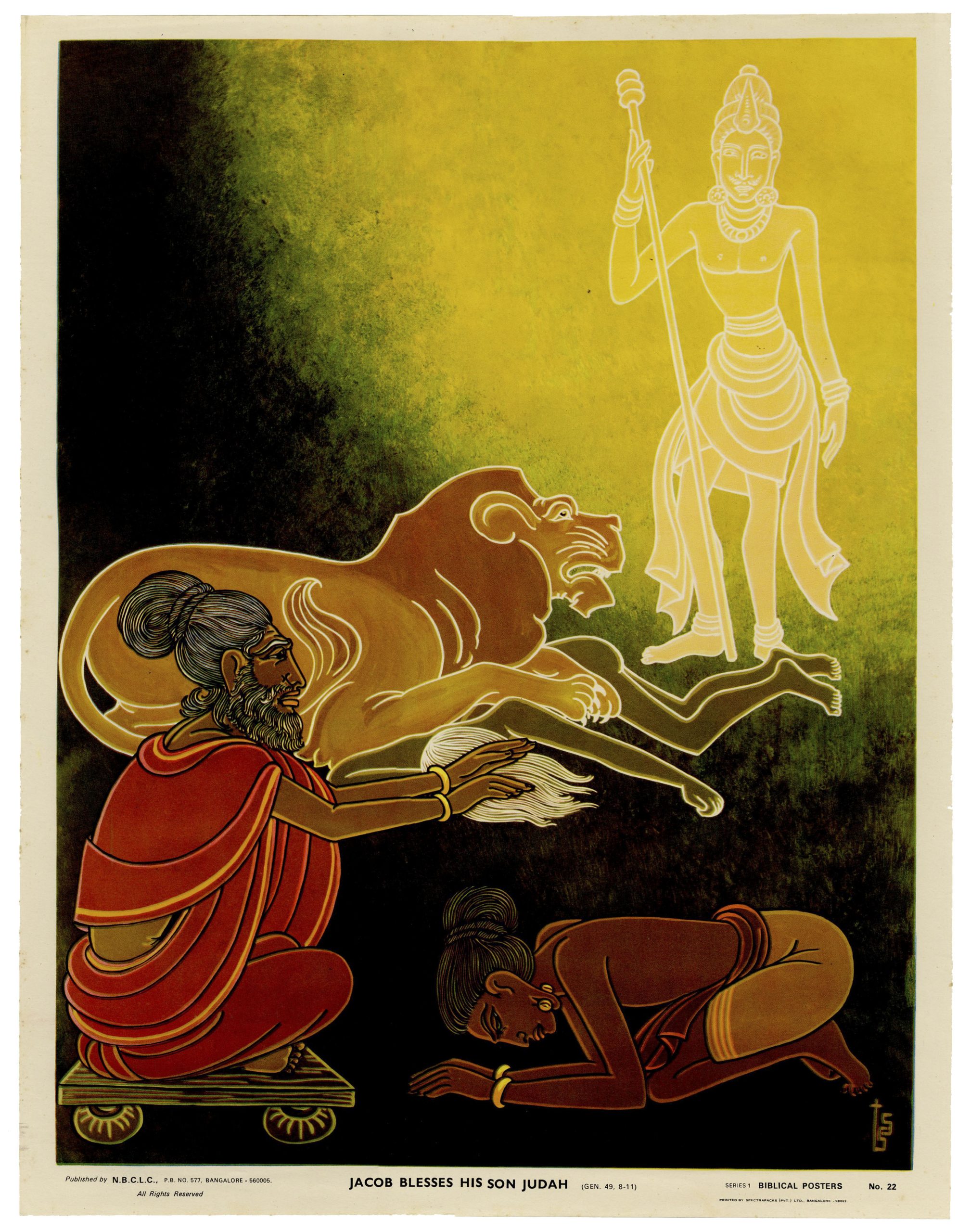
The name that is transliterated as “Judah” or “Judea” in English (referring to the son of Jacob, the tribe, and the territory) is translated in Spanish Sign Language as “lion” (referring to Genesis 49:9 and Revelation 5:5). This sign for lion is reserved for regions and kingdoms. (Source: John Elwode in The Bible Translator 2008, p. 78ff. and Steve Parkhurst)
Following are a number of back-translations as well as a sample translation for translators of Genesis 49:8:
Kankanaey: “‘You (sing.) Juda, your (sing.) siblings will honor and bow-face-down to you (sing.) and you (sing.) will choke the necks of your (sing.) enemies.” (Source: Kankanaey Back Translation)
Newari: “‘Judah, your brothers will praise you, you have completely defeated your enemies, the sons of your father will bow down to you.” (Source: Newari Back Translation)
Hiligaynon: “‘You (sing.) Juda, you (sing.) will-be-praised and respected by your (sing.) siblings/(brothers). You (sing.) will-defeat your (sing.) enemies.” (Source: Hiligaynon Back Translation)
English: “Judah, your older and younger brothers will praise you. They will bow down before you, because you will thoroughly defeat your enemies.” (Source: Translation for Translators)
The Greek, Hebrew, Aramaic, Ge’ez, and Latin that is translated as “enemy” or “foe” in English is translated in the HausaCommon Language Bible as “friends of front,” i.e., the person standing opposite you in a battle. (Source: Andy Warren-Rothlin)
In North Alaskan Inupiatun it is translated with a term that implies that it’s not just someone who hates you, but one who wants to do you harm (Source: Robert Bascom), in Tarok as ukpa ìkum or “companion in war/fighting,” and in Ikwere as nye irno m or “person who hates me” (source for this and one above: Chuck and Karen Tessaro in this newsletter ).
In Cherokee it is either translated as “the one(s) who reprimand(s) you” or “the one(s) feared.” (Source: Bender / Belt 2025, p. 47)
Click or tap here to see the rest of this insight.
Like a number of other East Asian languages, Japanese uses a complex system of honorifics, i.e. a system where a number of different levels of politeness are expressed in language via words, word forms or grammatical constructs. These can range from addressing someone or referring to someone with contempt (very informal) to expressing the highest level of reference (as used in addressing or referring to God) or any number of levels in-between. One way Japanese shows different degree of politeness is through the choice of a second person pronoun (“you” and its various forms) as shown here in the widely-used Japanese Shinkaiyaku (新改訳) Bible of 2017. The most commonly used anata (あなた) is typically used when the speaker is humbly addressing another person.
In these verses, however, omae (おまえ) is used, a cruder second person pronoun, that Jesus for instance chooses when chiding his disciples. (Source: S. E. Doi, see also S. E. Doi in Journal of Translation, 18/2022, p. 37ff. )
Judah, who is the fourth son of Leah, is the first to receive nothing but praise from Jacob. Note that the Hebrew text switches back to “you.”
Judah, your brothers shall praise you: for the play on Judah‘s name, see 29.35.
Your hand shall be on the neck of your enemies: this line gives the reason why Judah’s brothers (the other tribes of Israel) will praise him. This expression is a poetic way of saying “you defeat your enemies” or “you conquer your enemies in battle.”
Your father’s sons shall bow down before you: bow down expresses more than just a physical action. It is an action that displays submission or homage to a ruler or superior. In some translations this is expressed as “you will be the boss of all your brothers.” The most important inheritance and place in the family of Jacob/Israel, which the three oldest brothers have forfeited, is now given to Judah and his descendants.
In this line father’s sons matches brothers in the first line, and bow down matches praise. Translators may find it more suitable to keep the first and third lines together. In this way we may say:
Your brothers will bow down to you,
and they will praise you
because you defeat your enemies.
In some languages it may be preferable to place the reason at the beginning of the verse:
You conquer [all] your enemies,
and so your brothers will praise you.
They will bow down before you.
Quoted with permission from Reyburn, William D. and Fry, Euan McG. A Handbook on Genesis. (UBS Helps for Translators). New York: UBS, 1997. For this and other handbooks for translators see here .

Leave a Reply
You must be logged in to post a comment.