The Hebrew, Aramaic, Latin, and Greek that is translated in English typically as “obedience” or “obey” is translated in Tepeuxila Cuicatec as “thing hearing,” because “to hear is to obey.” (Source: Marjorie Davis in The Bible Translator 1952, p. 34ff. )
In Huba it is translated as hya nǝu nyacha: “follow (his) mouth.” (Source: David Frank in this blog post )
In Central Mazahua it is translated as “listen-obey” and in Huehuetla Tepehua as “believe-obey” (source: Waterhouse / Parrott in Notes on Translation October 1967, p. 1ff.), and in Noongar as dwangka-don, lit. “hear do” (source: Portions of the Holy Bible in the Nyunga language of Australia, 2018).
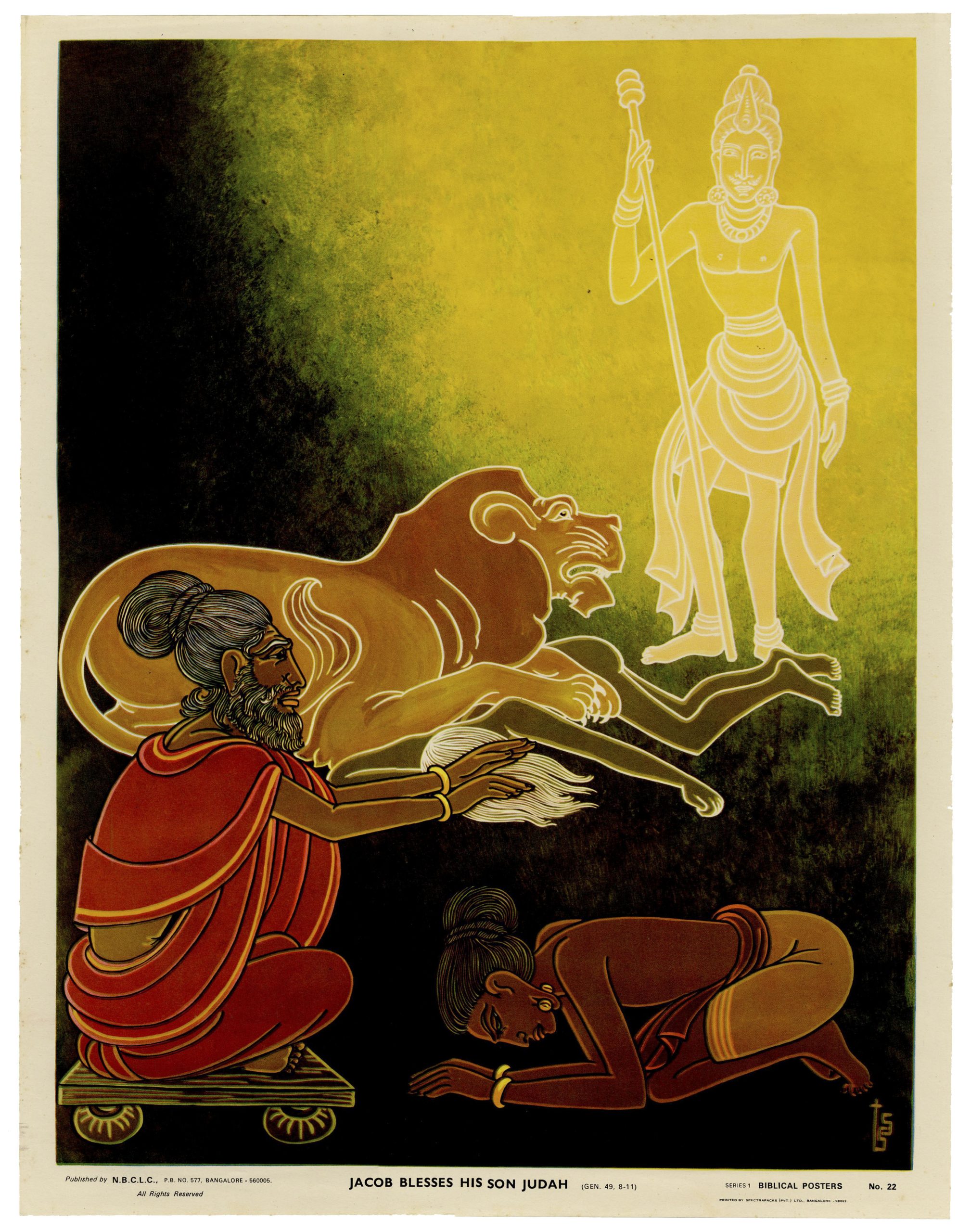
The Hebrew and Greek that is translated as “scepter” in English is translated in the HausaCommon Language Bible as “stick of ruling” (source: Andy Warren-Rothlin) and in Cherokee as “walking stick of chief” (source: Bender / Belt 2025, p. 17).
The name that is transliterated as “Judah” or “Judea” in English (referring to the son of Jacob, the tribe, and the territory) is translated in Spanish Sign Language as “lion” (referring to Genesis 49:9 and Revelation 5:5). This sign for lion is reserved for regions and kingdoms. (Source: John Elwode in The Bible Translator 2008, p. 78ff. and Steve Parkhurst)
Following are a number of back-translations as well as a sample translation for translators of Genesis 49:10:
Kankanaey: “The descendants of Juda will take-one-another’s-places to rule until one takes-the-place who is worthy to receive the taxes of the nations and they will obey him.” (Source: Kankanaey Back Translation)
Newari: “The scepter will always be in the hand of Judah, his descendants will always reign. The nations will bring gifts to him, and they will come and pay reverence to him.” (Source: Newari Back Translation)
Hiligaynon: “You (sing.) will-continue to rule, Juda. The rulers will-come-from your (sing.) descendants. So the nations will-give taxes to you (sing.) and they will-obey you (sing.).” (Source: Hiligaynon Back Translation)
English: “There will always be a ruler from the descendants of Judah. Each one will hold a scepter/staff to show that he has authority as a king. He will do that until the one to whom the scepter belongs comes, the one to whom the nations will bring tribute and show that they will obey him.” (Source: Translation for Translators)
Verses 10-12 are in the form of a promise made to Judah. Verse 10, particularly the second half, is one of the most difficult and disputed verses in the Old Testament.
The scepter shall not depart from Judah: the first two lines are parallel in meaning. Scepter translates a word meaning “rod” or “staff.” In the present context this object seems to be a symbol of authority. The question is, Whose authority? Some understand it to refer to a king’s authority, as in Psa 45.6. However, the matching word in the following line rendered staff by Revised Standard Version is not found elsewhere in connection with the office of a king. In Judges 5.14 these two words are in parallel, meaning military leaders, or, as Good News Translation says, “commanders” and “officers.” Judah is probably pictured either as a king or as a military commander holding his standard, that is, his flag or banner.
Replacing the images of scepter and staff with other images that function in the same way, we may say, for example, “No one will take away the commander’s flag from Judah,” or “The commander’s flag will remain in Judah’s hands.” If it is necessary to drop the symbol of the scepter, we may represent it by some such term as “power” or “authority” and say, for example, “No one will take away Judah’s power.”
Nor the ruler’s staff from between his feet: this line means the same as the first. When the king or commander stands or sits in war council, the base of his staff rests on the ground, that is, between his (your) feet. However, some understand feet as a metaphor for the sex organ, and therefore Good News Translation has “his descendants.” Bible en français courant translates “The ruler’s staff will remain in the hands of his offspring.”
Until he comes to whom it belongs: note that Revised Standard Version departs from the Hebrew text and follows some of the ancient versions. The Hebrew can be understood as “until Shiloh comes” or as “until he comes to Shiloh.” Anchor Bible objects to the first sense, in that Shiloh was a shrine located in the territory of Ephraim and not of Judah. He also rejects the second understanding on the basis of the grammar and its meaninglessness. He finds the Septuagint, one of the ancient targums (Onkelos), and some manuscripts of the Samaritan text to have understood Shiloh as shello, which means “what is his” or “what is due him,” giving it the general sense of “until he comes into his own.” More to the point, he finds Shiloh understood as shaylo “tribute to him” by medieval Jewish interpreters following an old midrashic (rabbinic) interpretation. If this is accepted, it allows the parallelism to be complete with “tribute is brought to him … homage is his.” The Good News Translation rendering fills out this interpretation with “Nations will bring him tribute and bow in obedience before him.” “Tribute” refers to a payment, tax, or gifts that a subject people are required to pay to their conquerors or overlords. Hebrew Old Testament Text Project, which rates the Hebrew as {A}, prefers “Shiloh comes” and comments that “Shiloh is the name of a son of Judah.” However, as it goes on to admit, the name of Judah’s son is everywhere spelled “Shelah” and not “Shiloh.”
Interpreters and translators are agreed that no final solution to this problem has emerged. In light of the difficulties there is considerable room for variation. The Handbook recommends Good News Translation as a possible model. Translators who are using “you” instead of “he” will need to make adjustments.
And to him shall be the obedience of the peoples: him refers to Judah, and obedience of the peoples means the peoples as “nations” (Good News Translation) will obey him.
Quoted with permission from Reyburn, William D. and Fry, Euan McG. A Handbook on Genesis. (UBS Helps for Translators). New York: UBS, 1997. For this and other handbooks for translators see here .

Leave a Reply
You must be logged in to post a comment.