2She came to Jerusalem with a very great retinue, with camels bearing spices and very much gold and precious stones, and when she came to Solomon, she told him all that was on her mind.
The Hebrew word bosem, which is often rendered “balm” (derived from “balsam”), can refer to any type of aromatic healing substance, but it also designates the product of a particular tree, the balsam or opobalsamum Commiphora gileadensis. Arabs call it balasam or balasham. In the Talmud it is called afarsimon. Excavations near En Gedi have uncovered an ancient processing plant for balsam oil.
The opobalsamum tree likes a desert or semi-desert climate. It grows to 2‑3 meters (7‑10 feet) tall and has small, wrinkled, three-part leaves, white flowers, and pea-sized red berries that have a fragrant yellow seed inside. The bark of younger branches is gray, turning brown with age. The resin appears by itself in green droplets from the stems and branches, but collectors also make cuts in the branches to speed the process. The droplets turn from green to brown, clump together, and fall to the ground, where they are collected.
In Bible times, balsam oil was used in holy anointing oil, as medicine, and as an ingredient of perfume.
A generic word or phrase for sweet-smelling substances is appropriate to render bosem, although where a specific name for the balsam tree is available, as in southwestern Arabia and Somalia, this could also be used. At least one hundred species of the genus Commiphora are spread throughout dry areas of the world. Translators in some areas will know the plants; others may know only the dried resin of Commiphora sold in spice markets.
The name that is transliterated as “Jerusalem” in English is signed in French Sign Language with a sign that depicts worshiping at the Western Wall in Jerusalem:
While a similar sign is also used in British Sign Language, another, more neutral sign that combines the sign “J” and the signs for “place” is used as well. (Source: Anna Smith)
“Jerusalem” in British Sign Language (source: Christian BSL, used with permission)
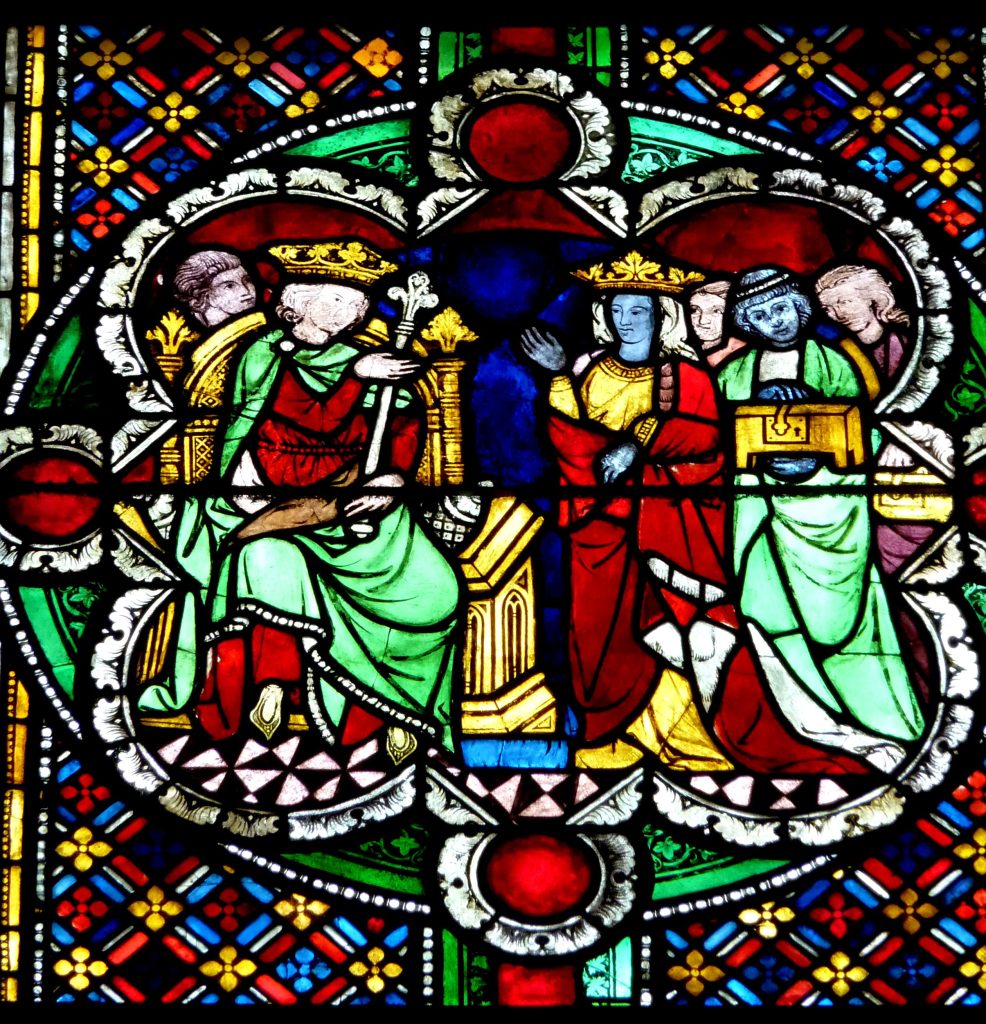
The following is a stained glass window from the Three choir windows in the Marienkirche, Frankfurt (Oder), Germany, of the 14th century, depicting Solomon and the Queen of Sheba:
Source: Der gläserne Schatz: Die Bilderbibel der St. Marienkirche in Frankfurt (Oder), Neuer Berlin Verlag, 2005, copyright for this image: Brandenburgisches Landesamt für Denkmalpflege und Archäologisches Landesmuseum
Stained glass is not just highly decorative, it’s a medium which has been used to express important religious messages for centuries. Literacy was not widespread in the medieval and Renaissance periods and the Church used stained glass and other artworks to teach the central beliefs of Christianity. In Gothic churches, the windows were filled with extensive narrative scenes in stained glass — like huge and colorful picture storybooks — in which worshipers could ‘read’ the stories of Christ and the saints and learn what was required for their religious salvation. (Source: Victoria and Albert Museum )
Stained glass is not just highly decorative, it’s a medium which has been used to express important religious messages for centuries. Literacy was not widespread in the medieval and Renaissance periods and the Church used stained glass and other artworks to teach the central beliefs of Christianity. In Gothic churches, the windows were filled with extensive narrative scenes in stained glass — like huge and colorful picture storybooks — in which worshipers could ‘read’ the stories of Christ and the saints and learn what was required for their religious salvation. (Source: Victoria and Albert Museum )
The Hebrew, Latin and Greek that is translated in English as “camel” is translated in Muna as “water buffalo.” René van den Berg explains: “Camels are unknown; the biggest known animal is the water buffalo (though now rare on Muna).”
In Bislama is is translated as buluk: “cow” / “bull” (source: Ross McKerras) and in Bahnar as aseh lăk-đa which is a combination of the Vietnamese loan word for “camel” (lăk-đa) and the Bahnar term for “horse” (aseh) to communicate that the camel is a beast of burden (source: Pham Xuan Tin in The Bible Translator 1952, p. 20ff. ).
In the 1900 Kalaallisut (Greenlandic) translation (a newer version was published in 2000) it was translated as ĸatigagtôĸ or “big-backed ones.” “Katigagtôĸ (modern qatigattooq), which has the literal meaning of ‘something with a big back.’ It comprises the noun ĸatigak (modern qatigak) ‘back’ combined with the suffix –tôĸ (modern –tooq) ‘something possessing a big X.’” (Source: Lily Kahn & Riitta-Liisa Valijärvi in The Bible Translator 2019, p. 125ff.)
In Luke 18:25, Mark 10:25, and Matthew 19:24 some versions of the Peshitta translation in Syriac Aramaic (Classical Syriac) show an ambiguity between the very similar words for “camel” and “rope.” Some translations of the Peshitta, therefore, use the “rope” interpretation, including the Classical Armenian Bible (մալխոյ for “rope”), the English translation by George Lamsa (publ. 1933) (It is easier for a rope to go through the eye of a needle), or the Dutch translation by Egbert Nierop (publ. 2020) (het voor een kabel eenvoudiger is het oog van een naald binnen te gaan).
In the above-mentioned three verses, it is translated in Noongar as “kangaroo” (source: Warda-Kwabba Luke-Ang).
There were two types of camel known in Bible times the most common being the Arabian Dromedary camelus dromedarius, which was indigenous to the area. The two-humped Bactrian Camel camelus bactrianus was also known and prized, but it was imported from Central Asia.
Camels belong to the same family as the South American llama, vicuna, alpaca, and guanaco, but camels are much larger and have a big fatty hump on their backs. Bactrian camels may reach a height of about two meters (6.5 feet), while dromedaries are even bigger. Dromedaries are a uniform light fawn color, while Bactrian camels are darker, especially in winter when they grow longer fur.
Camels do not have hooves but a large footpad with two broad toes ideally suited to walking on sand. In other ways too they are ideally suited to life in desert areas. They store excess food in their humps and this makes it possible for them to go a long time without eating. Special blood cells also enable them to go without water for long periods. They also have a very efficient digestive system and can extract the maximum amount of nutrition from apparently dry vegetation. This adaptation to harsh environments means that camels can make long journeys through dry areas which would be beyond the abilities of other types of pack animal such as donkeys. Camels were used for riding and for carrying heavy loads. They were also used to pull carts.
In winter the fur of camels thickens and grows longer and then when summer comes they shed their winter fur in large wads. These wads of camel hair are collected and twisted into cords and ropes or spun into thread which is then used for weaving coarse cloth. This cloth was usually used for making tents but it was sometimes used for making outer robes.
Camels’ milk was used as food and drink but their meat was considered unclean by the Israelites.
In spite of the fact that camels were considered to be unclean for food they were a symbol of wealth and commerce. People or nations with many camels were automatically viewed as commercially successful and wealthy as the possession of camels opened up the possibility of transporting goods long distances and engaging in trade.
In areas where camels are not known, the word is often transliterated from Hebrew or the dominant language of the area. However, in some languages descriptive names have been invented. In some South American languages names meaning “hump-backed llama” or “big alpaca with a hump” have been used. Elsewhere expressions such as “hump-backed horse” have been used. A fuller description should usually be included in a glossary or word list.
Following are a number of back-translations as well as a sample translation for translators of 1 Kings 10:2:
Kupsabiny: “Then, that woman reached Jerusalem with a delegation of people and camels which were carrying sweet smelling things, stones which cost a lot of money and a lot of gold. And when she had met with Solomon, she asked him all that matters/questions she had.” (Source: Kupsabiny Back Translation)
Newari: “She came and with her a crowd of attendants [lit.: service-giving people] along with camels loaded with spices, much gold and valuable precious stones. She met Solomon and put before him the questions she had on her heart.” (Source: Newari Back Translation)
Hiligaynon: “She arrived in Jerusalem accompanied with many men, and she brought camels loaded with gifts which-are spices, gold which-are very many, and precious/[lit. expensive] stones. When she met with Solomon, she asked him everything that she wanted to ask-for.” (Source: Hiligaynon Back Translation)
English: “She came with a large group of wealthy/influential people, and she brought camels that were loaded with spices, and valuable gems, and a lot of gold. When she met Solomon, she asked him questions about all the topics/things in which she was interested.” (Source: Translation for Translators)
With a very great retinue: Retinue translates a Hebrew noun that has a range of meanings, including “power,” “wealth,” “landowner,” “army,” and “upper class [of a city].” In this context most interpreters understand it as referring to the persons who accompany the queen, so it has been rendered as “retinue” (Revised Standard Version, New Revised Standard Version, Revised English Bible), “group of attendants” (Good News Translation, New Living Translation), “caravan” (New International Version), and “armed guard” (De Vries). Osty-Trinquet, however, sees the focus on the wealth itself and not on the persons bringing the gifts. For the whole phrase here he has “with immense riches.”
In some languages camels are completely unknown. One suggestion is to say “hump-backed horse.” Another possibility is transliterate the Hebrew word gamal for camel or the word used in a major language. It can be explained more fully in the glossary.
Spices translates a Hebrew noun meaning “balsam oil,” but it is to be taken here in the more general sense of various sweet-smelling objects. These spices were expensive because they were imported (2 Kgs 20.13). They were ground up and mixed with oil and used as perfumes, incense, or embalming substances. They were not used for cooking.
Very much gold: According to verse 10, the amount of gold was one hundred and twenty talents.
Precious stones: See the comments on this same phrase in 1 Kgs 5.17, where Revised Standard Version translates it “costly stones.” The stones in 5.17 were used for building the Temple, but here the reference is to “precious gems” (De Vries).
The text implies that the various items brought by the queen of Sheba were to be given as gifts to Solomon. This information comes in verse 10. It seems reasonable, however, to make this explicit in the receptor language if there is any danger that readers may think that she has some other purpose in mind. Contemporary English Version adds the word “gifts” to make this clear.
She told him all that was on her mind: This nearly literal translation of the Hebrew in Revised Standard Version may suggest the wrong meaning. In contemporary American English, when you “tell someone what is on your mind,” it means to tell someone what is bothering you or what your concerns are. Mind translates the Hebrew noun for “heart” (see the comments on this noun in 1 Kgs 3.9). Good News Translation renders this clause as “she asked him all the questions that she could think of,” and New American Bible says “[she] questioned him on every subject in which she was interested.” Knox translates this expression as “she told him all the thoughts that exercised her mind.”
Quoted with permission from Omanson, Roger L. and Ellington, John E. A Handbook on 1-2 Kings, Volume 1. (UBS Helps for Translators). New York: UBS, 2008. For this and other handbooks for translators see here .





Leave a Reply
You must be logged in to post a comment.