kos / little owl

Owls are found worldwide except in the Antarctic and on some islands. They are active at night and are characterized by flat faces and short hooked beaks that they can open very wide. They swallow their prey whole and later regurgitate the undigested parts as small balls. They also have the ability to turn their heads more than 180 degrees.

There are two basic owl families, both of which are found in the land of Israel. One family is the Tytonidae, which are the Barn and Grass Owls. They have heart-shaped whitish faces, usually outlined by a dark line, and small dark eyes. The other family is the Strigidae, the typical owls. This family contains a large variety of species, all of which have large eyes that may vary in color from light brown through orange to yellow. This family includes the eared or horned owls, the fairly rare fishing owls, and owls that vary in size from the midget scops owl (less than 20 centimeters [8 inches]) through to the giant eagle owl (over 70 centimeters [28 inches]).

Eight species of owl are fairly common in the land of Israel. Most are very seldom seen by humans, but they are quite well known by their different and distinct calls. In biblical times the nights would have been much quieter than in most modern places, and the strange night sounds probably would have interested people, causing some speculation about what was making the sound. The different owls would thus probably have had different names even if people had never seen them. In fact it is unlikely that they would have been able to associate most of the calls with the owls that were seen.

Traditionally kos has been translated as “little owl”, and this is the meaning in modern Hebrew. The case for this translation is probably the strongest, even though not conclusive. If we accept this identification, the lists of unclean birds has a rather neat structure with this the smallest of the owls being paired with nets, the smallest of the birds of prey.

The Little Owl Athene noctua is, as its name suggests, a small owl, which feeds at night mainly on insects and nestlings. It is about 25 centimeters (10 inches) in length and has a short tail. It does not have ear tufts. It nests in holes in banks or termite hills. It is often seen in the daytime, usually being chased by a group of small birds.

It is listed as an unclean bird.

The little owl is found in southeastern Europe, the Middle East, and northeast Africa. Elsewhere one may use the name of a small species of owl or the phrase “little owl”.

Little owl, Wikimedia Commons

Source: All Creatures Great and Small: Living things in the Bible (UBS Helps for Translators)

camel

The Hebrew, Latin and Greek that is translated in English as “camel” is translated in Muna as “water buffalo.” René van den Berg explains: “Camels are unknown; the biggest known animal is the water buffalo (though now rare on Muna).”

In Bislama is is translated as buluk: “cow” / “bull” (source: Ross McKerras) and in Bahnar as aseh lăk-đa which is a combination of the Vietnamese loan word for “camel” (lăk-đa) and the Bahnar term for “horse” (aseh) to communicate that the camel is a beast of burden (source: Pham Xuan Tin in The Bible Translator 1952, p. 20ff. ).

In the 1900 Kalaallisut (Greenlandic) translation (a newer version was published in 2000) it was translated as ĸatigagtôĸ or “big-backed ones.” “Katigagtôĸ (modern qatigattooq), which has the literal meaning of ‘something with a big back.’ It comprises the noun ĸatigak (modern qatigak) ‘back’ combined with the suffix –tôĸ (modern –tooq) ‘something possessing a big X.’” (Source: Lily Kahn & Riitta-Liisa Valijärvi in The Bible Translator 2019, p. 125ff.)

In Luke 18:25, Mark 10:25, and Matthew 19:24 some versions of the Peshitta translation in Syriac Aramaic (Classical Syriac) show an ambiguity between the very similar words for “camel” and “rope.” Some translations of the Peshitta, therefore, use the “rope” interpretation, including the Classical Armenian Bible (մալխոյ for “rope”), the English translation by George Lamsa (publ. 1933) (It is easier for a rope to go through the eye of a needle), or the Dutch translation by Egbert Nierop (publ. 2020) (het voor een kabel eenvoudiger is het oog van een naald binnen te gaan).

In the above-mentioned three verses, it is translated in Noongar as “kangaroo” (source: Warda-Kwabba Luke-Ang).


There were two types of camel known in Bible times the most common being the Arabian Dromedary camelus dromedarius, which was indigenous to the area. The two-humped Bactrian Camel camelus bactrianus was also known and prized, but it was imported from Central Asia.

Camels belong to the same family as the South American llama, vicuna, alpaca, and guanaco, but camels are much larger and have a big fatty hump on their backs. Bactrian camels may reach a height of about two meters (6.5 feet), while dromedaries are even bigger. Dromedaries are a uniform light fawn color, while Bactrian camels are darker, especially in winter when they grow longer fur.

Camels do not have hooves but a large footpad with two broad toes ideally suited to walking on sand. In other ways too they are ideally suited to life in desert areas. They store excess food in their humps and this makes it possible for them to go a long time without eating. Special blood cells also enable them to go without water for long periods. They also have a very efficient digestive system and can extract the maximum amount of nutrition from apparently dry vegetation. This adaptation to harsh environments means that camels can make long journeys through dry areas which would be beyond the abilities of other types of pack animal such as donkeys. Camels were used for riding and for carrying heavy loads. They were also used to pull carts.

In winter the fur of camels thickens and grows longer and then when summer comes they shed their winter fur in large wads. These wads of camel hair are collected and twisted into cords and ropes or spun into thread which is then used for weaving coarse cloth. This cloth was usually used for making tents but it was sometimes used for making outer robes.

Camels’ milk was used as food and drink but their meat was considered unclean by the Israelites.

In spite of the fact that camels were considered to be unclean for food they were a symbol of wealth and commerce. People or nations with many camels were automatically viewed as commercially successful and wealthy as the possession of camels opened up the possibility of transporting goods long distances and engaging in trade.

In areas where camels are not known, the word is often transliterated from Hebrew or the dominant language of the area. However, in some languages descriptive names have been invented. In some South American languages names meaning “hump-backed llama” or “big alpaca with a hump” have been used. Elsewhere expressions such as “hump-backed horse” have been used. A fuller description should usually be included in a glossary or word list.

Source: All Creatures Great and Small: Living things in the Bible (UBS Helps for Translators)

For information on the domestication of camels, see Early camel incidents in the Hebrew Bible .

Click or tap here to see a short video clip about camels (source: Bible Lands 2012)

chicken / rooster / chick

There is considerable doubt about the meaning of the word sekwi. However, the rendering “cock” or “rooster” has support from the Vulgate and one of the Targums, as well as the majority of commentaries. In the context of Job 38:36 the reference seems to be to the way in which the ibis is able to announce the flooding of the Nile, and the rooster is able to announce the coming of the dawn. Both of these abilities are mentioned quite often in Egyptian literature.

The word zarzir is probably related to a word meaning “narrow waisted,” but most commentaries and translations interpret this as a reference to the rooster.

The Greek word ornis and the Latin word gallina mean “hen,” and the Greek words nossia and nossion mean “chick,” that is, a baby fowl.

All modern domestic fowls are descended from the jungle fowl of India, Southeast Asia, and China. These were domesticated very early in the history of that region, almost as soon as the farming of rice and other grains began. According to the Talmud, it was forbidden to keep domestic poultry in Jerusalem, but there is evidence from ancient Hebrew seals that chickens were known in the land as early as 600 B.C. The reference to the cock crowing on the night of the crucifixion would indicate that chickens were kept near, if not in, Jerusalem.

Ancient domestic fowls would still have looked very much like the Jungle Fowl Gallus gallus from which they were descended. Jungle fowl roosters are dark, brownish red, with orange-red neck hackles, a smallish red comb on the top of their heads, and red lappets on each side under the beak. They have a white spot on their backs near the base of their long glossy black and green tails. The hens are a lighter brownish red, have no white spot or long tail, and have a smaller comb on their heads.

Domestic fowl had connotations of fertility to the Egyptians and Persians. This seems to have been adopted later in Judaism, since it became the practice to carry a cock and a hen in front of the bride and groom at a wedding. However, their significance in the Bible seems related to the fact that cocks crow very early in the morning, thus announcing the coming dawn before humans are aware of it.

Domestic fowl have now spread around the world and are well-known, apart from some areas of the tundra region.

The words sekwi, zarzir, alektruōn, and alektōr are probably best translated as “rooster,” ornis as “hen,” and nossion and nossia as “chickens.” In some languages where roosters and hens are not normally differentiated, it may not be necessary to do so in the gospel passages, since the verb “crow” will usually be sufficient context to make the meaning clear. However, in the Job and Proverbs passages it may still be necessary in some languages to say something like “male chicken.”

Source: All Creatures Great and Small: Living things in the Bible (UBS Helps for Translators)

See also rooster.

lilith / scops owl

Owls are found worldwide except in the Antarctic and on some islands. They are active at night and are characterized by flat faces and short hooked beaks that they can open very wide. They swallow their prey whole and later regurgitate the undigested parts as small balls. They also have the ability to turn their heads more than 180 degrees.

There are two basic owl families, both of which are found in the land of Israel. One family is the Tytonidae, which are the Barn and Grass Owls. They have heart-shaped whitish faces, usually outlined by a dark line, and small dark eyes. The other family is the Strigidae, the typical owls. This family contains a large variety of species, all of which have large eyes that may vary in color from light brown through orange to yellow. This family includes the eared or horned owls, the fairly rare fishing owls, and owls that vary in size from the midget scops owl (less than 20 centimeters [8 inches]) through to the giant eagle owl (over 70 centimeters [28 inches]).

Eight species of owl are fairly common in the land of Israel. Most are very seldom seen by humans, but they are quite well known by their different and distinct calls. In biblical times the nights would have been much quieter than in most modern places, and the strange night sounds probably would have interested people, causing some speculation about what was making the sound. The different owls would thus probably have had different names even if people had never seen them. In fact it is unlikely that they would have been able to associate most of the calls with the owls that were seen.

Some commentators associate the word lilith with a female demon referred to in Babylonian legends. However, even if this is accepted, it is likely that this demon was also associated with some type of night bird. In many Middle Eastern cultures, demons and monsters have been identified with owls, probably as the result of their strange sounds at night.

In modern Hebrew lilith is the name of the tawny owl. Some Bedouin say that the trilled call of another owl, the Scops Owl Otus scops (one of the most common owls in Israel), is the hooting of a female demon quietly rejoicing that she has found prey. The root of this name is similar to the Hebrew word for “night” but is actually a Babylonian word. It is also similar to the way some modern Palestinians describe the sound of hooting.

The scops owl is a tiny eared owl that is a mottled gray in color. By day it perches close to the trunk of a tree, where its mottled coloring blends in with the tree bark, making the owl look like the stump of a broken branch. It has a soft, trilled call.

It is associated with doom, destruction, and demons.

An expression, such as “owl demon” or “owl witch”, is probably the best solution. In sub-Saharan Africa, where the scops owl is well known, the local name plus a word for demon or witch can be used.

Scops owl, Wikimedia Commons

Source: All Creatures Great and Small: Living things in the Bible (UBS Helps for Translators)

cormorant

Although the translation of shalak as “cormorant” has a tradition going back to the seventeenth century, there has always been considerable doubt about this translation. For one thing, the root of the word shalak means “to throw or hurl”, which would indicate that the bird with this name “throws” itself down onto its prey, something cormorants do not do. They swim low in the water and dive underwater to hunt their prey. This led the late G. R. Driver to suggest the translation “fisher owl”. However, there are problems with this suggestion too. The fisher owl, or more correctly, the Brown Fish Owl Scotopelia ceylonensis, is not likely to have been a bird that was well known, and its fishing habits would only have been seen by fishermen on moonlit nights, and that very rarely. The Israelites were not yet a fishing people in the period of the Exodus.

In modern Hebrew shalak is the name given to the Osprey Pandion haliaetus, which is a type of fishing eagle that plunges into the water from a height and catches fish in its claws. Some Israeli scholars have suggested that it may have been the ancient name for the Smyrna Kingfisher Halcyon smyrnensis, or the Gannet Sula bassana, both of which drop down from a height onto their prey, which they catch underwater in their beaks.

Since there is so much doubt about the identification of this bird, the translation “osprey” seems to have as much, if not more, justification than “cormorant”.

The White-necked Cormorant Phala-crocorax carbo, which is the most common type of cormorant in the Middle East, is a large bird with a long slim body and a long beak that is hooked at the tip. The adults are black all over with a small yellow pouch where the throat meets the beak. They also have yellow skin on their faces. This type of cormorant is found along the sea and lake coasts, along the larger rivers, and in swampy areas. It has webbed feet like a duck and swims in the water, but with most of the body under the water. It dives and can swim quite a long way underwater hunting fish.

Like all cormorants its feathers are not waterproof, and this enables it to swim underwater easily. However, it also means that after diving or swimming for a while, a cormorant has to come out of the water to dry out its wings. Thus cormorants can often be seen perched on logs or rocks, with their wings spread out to dry.

During the daytime they can usually be found in small groups of four or five, but in the evening when they roost in trees they come together in large numbers and are very noisy. In seasons when large shoals of small fish swim near the surface, large numbers of black cormorants can often be seen flying fast and low above the water in long lines one behind the other, searching for such a shoal. When they find it, they all land on the water together and feed in great excitement.

Apart from the fact that the shalak is found in the lists of unclean birds, it has no other significance in the Bible.

If the translator chooses to identify shalak as “cormorant”, it should not be difficult to find some species of cormorant locally, since cormorants are found all over the world near large bodies of water. The white-necked cormorant is in fact found not only in Israel but also near the coasts, lake shores, large rivers, and swamps throughout Europe, Asia, Australasia, Africa, and the eastern half of North America. In southern Africa a slightly different form of the white-necked cormorant is found, called the white-breasted cormorant. It has a white breast and throat and a smaller throat pouch, but has the same scientific name. Elsewhere there will be local species of cormorant, which can be identified by the habit of perching with wings spread out to dry.

White-breasted cormorant, Wikimedia Commons

Source: All Creatures Great and Small: Living things in the Bible (UBS Helps for Translators)

tinshemeth / barn owl

Owls are found worldwide except in the Antarctic and on some islands. They are active at night and are characterized by flat faces and short hooked beaks that they can open very wide. They swallow their prey whole and later regurgitate the undigested parts as small balls. They also have the ability to turn their heads more than 180 degrees.

There are two basic owl families, both of which are found in the land of Israel. One family is the Tytonidae, which are the Barn and Grass Owls. They have heart-shaped whitish faces, usually outlined by a dark line, and small dark eyes. The other family is the Strigidae, the typical owls. This family contains a large variety of species, all of which have large eyes that may vary in color from light brown through orange to yellow. This family includes the eared or horned owls, the fairly rare fishing owls, and owls that vary in size from the midget scops owl (less than 20 centimeters [8 inches]) through to the giant eagle owl (over 70 centimeters [28 inches]).

Eight species of owl are fairly common in the land of Israel. Most are very seldom seen by humans, but they are quite well known by their different and distinct calls. In biblical times the nights would have been much quieter than in most modern places, and the strange night sounds probably would have interested people, causing some speculation about what was making the sound. The different owls would thus probably have had different names even if people had never seen them. In fact it is unlikely that they would have been able to associate most of the calls with the owls that were seen.

The terms “barn owl,” “screech owl,” and “white owl” are alternative names for the same owl. There is a long tradition among both Jewish and Christian scholars of translating tinshemeth as “barn owl”. New English Bible and Revised English Bible follow Driver’s suggestion “little owl”, but this does not have as wide support among scholars as “barn owl,” which is also the modern Hebrew meaning of tinshemeth. The New Revised Standard Version, updated edition rendering of “water hen” can be disregarded since it’s too vague a term to be useful.

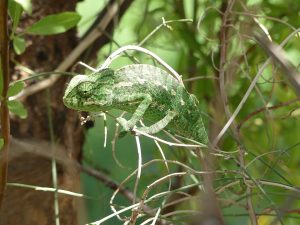
The word tinshemeth actually occurs three times in the Bible. Twice the word probably refers to the barn owl, but the third occurrence is a reference to a type of lizard or chameleon.

The Barn Owl Tyto alba is one of the most widely distributed owls in the world, being common virtually everywhere but the Arctic and Antarctic regions and remote islands. It is a very pale color, light fawn or gray on the wings and back, and almost white on the chest and under the wings. It has small eyes, a large head for its size, and a very striking heart-shaped white facial disk outlined in brown. This facial disk consists of short bristle-like feathers that help the owl to sense very small sounds. Barn owls often roost in barns, deserted houses, caves, and tombs. They utter a variety of strange sounds, varying from the well-known drawn-out trembling screech, to various hissing, chirruping, and snoring sounds. The females are larger and more vocal than the males. These owls live mainly on rats, mice, and other small nocturnal creatures.

It is listed as an unclean bird and was associated with tombs and death.

This is one owl for which finding a local equivalent should not present any major problem. Failing all else, the phrase “white-faced owl” can be used, although strictly speaking, there is another smaller owl, not closely related to the barn owl, that has this English name.

Barn owl, Wikimedia Commons

Source: All Creatures Great and Small: Living things in the Bible (UBS Helps for Translators)

ibex / wild goat / mountain goat

The wild goat found in the land of Israel is the Nubian Ibex Capra ibex nubiana. It has existed in the mountains of this region from time immemorial and until fairly recently it was a very common animal. It was and to some degree still is found in the mountainous parts of Israel the Sinai Peninsula Arabia and Egypt. A closely related species Capra walie is found in Ethiopia and Eritrea.

However the ibex is the only type of wild goat now found in Israel. One other type once lived there but disappeared in the Stone Age long before the time of Abraham. Both ya‘el and ’aqo are the Hebrew names for this animal. Thus versions which include two types of wild goat in the list of clean animals in Deuteronomy 14:5 are probably not correct.

The Nubian ibex is a fairly large wild goat, with adults being about ninety centimeters (3 feet) high at the shoulder. It is a grayish color for most of the year but turns browner in winter. Males have thick long horns over 130 centimeters (4 feet) in length which curve backwards in a semicircle. The horns of the females are much slimmer and shorter, reaching a length of only about 40 centimeters (15 inches). Only the last few centimeters of the horns are smooth, the rest being ringed with ridges. These ibexes live in small herds in the mountains and prefer cliffs and crags, where they live off the bushes that grow on the ledges. Ibex meat is moister and more tender than that of gazelle or deer, and they have been a favorite game animal for many centuries.

The “Wild Goat Rocks” mentioned in 1 Samuel 24:2 is probably the rocky area around the pools and streams of Nahal Arugot near En Gedi. The area has been declared a nature reserve, and the ibexes and other indigenous animals are protected there. The name En Gedi itself, which means “Oasis of the Kid” or “Spring of the Kid”, probably refers to a young ibex.

The ibex is closely associated with remote high mountains and in both Hebrew and Arabic culture it became viewed as the most remote of all animals (compare Job 39:1). This is probably the reason why so many English translations render ya‘el as “mountain goat”. Although not referred to in the Bible ibexes are also known for their surefootedness on rocky ledges.

However to both of the above-mentioned cultures the female ibex was a symbol of grace and beauty grace being associated with the perfect balance with which ibexes stand walk and jump on the cliff faces and beauty probably being associated with their large human-like eyes. In English and many other cultures this poses a problem in Proverbs 5:19, because in these cultures goats are not positive symbols of beauty. In some Tibeto-Burman cultures the wild serow goat is viewed as the ugliest of all animals. In these languages to refer to a woman as a “wild goat” would be an insult. This is the reason why the English versions have “doe” rather than “wild goat”.

In sub-Saharan Africa there are no true wild goats. The closest equivalent animal is a small cliff-dwelling antelope, the Klipspringer Oreotragus oreotragus. The local name of this common, well-known animal has been used to translate ya‘el and ’aqo in many African translations.

In the remaining countries where no indigenous wild goats are found, or where specific words for such do not exist, a phrase equivalent to wild goat or wild mountain goat is usually used. The latter expression is probably the better choice, because in West Africa particularly bush goat is the word for the duiker, a small antelope not associated with mountains.

Proverbs 5:19: This verse occurs in the middle of a series of proverbs dealing with the value of sexual restraint and faithfulness within marriage. The writer/editor exhorts his readers to find sexual fulfillment with their wives alone. A wife is then referred to as “a lovable [or attractive] deer, a graceful ibex.”
As mentioned above in the Discussion: subsection of this section, there are many cultures in which to call a woman a “wild goat” would be an insult rather than a compliment. Where this is the case, a more suitable animal metaphor should be found which denotes gracefulness and can function as the parallel expression for “deer”.
Deuteronomy 14:4,5: The use of two words for wild goat in this list of clean animals should be avoided. However, it is advisable to translate ’aqo (that is, the seventh name in the list) as “ibex” or “wild goat.”

Nubian Ibex, Wikimedia Commons

Source: All Creatures Great and Small: Living things in the Bible (UBS Helps for Translators)

hornet / wasp

There is little doubt among scholars that the Hebrew and Greek words refer to both hornets and wasps.

Hornets and wasps are closely related species, with the hornets being larger than the wasps. Like bees they both belong to the zoological order Hymenoptera, which means that they have stiff, transparent, membrane-like wings. The hornets are usually black or brown; some species have yellow bands. Wasps are often greenish and may also have yellow or light green bands. The larger hornets can be 30-40 millimeters (1-1.5 inches) long.
Both hornets and wasps are characterized by having a long narrow waist between the thorax (chest) and the abdomen (stomach). All have a sting that, because of their large size, can be very painful, even dangerous. Unlike bees, hornets and wasps do not have a detachable sting and can sting repeatedly. They feed on insects, caterpillars, and spiders, and many types sting their prey and then deposit the paralyzed but still living insect or spider near the hornet’s eggs, as a readily available source of food for the larvae when they hatch from the eggs. Some species actually lay their eggs on the paralyzed victim.

One of the most dangerous varieties is the Oriental Black Ground Hornet Vespa orientalis, which establishes large underground nests. They are large shiny black hornets, and when their nest is disturbed they emerge in numbers and attack any animal or person nearby. They are very sensitive to vibration, and a single animal or person walking nearby is enough to arouse them. Once they begin to sting, the smell of the sting arouses them even further, and they may remain in this angry state for hours, with each fresh sting stimulating their ferocity afresh. Some of their victims may end up paralyzed or may even die.

Black ground hornets are found across tropical Africa, through the Middle East, and across Asia to eastern China. In many of these countries known black ground hornet nest sites are marked in some way, such as with a sharpened stick pointing to the nest, as a warning to passersby.

It is little wonder that hornets are a symbol in the Bible for a dangerous enemy or an attacking army.

Although hornets or wasps are found in most warm countries, some large dangerous-looking hornets are relatively harmless. For instance, the black house hornet found all over Africa does not live in swarms but on its own. It makes mud nests on walls or under a roof. It is large and has a sting, but it is not aggressive and very seldom stings any person or animal. Thus care should be taken by translators to choose the name of a hornet that both lives in swarms and is dangerous. In cases where all local hornets or wasps are relatively harmless, a descriptive phrase meaning “warrior hornet”, “war hornet”, “army hornet”, “death hornet” or something similar can be used.

Source: All Creatures Great and Small: Living things in the Bible (UBS Helps for Translators)