
Owls are found worldwide except in the Antarctic and on some islands. They are active at night and are characterized by flat faces and short hooked beaks that they can open very wide. They swallow their prey whole and later regurgitate the undigested parts as small balls. They also have the ability to turn their heads more than 180 degrees.
There are two basic owl families, both of which are found in the land of Israel. One family is the Tytonidae, which are the Barn and Grass Owls. They have heart-shaped whitish faces, usually outlined by a dark line, and small dark eyes. The other family is the Strigidae, the typical owls. This family contains a large variety of species, all of which have large eyes that may vary in color from light brown through orange to yellow. This family includes the eared or horned owls, the fairly rare fishing owls, and owls that vary in size from the midget scops owl (less than 20 centimeters [8 inches]) through to the giant eagle owl (over 70 centimeters [28 inches]).
Eight species of owl are fairly common in the land of Israel. Most are very seldom seen by humans, but they are quite well known by their different and distinct calls. In biblical times the nights would have been much quieter than in most modern places, and the strange night sounds probably would have interested people, causing some speculation about what was making the sound. The different owls would thus probably have had different names even if people had never seen them. In fact it is unlikely that they would have been able to associate most of the calls with the owls that were seen.
Traditionally kos has been translated as “little owl”, and this is the meaning in modern Hebrew. The case for this translation is probably the strongest, even though not conclusive. If we accept this identification, the lists of unclean birds has a rather neat structure with this the smallest of the owls being paired with nets, the smallest of the birds of prey.
The Little Owl Athene noctua is, as its name suggests, a small owl, which feeds at night mainly on insects and nestlings. It is about 25 centimeters (10 inches) in length and has a short tail. It does not have ear tufts. It nests in holes in banks or termite hills. It is often seen in the daytime, usually being chased by a group of small birds.
It is listed as an unclean bird.
The little owl is found in southeastern Europe, the Middle East, and northeast Africa. Elsewhere one may use the name of a small species of owl or the phrase “little owl”.
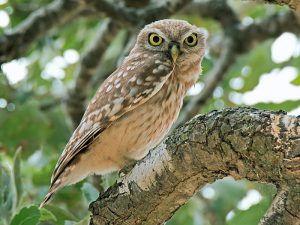

Source: All Creatures Great and Small: Living things in the Bible (UBS Helps for Translators)