“In each of these verses there are no less than four different words for locust: gazam, ‘arbeh, yeleq, and chasil. Most commentators accept that this refers to locusts in four different stages of development. These would presumably be the swarming adult locust, the resident adult locust, the wingless hopper, and the crawling nymph.
“The Good News Bible rendering ‘Swarm after swarm of locusts settled on the crops; what one swarm left, the next swarm devoured’ conveys the general idea, but is technically inaccurate in that not all the Hebrew words necessarily refer to swarming locusts. A more precise translation would be:
“What the swarming locusts left, the resident locusts ate;
What the resident locusts left, the young crawling locusts ate;
And what the young hopping locusts left, the young crawling locusts ate.” (Source: Hope 2003, p. 207)
Earlier English translations have tried to translate this verse by using different species:
That which the palmerworm hath left, the locust hath eaten: and that which the locust hath left, the bruchus hath eaten: and that which the bruchus hath left, the mildew hath destroyed. (Douay-Rheims)
That which the palmerworm hath left hath the locust eaten; and that which the locust hath left hath the cankerworm eaten; and that which the cankerworm hath left hath the caterpiller eaten. (King James Version)
“It is interesting to note that most of the [East African] translations examined give specific local names for the types of stages of locusts referred to in 1:4. (…) The East African region has for many years experienced the scourge of locust devastation of crops and vegetation. The locust is therefore well known in this region and local languages obviously reflect the people’s knowledge. (…) Because locusts are so well known, verse 1:4 is indeed more dynamic in these languages than in English, and probably reflects the poetic nature of the original which English may not.”
Lingala for instance uses the different species hamhinzo, makonko, makololo, makelele for the different locusts. (Source: Maleme Taam-Ambey in The Bible Translator 1985, p. 216)
The Greek in Luke 13:32 that is translated in virtually all English translations as “fox” presents an intriguing example of the complexity of translation and meaning across different cultures.
Edward Hope (2005, p. 64ff.) describes the occurrence of the fox and its meaning in the Bible as an inferior rather than crafty animal (see jackal / fox).
Due to a lack of understanding of the differences in the meaning of “fox” as a metaphor in Hebrew and Greek culture, early versions of translations tended to emphasize the craftiness of the metaphor:
Harry McArthur (in Notes on Translation 1992, p. 16ff), who had worked on a translation of the Aguacateco New Testament in the 1970s and then revised that version in the 1990s describes the original translation of this passage as one of “the few places where, when I was translating, I did not understand the original text (or the translations of it). (…) The helps we had at that time told us that the point of comparison was that Herod was a ‘cheater.’ We have since come to understand from the use of the word ‘fox’ on many other Biblical passages that Jesus was calling him a small or inconsequential man: a better rendering would be “go tell that poor benighted soul…”
An early Swati version translates “fox” as nyoka: “snake” (in the 1996 Swati translation it says mphungutja: “jackal”). Eric Hermanson comments on this:
“This change, however, rather than bringing out what was intended in the original utterance, made it suggest even more strongly that Jesus was calling Herod a twisty schemer than is indicated when ‘fox’ is used as a metaphor in English. What happened in this case. then, was that replacing a metaphor from the original language with a different metaphor from the second language resulted in readers and hearers having different thoughts and ideas than were intended by the original author. (…)
“In Zulu and other African languages, however, itnpungushe (‘the jackal’) is also seen as an insignificant animal; and referring metaphorically to a king as itnpungushe instead of as iSilo or iNgonyama (‘the lion’), the normal praise-names of a paramount chief, has the same effect (…) that was intended by Jesus.” (Source: Eric Hermanson in The Bible Translator 1999, p. 235 ff. )
The German translation by Jörg Zink (1965) translates “dieser Fuchs, dieser Verderber”: “that fox, that spoiler (or: destroyer).”
In Meyah, it is translated as “evil person” (source: Gilles Gravelle in Kroneman 2004, p. 502).
The Hebrew, Greek, and Latin that is translated in English as “wolf” is translated in Muna as da’u ngkahoku: “forest dog,” because there is no immediate lexical equivalent. (Source: René van den Berg)
In Asháninka, it is translated as “ferocious animal,” in Waffa and Kui as “wild dog,” and in Navajo (Dinė) as “Coyote” (source: M. Larson / B. Moore in Notes on Translation February 1970, p. 1-125), and in Odia as “tiger” (source for this and for Kui: Helen Evans in The Bible Translator 1954, p. 40ff. )
In Lingala it is translated as “leopard.” Sigurd F. Westberg (in The Bible Translator 1956, p. 117ff. ) explains: “The wolf, for example, does not exist here, but its relative the jackal does and we have a name for it. But the jackal does not prey on domestic animals as the wolf did in Palestine, nor is he as fierce. The equivalent from these points of view is the leopard. Hence in Genesis 49 Benjamin is likened to a ravenous leopard, and the basic meaning is approached more closely than if we had been governed by scientific classification.”
Mungaka also uses “leopard” (see also bear (animal)) (source: Nama 1990). Likewise in Klao and Dan (source: Don Slager).
In Elhomwe “fierce animal” is used. (Source: project-specific translation notes in Paratext)
Michel Kenmogne comments on this and comparable translations (in Noss 2007, p. 378 ff.): “Some exegetical solutions adopted by missionary translations may have been acceptable during that time frame, but weighed against today’s translation theory and procedures, they appear quite outdated and even questionable. For example, Atangana Nama approvingly mentions the translation into Mungaka of terms like ‘deer’ as ‘leopard’, ‘camel’ as ‘elephant’, and ‘wheat’ as ‘maize,’ where the target language has no direct equivalent to the source text. These pre-Nida translation options, now known as adaptations, would be declared unacceptable in modern practice, since they misrepresent the historico-zoological and agricultural realities in the Bible. Nowadays it is considered better to give a generalized term, like ‘grain,’ and where necessary specify ‘a grain called wheat,’ than to give an incorrect equivalence. Unknown animals such as bears, can be called ‘fierce animals,’ especially if the reference is a non-historical context.”
Click or tap here for the rest of the entry about “wolf” in United Bible Societies’ All Creatures Great and Small: Living things in the Bible.
There is no problem in identifying the Hebrew word with the Wolf Canis lupus, which was a common wild animal all over the land of Israel in the biblical period. Today it is almost extinct in Israel, but small numbers still exist in Lebanon, Syria, Iraq, and Iran. The Greek and Latin words are general words for the wolf, including European species as well as the Syrian one.
The wolf is the ancestor of the German shepherd dog, and all similar breeds. The Syrian wolf, however, unlike the European and North American breeds, does not have long thick fur. It is a light brown color with a typical long face, and it is about the size of the German shepherd dog. It looks similar to the jackal, but is much bigger. This type of wolf lived singly, in pairs, or occasionally in a small family group of three or four animals; but sometimes, when prey was scarce, neighboring wolves would come together temporarily to hunt in cooperation with each other. The varieties in North America and Europe, on the other hand, come together in packs in the winter and stay together until well into the spring.
In biblical times the Syrian wolf took hares, small gazelle, and partridges as its main prey, but it was also a constant threat to sheep and goats. Only extremely rarely would it attack a human being. It was nowhere near as dangerous to humans as the lion or the bear. On the other hand, the Syrian wolf was not afraid of humans, and once it had killed a sheep, it would fiercely protect its kill. A group of men was required if it was to be chased away. It was extremely clever at avoiding traps that had been set for it. It hunted at night and located other wolves early in the evening by howling loudly.
These wolves did not stay in one area but roamed constantly. Shepherds could thus never be confident that there were no wolves nearby. They could appear unexpectedly at any time, even in the villages where they were often mistaken for dogs.
To the biblical writers the wolf was a symbol of roaming, opportunistic, dangerous, fierce, and clever banditry. To refer to a person as a wolf would in some contexts indicate that he was a roaming, clever bandit, and in other contexts that he was a clever, dangerous opportunist. This latter usage usually referred to someone using a position of leadership for his own benefit at the expense of other people.
In Africa there are no wolves, but the Spotted Hyena Crocula crocuta, the Brown Hyena Hyaena brunnea, or the African Painted Hunting Dog Lycaon pictus are the local equivalents used in many translations. A problem with using these terms for the Syrian wolf is that these African animals may have a symbolic significance for the local readers which is very different from that intended by the biblical writers. For instance, the spotted hyena is associated with witchcraft in some societies. In cases where the local significance is sufficiently different, a footnote should be used to provide a guide to the readers.
In Argentina and Brazil the beautiful Maned Wolf Chrysocyon jubatus is a good local equivalent, or the Portuguese or Spanish words for wolf can be used. The coyote is another possible equivalent.
In India and in Central and Southeast Asia, the Indian (or red) wild dog, also known as the Dhole Cuon alpinus, is likewise a good local equivalent for the wolf.
In areas where there are no animals equivalent to wolves, a phrase like “large wild dog” can be used, or a word may be borrowed from the dominant language of the area.
In the context of being in the wilderness, the Aramaic, Hebrew and Greek that is translated as “wild ass” in English is translated in Chitonga as cibize or “zebra,” because “from the Tonga perspective, no ‘donkey of the bush’ [the literal correspondent of ‘wild ass’] could be expected to live very long, due to predators like lions, etc.” (Source: Wendland 1987, p. 130)
Two species of wild ass were known by the Israelites, the Nubian Wild Ass Equus asinus africanus, which lived on the African side of the Red Sea, and the Persian Wild Ass or Onager Equus hemionus, which was common in the land of Israel, Syria, and Mesopotamia. It seems likely that the Hebrew ‘arod and the Aramaic ‘arad refer to the Nubian wild ass, and the Hebrew pere’ to the onager.
Both species of wild ass were hunted for their meat.
The Nubian wild ass is probably the ancestor of virtually all domestic donkeys. It is a smallish, light brown donkey with a characteristic dark stripe down its spine and across its shoulders. It originally had stripes on the lower part of its forelegs. It has long ears and a tufted tail. It is still found in Ethiopia, Eritrea, and Somalia.
The onager, or Persian wild ass, is a larger animal, classified scientifically as a species of horse. It looks something like a mule. The scientific name hemionus means “half-ass”. It has smaller ears than a typical donkey. It is a fawn color but has a whitish chest and belly. It was evidently never fully domesticated, although one ancient Sumerian illustration shows onagers harnessed to a chariot. Onagers are still found in very small numbers in parts of Syria and Iraq and have been reintroduced into Israel.
The onager was a symbol of untameable wildness, and thus the metaphor “wild ass” was used to describe anyone with wild uncontrolled behavior.
In Africa the closest equivalent to the wild ass is the zebra, which is about the same size and belongs to the same animal family. Like the onager, the zebra has never been widely domesticated. Where the phrase “wild donkeys” would refer to domestic donkeys that have returned to living in a wild state (“feral donkeys”), a phrase meaning “wild horse” is a better choice, since feral donkeys are easily captured and domesticated, whereas feral horses are harder to domesticate. Languages that use the same word for horse and zebra may still have a problem.
The same word or expression can be used for both Hebrew words and for the Aramaic ‘arad, since no distinction between the wild ass species is intended in the biblical text, except in Job 39:5. In this verse, the Hebrew pere’ and ‘arod are both used:
The parallelism can be preserved either by using a pronoun in the second line (Who untied its ropes?) or by using “zebra” or “wild horse” for pere’ and “wild ass” for ‘arod.
The phrase that is rendered in English versions as “land flowing with milk and honey” (“milk and syrup” in Goldingay [2018]) is translated into Afar as niqmatak tan baaxoy buqre kee lacah meqehiyya: “a blessed land good for fields and cattle.” (Source: Loren Bliese)
In the interconfessional Chichewa translation (publ. 1999) it is translated with the existing proverb dziko lamwanaalirenji or “a land of what (type of food) can the child cry for?” (i.e. there is more than enough to eat). (Source: Ernst Wendland in The Bible Translator 1981, p. 107 )
In Kwere it is “good/fertile land.” (Pioneer Bible Translators, project-specific translation notes in Paratext)
The Hebrew word for “honey”, devash, is also used for syrup extracted from figs, dates, and grapes, or from certain types of palm tree. The phrase “a land flowing with milk and honey” refers to a land that is fertile and thus rich in pasture, fruit, and the grain and flowers from which bees make honey. (Source: All Creatures Great and Small: Living things in the Bible (UBS Helps for Translators) )
In Russian, the phrase молоко и мед (moloko i med) or “milk and honey” is widely used as an idiom in every-day life. (Source: Reznikov 2020, p. 67)
Another often transliterated biblical term is bĕhēmôt (…). The Hebrew noun behemâ typically means “beast, animal, cattle,” while the -ôt feminine plural ending here seems to indicate something like a “plural of majesty,” since in the context of Job 40, this creature is obviously singular in number.
Countless tons of ink have been spilled in arguments over whether this creature is a hippopotamus, an elephant, a dinosaur, or a mythical amalgam of large, powerful land animals. The point that is of interest to us here is that in modern English, at least the U.S. variety which I speak, the commonly recognized meaning of the term behemoth has become the following: “any monstrous or grotesque creature or thing,” “something of oppressive or monstrous size or power.” This word is usually applied as a description of inanimate entities, such as “a behemoth car” or “the behemoth government agency,” but can occasionally also be used to refer to animate creatures. A quick search through a corpus of contemporary American English (…) shows that the term is often used with a negative connotation approximating “more trouble than it’s worth.” So when an English reader who has not had much contact with Christian teaching or the Bible reads this passage in Job for the first time, it is quite likely that associations of oppressiveness or inutility will color this reader’s initial mental image of the creature, even though the context of the verse does not contain any such connotations, but rather the opposite connotation of appreciative wonder.
The Russian Synodal translation (RST) has transliterated this word from the Hebrew as “бегемот” (begemot), apparently borrowing this rendering from the Russian scholar/poet M. Lomonosov in his poetic translation of the Job 40 passage (c. 1750 AD). What is of interest is that this very transliteration has become the main term meaning “hippopotamus” in modern Russian. There is another Russian term with an almost completely synonymous meaning, “gippopotam,” derived from ancient Greek, but in contemporary Russian usage this latter term is becoming more and more obsolete, or at least restricted to scientific contexts. An informal corpus study of the use of the word begemot in Russian texts indicates that prior to the publication of the RST, it was used to refer to monstrously large animals, but not specifically to the hippopotamus. Thus, it seems that what gave the meaning of “hippopotamus” to the transliterated word “begemot” was the tradition of scriptural interpretation in favor at the time of the translation of the RST. Even though the transliteration “begemot” was originally introduced into the Russian text of Job ostensibly because the translators were not quite sure what this creature was, the new word eventually came to refer unambiguously to the hippopotamus and nothing else.
What should the Tuvan translation team have done with this term? (Note: The goal of the Tuvan translators was to match the Tuvan transliterations with those of the Russian Synodal translation)? the RST, which all Tuvan believers currently read as their main Bible version, specifically states in Job 40:15 that this animal is a begemot, which in contemporary Russian is completely unambiguous as meaning “hippopotamus.” This is the meaning with which the Russian word has already been borrowed into the Tuvan language. Maintaining this transliteration would mean affirming this specific interpretation of the Hebrew term “bĕhēmôt.” Although the explicit “hippopotamus” interpretation is found in some other modern translations (e.g., the English CEV, The FrenchLa Bible en français courant or Louis Segond’s translation, or the ItalianConferenza Episcopala Italiana), the Tuvan translation team did not want to commit themselves wholeheartedly to this interpretation. So we decided to retransliterate the Hebrew word using a different medial consonant — “бехемот” (bekhemot), with a footnote explaining this decision as an attempt to remain open-minded concerning the exact nature of this beast. This new transliteration created a word that did not have any pre-existing semantic associations transferred from the Russian language. Only time will tell how exactly future generations of Tuvinian Bible readers will react to the new transliteration of this term, and whether or not they will imbue it with the same “hippopotamus” sense as in the RST or with something completely unforeseen by our translation team.
In Mandarin Chinese is is translated as hémǎ (河马 / 河馬) or “hippo” (lit. “river – horse”). (Source: Zetzsche)
In other contexts the Hebrew word behemah refers generally to any large animal and specifically to cattle, but in Job 40:15 (where the Hebrew word is plural) the animal is described, and this identifies it as one particular kind of animal. There are basically three possible interpretations:
a) A mythical monster, symbolic of the forces of evil. Later rabbinical writings make reference to this monster, who is said to engage in a critical fight with another monster, Leviathan. In some of these writings it is said that the meat to be eaten at the Great Feast of Abraham in the last days will be the meat of Behemoth. It was associated with the “great sea monsters” mentioned in Genesis 1:21.
b) The Hippopotamus Hippopotamus amphibious. This suggestion has been widely accepted and included in various English versions in footnotes. The hippopotamus was certainly well-known in Egypt and possibly in parts of Mesopotamia. However, the description in Job 40:15,16,17,18,19,20 does not fit the hippopotamus at many points:
For one thing the strength and the powerful muscles of Behemoth mentioned in could hardly be associated with the hippopotamus, which spends most of its time quietly grazing or just resting in the water. (The jaws of a hippo are enormously strong, and bull hippos are dangerous animals, but overall, even a careful observer would not be struck with awe at its muscles and strength.)
Secondly, the very small stubby tail of the hippopotamus cannot be raised and is only used for scattering dung as the hippo defecates. It could hardly be likened to a cedar as Job 40:17 says.
And finally, in Job 40:20 Behemoth is said to be fed by the grass of the mountains, but hippos normally feed on riverbanks, or in the vicinity of flood plains and river valleys, and are rarely, if ever, found in hills, since their extremely short legs and great weight make it difficult for them to step over rocks or climb steep slopes.
c) The elephant. Both the African Elephant Loxodonta Africana, which lived in the Nile valley in southern Egypt, Sudan, and Ethiopia, and the Indian Elephant Elephas maximus, which lived in northern Mesopotamia, were known in Old Testament times. The description of Behemoth fits the elephant better than the hippopotamus. Its great strength is very evident. When running, elephants also hold their tails out straight. However, the Hebrew word translated as “tail” could also refer to the trunk. The mention of “lying down under the thorn trees, in the cover of the reeds in the marsh” (Job 40:21) could refer to the well-known habit elephants have of taking dust baths and wallowing in mudholes and rivers.
It has sometimes been argued that the references to frequenting rivers and eating grass cannot apply to elephants. But in fact, riverine grasses are a favorite food of elephants, and they often spend hours at a time in rivers and waterholes.
It is probably best to use an expression like “the monster Behemoth” in the body of the text with a footnote indicating that this possibly refers to the elephant, assuming of course that elephants are known to the readers. If they are unknown it would be better to omit the footnote.
There is considerable doubt about the meaning of the word sekwi. However, the rendering “cock” or “rooster” has support from the Vulgate and one of the Targums, as well as the majority of commentaries. In the context of Job 38:36 the reference seems to be to the way in which the ibis is able to announce the flooding of the Nile, and the rooster is able to announce the coming of the dawn. Both of these abilities are mentioned quite often in Egyptian literature.
The word zarzir is probably related to a word meaning “narrow waisted,” but most commentaries and translations interpret this as a reference to the rooster.
The Greek word ornis and the Latin word gallina mean “hen,” and the Greek words nossia and nossion mean “chick,” that is, a baby fowl.
All modern domestic fowls are descended from the jungle fowl of India, Southeast Asia, and China. These were domesticated very early in the history of that region, almost as soon as the farming of rice and other grains began. According to the Talmud, it was forbidden to keep domestic poultry in Jerusalem, but there is evidence from ancient Hebrew seals that chickens were known in the land as early as 600 B.C. The reference to the cock crowing on the night of the crucifixion would indicate that chickens were kept near, if not in, Jerusalem.
Ancient domestic fowls would still have looked very much like the Jungle Fowl Gallus gallus from which they were descended. Jungle fowl roosters are dark, brownish red, with orange-red neck hackles, a smallish red comb on the top of their heads, and red lappets on each side under the beak. They have a white spot on their backs near the base of their long glossy black and green tails. The hens are a lighter brownish red, have no white spot or long tail, and have a smaller comb on their heads.
Domestic fowl had connotations of fertility to the Egyptians and Persians. This seems to have been adopted later in Judaism, since it became the practice to carry a cock and a hen in front of the bride and groom at a wedding. However, their significance in the Bible seems related to the fact that cocks crow very early in the morning, thus announcing the coming dawn before humans are aware of it.
Domestic fowl have now spread around the world and are well-known, apart from some areas of the tundra region.
The words sekwi, zarzir, alektruōn, and alektōr are probably best translated as “rooster,” ornis as “hen,” and nossion and nossia as “chickens.” In some languages where roosters and hens are not normally differentiated, it may not be necessary to do so in the gospel passages, since the verb “crow” will usually be sufficient context to make the meaning clear. However, in the Job and Proverbs passages it may still be necessary in some languages to say something like “male chicken.”
Owls are found worldwide except in the Antarctic and on some islands. They are active at night and are characterized by flat faces and short hooked beaks that they can open very wide. They swallow their prey whole and later regurgitate the undigested parts as small balls. They also have the ability to turn their heads more than 180 degrees.
There are two basic owl families, both of which are found in the land of Israel. One family is the Tytonidae, which are the Barn and Grass Owls. They have heart-shaped whitish faces, usually outlined by a dark line, and small dark eyes. The other family is the Strigidae, the typical owls. This family contains a large variety of species, all of which have large eyes that may vary in color from light brown through orange to yellow. This family includes the eared or horned owls, the fairly rare fishing owls, and owls that vary in size from the midget scops owl (less than 20 centimeters [8 inches]) through to the giant eagle owl (over 70 centimeters [28 inches]).
Eight species of owl are fairly common in the land of Israel. Most are very seldom seen by humans, but they are quite well known by their different and distinct calls. In biblical times the nights would have been much quieter than in most modern places, and the strange night sounds probably would have interested people, causing some speculation about what was making the sound. The different owls would thus probably have had different names even if people had never seen them. In fact it is unlikely that they would have been able to associate most of the calls with the owls that were seen.
Some commentators associate the word lilith with a female demon referred to in Babylonian legends. However, even if this is accepted, it is likely that this demon was also associated with some type of night bird. In many Middle Eastern cultures, demons and monsters have been identified with owls, probably as the result of their strange sounds at night.
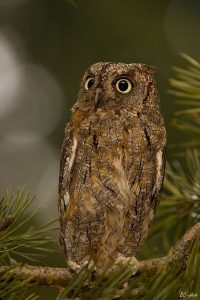
In modern Hebrew lilith is the name of the tawny owl. Some Bedouin say that the trilled call of another owl, the Scops Owl Otus scops (one of the most common owls in Israel), is the hooting of a female demon quietly rejoicing that she has found prey. The root of this name is similar to the Hebrew word for “night” but is actually a Babylonian word. It is also similar to the way some modern Palestinians describe the sound of hooting.
The scops owl is a tiny eared owl that is a mottled gray in color. By day it perches close to the trunk of a tree, where its mottled coloring blends in with the tree bark, making the owl look like the stump of a broken branch. It has a soft, trilled call.
It is associated with doom, destruction, and demons.
An expression, such as “owl demon” or “owl witch”, is probably the best solution. In sub-Saharan Africa, where the scops owl is well known, the local name plus a word for demon or witch can be used.





.jpg)