
The Greek in Revelation 17:5 that is translated as “name of mystery” or similar in English is translated in the German New Testament translation by Berger / Nord (publ. 1999) as Deckname or “alias (or: “code name”).”
prostitute
The Greek, Latin, and Hebrew that is typically translated as “prostitute” in English (in some, mostly earlier translation also as “harlot” or “whore”) is translated in the 2024 revision of the inter-confessional Latvian Jauna Pārstrādāta latviešu Bībele as netikle or “hussy.” This replaced the previous translation mauka or “whore.” Nikita Andrejevs, editor of the Bible explains the previous and current translations: “The translators at the time felt that this strong word best described the thought contained in the main text. Many had objections, as it seemed that this word would not be the most appropriate for public reading in church.” (Source: Updated Bible published in Latvia ).
Other translations include:
- Bariai: “a woman of the road” (source: Bariai Back Translation)
- Hiligaynon: “a woman who sells her body” (source: Hiligaynon Back Translation)
- Uma: “a woman whose behavior is not appropriate” or “a loose woman” (source: Uma Back Translation)
- Yakan: “a bad woman” (source: Yakan Back Translation)
- Western Bukidnon Manobo: “a woman who make money through their reputation” (source: Western Bukidnon Manobo Back Translation)
- Tagbanwa: “a woman who makes money with her body” (source: Tagbanwa Back Translation)
- Kankanaey: “a woman whose womanhood is repeatedly-bought” (source: Kankanaey Back Translation)
See also Translation commentary on Genesis 34:31, Rahab, and prostitute oneself / play the prostitute.
Learn more on Bible Odyssey: Prostitution in the Bible .
complete verse (Revelation 17:5)
Following are a number of back-translations of Revelation 17:5:
- Uma: “On her forehead was written a name that is a figure-of-speech for her behavior: BIG BABEL: MOTHER OF ALL LOOSE PEOPLE AND THE APPEARING-PLACE OF EVERY KIND OF DEED THAT IS NOT FITTING ON THE EARTH” (Source: Uma Back Translation)
- Yakan: “On her forehead there was a name written, its meaning was hidden. This is what was written on her forehead, ‘The famous city of Babilon. The source of bad women and the beginning of all that is unclean in the world.'” (Source: Yakan Back Translation)
- Western Bukidnon Manobo: “On her forehead was written a name whose meaning was hidden. It said, ‘The famous city of Babylon which is the mother, which is to say, the source of all prostitutes and every kind of vulgar, filthy deeds all over the earth.'” (Source: Western Bukidnon Manobo Back Translation)
- Kankanaey: “Her name whose meaning was deep (i.e. difficult to understand), it was written on what was used-as-a-headband on her forehead. It said, ‘Babilonia the famous (lit. newsed), mother of women whose womanhood is repeatedly-bought, and source of all the filthy-things that are being-done on the earth.'” (Source: Kankanaey Back Translation)
- Tagbanwa: “Written on her forehead was a name with a secret meaning, which said, ‘Famous Babilonia, who is the mother of immorality and all disgusting deeds here under the heavens.'” (Source: Tagbanwa Back Translation)
- Tenango Otomi: “Written on her head was a name which was not known as to its meaning. But the meaning of the word is: ‘This city of Babylon is the mother of all prostitutes all over the world, and of all the evils there are.” (Source: Tenango Otomi Back Translation)
The Woman and the Beast
The following is a stained glass window by William Wailes from the Cathédrale Notre-Dame in Clermont-Ferrand, France:
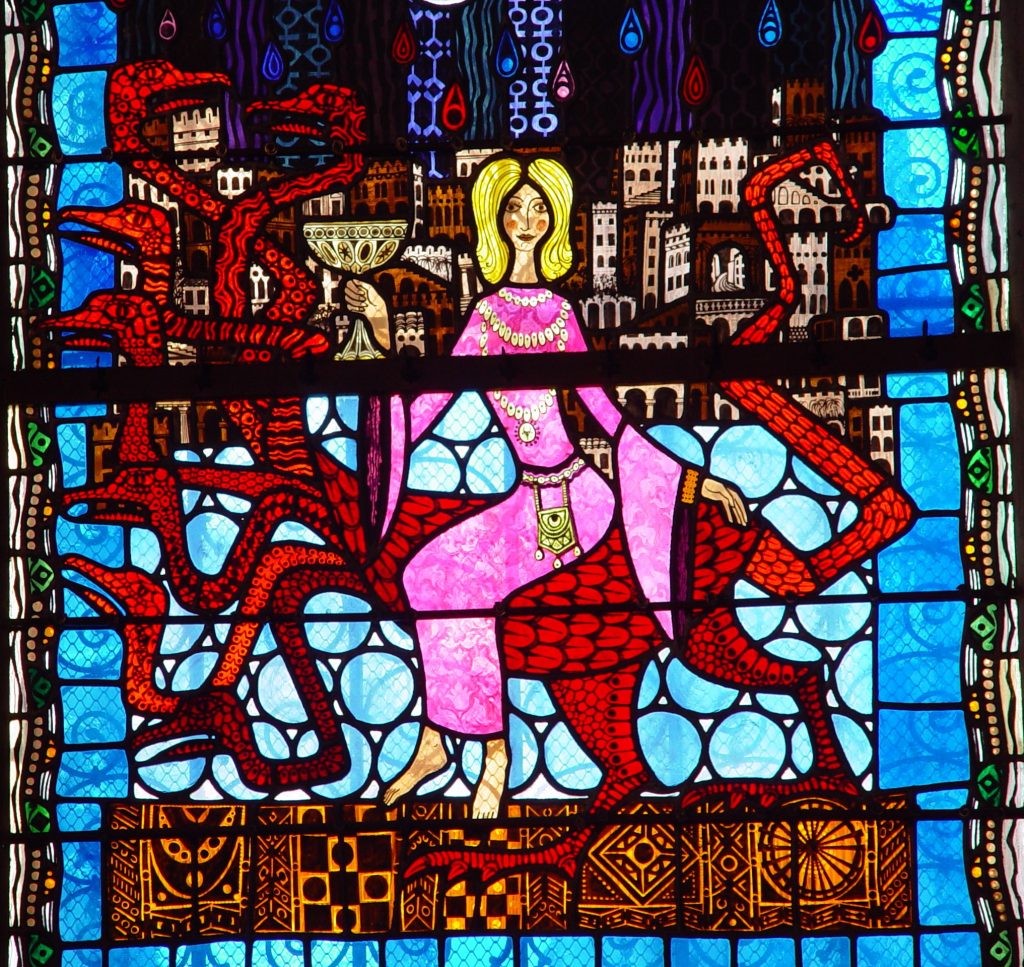
Source: Art in the Christian Tradition , a project of the Vanderbilt University Divinity Library, Nashville, TN. Original source: image donated by Jim Womack and Anne Richardson
Stained glass is not just highly decorative, it’s a medium which has been used to express important religious messages for centuries. Literacy was not widespread in the medieval and Renaissance periods and the Church used stained glass and other artworks to teach the central beliefs of Christianity. In Gothic churches, the windows were filled with extensive narrative scenes in stained glass — like huge and colorful picture storybooks — in which worshipers could ‘read’ the stories of Christ and the saints and learn what was required for their religious salvation. (Source: Victoria and Albert Museum )
Translation commentary on Revelation 17:5
Was written a name of mystery: the passive was written does not here imply that God wrote the name; it simply says that there was a mysterious name on her forehead. As Good News Translation shows, the phrase a name of mystery means “a name that has a secret meaning.” In languages that do not use the passive, there are often special verbs for “written” or “inscribed” that help to avoid the passive but do not require a subject; something like the following English sentence: “On her forehead she had a name written (or, inscribed),” or “on her forehead someone had written a name.” Good News Translation‘s “secret meaning” may also be rendered “hidden meaning” or “meaning not known to others.” See also 1.20.
Babylon the great: see 14.8. In some languages it may be necessary to make a complete sentence out of what is a title in Greek: “I am Mighty (or, Powerful) Babylon.”
Mother of harlots and of earth’s abominations: it is easy enough to translate mother of harlots, but it is more difficult to translate mother … of earth’s abominations. Good News Translation “perverts” takes this last expression to indicate people, but it is better to take it to refer to actions: “the one who is the source of all obscene (or, filthy) actions in the world.” Revised English Bible has “of every obscenity on earth,” and New Jerusalem Bible “all the filthy practices on earth.”
An alternative translation model for this verse is:
• On her forehead she had a name inscribed that had a secret meaning. The name said, “I am great (or, powerful) Babylon, the mother of all prostitutes and the one who is the source of all obscene (or, filthy) actions in the world.”
Quoted with permission from Bratcher, Robert G. and Hatton, Howard A. A Handbook on The Revelation to John. (UBS Handbook Series). New York: UBS, 1993. For this and other handbooks for translators see here .
SIL Translator’s Notes on Revelation 17:5
17:5a–c
And on her forehead a mysterious name was written: BABYLON THE GREAT, THE MOTHER OF PROSTITUTES AND OF THE ABOMINATIONS OF THE EARTH: The Berean Standard Bible and some English versions write this title with all capital letters. Other English versions capitalize the first letter of each word. Write this title as a name or title in your language.
17:5a
And on her forehead a mysterious name was written: There are two ways to interpret how the Greek word that the Berean Standard Bible translates as mysterious is used:
(1) It describes the name or title on her forehead. The name was mysterious or secret. For example:
on her forehead a name was written, a mystery, (New American Standard Bible)
(2) It is itself part of the name or title. For example:
upon her forehead [was] a name written, MYSTERY (King James Version)
It is recommended that you follow interpretation (1). Other ways to translate this interpretation are:
On her forehead a mysterious name was written: (Contemporary English Version)
-or-
On her forehead was written a name, a mystery: (NET Bible)
-or-
On her forehead was written a name that has a secret meaning: (Good News Translation)
on her forehead a mysterious name was written: The Greek grammar indicates that the writing was already there when John saw the woman. The clause is passive. Some languages must use an active or intransitive clause. For example:
⌊someone⌋ had written a name on her forehead
-or-
On her forehead were these words:
-or-
A name/title was on her forehead:
If you translate following the last two examples, your translation should imply that the title was written.
mysterious: The Greek word that the Berean Standard Bible translates as mysterious refers to truth or knowledge that people have not discovered on their own. Someone else reveals it to them.
The name is told in 17:5b–c. So the mystery is probably that this particular name had not been told before. It is not explained here. People will have to read the name and try to understand its meaning. Other ways to translate this word are:
a name of mystery: (Revised Standard Version)
-or-
a name that has a secret meaning: (Good News Translation)
Also see how you translated this word in 1:20.
17:5b
BABYLON: The name of this woman is BABYLON. It is used in the same way in 14:8 and 16:19.
THE GREAT: This word means “important” or “well-known” here. It does not indicate that Babylon was good or noble in any way. See how you translated this word in 16:19 or possibly 17:1.
THE MOTHER OF PROSTITUTES: This phrase indicates figuratively that the woman is the origin of all those who do prostitution. Here prostitution refers figuratively to worshiping idols and being unfaithful to God.
In some languages a literal translation would not clearly indicate the figurative meaning. If that is true in your language, you may want to:
• Translate literally and explain its meaning in a footnote. For example:
This phrase indicates figuratively that Babylon began the practices/ways of idolatry. She encouraged others to be unfaithful to God.
• Translate the meaning without the figure of speech. For example:
The Originator of Prostitutes
PROSTITUTES: Here this word implies seduction, immorality, greed, and immoral selling practices, as well as other shameful deeds. See how you translated this word in 17:1.
17:5c
AND OF THE ABOMINATIONS OF THE EARTH: The word “mother” is implied from 17:5b but not repeated here. The woman began the ABOMINATIONS and other people followed her in those sins. In some languages it is more natural to repeat the meaning of the word “mother” here. For example:
Mother of the Abominations of the Earth
-or-
Originator of the Abominations of the Earth
ABOMINATIONS: This word refers to deeds that are detestable or very awful. The word refers figuratively to the woman’s sinful life and deeds. Other ways to translate this word are:
Obscenities (New Living Translation (2004))
-or-
detestable things (NET Bible)
See how you translated this word in 17:4 (“abominations”).
© 2020 by SIL International®
Made available under the terms of a Creative Commons Attribution-ShareAlike 4.0 License (CC BY-SA) creativecommons.org/licenses/by-sa/4.0.
All Scripture quotations in this publication, unless otherwise indicated, are from The Holy Bible, Berean Standard Bible.
BSB is produced in cooperation with Bible Hub, Discovery Bible, OpenBible.com, and the Berean Bible Translation Committee.
Leave a Reply
You must be logged in to post a comment.