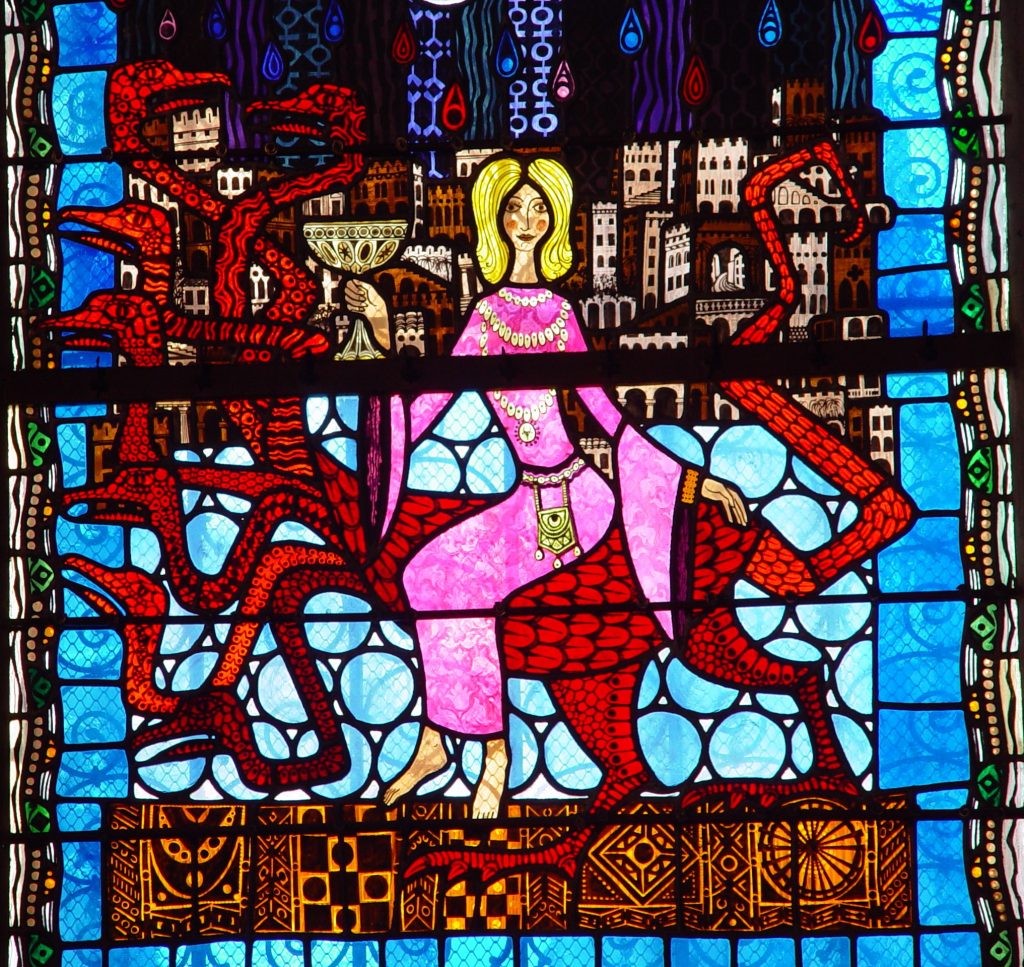
4The woman was clothed in purple and scarlet and adorned with gold and jewels and pearls, holding in her hand a golden cup full of abominations and the impurities of her prostitution,
In Gbaya, the notion of scarlet is emphasized with yúŋgú-yúŋgú, an ideophone that describes a red like the sun when it’s rising and setting.
Ideophones are a class of sound symbolic words expressing human sensation that are used as literary devices in many African languages. (Source: Philip Noss)
The Greek and Hebrew hat is translated as “purple” in English is translated as “blue-red” in Ojitlán Chinantec (source: M. Larson in Notes on Translation 1970, p. 1ff.) and in Elhomwe (source: project-specific translation notes in Paratext). In Silimo it is translated with a local reference: “the colour of the wipegen berry” (source: Buzz and Myrna Maxey ).
“The Kasua people of Western Province have no word for the color purple. They have words for many other colors: black, red, white, yellow, green, and blue, but not for the color of royalty.
“About nine New Testament passages mention people placing a purple robe on Jesus. The Kasua translation team always wanted to use the word ‘red,’ or keyalo, to describe the robe. Tommy, one of the translation team helpers, disagreed because this is not historically accurate or signifies the royalty of Jesus.
“One of the main rules of translation is that the team must stick to the historical facts when they translate a passage. If they don’t, then how can the readers trust what they’re reading is true? Other questions about truth could bubble in the reader’s minds about the Scriptures. For this reason, Tommy was not willing to change the word purple. So the team hung up the problem, hoping to revisit it later with more inspiration.
“God did not disappoint.
“Years later, Tommy hiked with some of the men near their village. They saw a tree that possessed bulbous growths growing on the side of it like fruit. These growths were ‘the most beautiful color of purple I’d ever seen,’ explained Tommy.
“’What is the name of this tree?’ Tommy asked the men.
“’This is an Okani tree,’ they replied.
“Tommy suggested, ‘Why don’t you, in those passages where we’ve been struggling to translate the color purple, use ‘they put a robe on Jesus the color of the fruit of the Okani tree’?
“’Yeah. We know exactly what color that is,’ the men said enthusiastically.
“Everyone in their village would also visualize this phrase accurately, as the Okani tree is the only tree in that area that produces this kind of purple growth. So now, among the Kasua people, in his royal purple robe, Jesus is shown to be the king that he is.”
In Numbers 4:13, Gbaya uses the ideophone soi-soi to emphasize the purple color. Ideophones are a class of sound symbolic words expressing human sensation and soi-soi designates something that has a red or purple color, or a thing with a clear or clean appearance. (Source: Philip Noss)
The Hebrew, Greek, and Latin that is translated as “cup” in English is translated in Sar with “calabash” (see here ) (source: Ngarbolnan Riminan in Le Sycomore 2000, p. 20ff. ) and in Bariai with “coconut shell” (source: Bariai Back Translation)
The following is a stained glass window by William Wailes from the Cathédrale Notre-Dame in Clermont-Ferrand, France:
Source: Art in the Christian Tradition , a project of the Vanderbilt University Divinity Library, Nashville, TN. Original source: image donated by Jim Womack and Anne Richardson
Stained glass is not just highly decorative, it’s a medium which has been used to express important religious messages for centuries. Literacy was not widespread in the medieval and Renaissance periods and the Church used stained glass and other artworks to teach the central beliefs of Christianity. In Gothic churches, the windows were filled with extensive narrative scenes in stained glass — like huge and colorful picture storybooks — in which worshipers could ‘read’ the stories of Christ and the saints and learn what was required for their religious salvation. (Source: Victoria and Albert Museum )
Following are a number of back-translations of Revelation 17:4:
Uma: “As for the woman, her clothes were all the best/fanciest: bright red and purple [lit., grayish like new mango leaves], decorated with gold and pearls and expensive rocks. She held a golden cup filled with a drink that is forbidden because it is evil and disgusting. That drink means her shameful and not-fitting deeds.” (Source: Uma Back Translation)
Yakan: “That woman was dressed in purple and red, covered with jewelry, precious stones and pearls. She carried a golden cup full of the uncleanness/dirt and filth of her immorality.” (Source: Yakan Back Translation)
Western Bukidnon Manobo: “And as for that woman, she was clothed with expensive red and purple cloth. Her body was decorated with pearls, and expensive stones, and gold. There was in her hand a golden cup full of wine which is the vulgar, filthy deeds of her prostitution.” (Source: Western Bukidnon Manobo Back Translation)
Kankanaey: “The clothes of the woman, they were red and blue (loan asul, closest color to purple) like clothes of a ruler. She was also decorated-all-over with gold and valuable stones and pearls. She was holding a gold cup full of the nauseating/repulsive and filthy things she had done.” (Source: Kankanaey Back Translation)
Tagbanwa: “The clothing of that woman was red and really ornate like the clothing of a king. Gold and expensive mined stones and far-from-ordinary beads were the decoration of her body. She was holding a gold cup which was full of the filthy and disgusting things of that habit of hers which was like that.” (Source: Tagbanwa Back Translation)
Tenango Otomi: “Concerning the woman her clothing was purple and red. The clothing had ornaments of gold, with little stones which were beautiful and stones named pearls. She held a bowl made of gold. All kinds of evil filled the bowl, because the woman was guilty of fornication.” (Source: Tenango Otomi Back Translation)
Was arrayed in purple and scarlet: these are purple and scarlet clothes, or robes that she was wearing. The cloth used to make such robes was expensive and was a mark of luxury or of royalty. One may also say “The woman wore purple and scarlet (or, red) clothes.”
Bedecked: this little-used English verb means “adorned” (so New Revised Standard Version). The Greek text uses a verb and its related noun “gilded with gold….” Something like “adorned” or “was wearing” makes for a more natural translation. In certain languages it will be necessary to say “her body and clothes were adorned” or “she had adorned (or, bedecked) her body with….”
Gold and jewels and pearls: the gold is gold ornaments, while jewels may be translated “precious stones.” In cultures where pearls are unknown, translators may use expressions such as “expensive beads named ‘pearls.’ ” However, the focus in this context is on bodily adornments in general, not on any particular type of jewelry. Therefore it is recommended that translators in such cultures combine jewels and pearls and say, for example, “expensive stones (or, beads) of many kinds.”
In her hand a golden cup: in 14.10 John speaks of the cup that is filled with the wine of God’s wrath; the prostitute’s gold cup is filled with the wine of her sexual immorality. Like the Old Testament prophets, John speaks of idolatry as sexual immorality and describes nations that try to lead God’s people into idolatry as fornicators and whores. If it is necessary to specify which hand held the cup, it is recommended that “right hand” be said.
Full of abominations and the impurities of her fornication: this may be difficult to translate literally. The word translated abominations is used also in 17.5 and 21.27 (and see Luke 16.15). It means detestable things, odious, revolting, disgusting, obscene (Revised English Bible “obscenities”). If the metaphor will be difficult to understand, a simile can be used: “full of the wine that represents her obscene (or, disgusting) actions and her filthy sexual practices.”
Alternative translation models for this verse are:
• The woman was wearing purple and scarlet clothes. She had adorned her body with gold ornaments, precious stones, and expensive beads named “pearls.” In her right hand she held a golden cup full of the wine that represents her disgusting actions and filthy sexual practices.
Or:
• … She had adorned her body with gold ornaments and expensive stones (or, beads) of all kinds….
Quoted with permission from Bratcher, Robert G. and Hatton, Howard A. A Handbook on The Revelation to John. (UBS Handbook Series). New York: UBS, 1993. For this and other handbooks for translators see here .
The woman was dressed in purple and scarlet: The dress that the woman wore was made of purple and scarlet cloth. Purple cloth was very expensive at that time. It was worn only by the most important officials.
Scarlet cloth was also somewhat expensive at that time. It was worn only by the very wealthy or by military leaders. Other ways to translate this clause are:
The woman wore purple and scarlet clothing (New Living Translation (2004)) -or-
The woman wore an ⌊expensive⌋ purple and scarlet dress
purple: Purple is a mix of blue and red.
Use the proper color word or use the name of something purple in your area. For example:
lavender color -or-
the color of eggplant
17:4b
and adorned with gold and precious stones and pearls: The Greek word that the Berean Standard Bible translates as adorned means “wearing.” The woman was wearing jewelry and other ornaments in order to make herself look attractive. This showed how wealthy she was. Other ways to translate these words are:
adorned with gold and jewels and pearls (New Revised Standard Version) -or-
was decorated all over with gold and valuable stones and pearls
gold: The word gold refers to a rare metal of a somewhat yellow color. It was the most expensive metal at that time. It is naturally shiny and beautiful. See how you translated this word in 1:12 or 9:20.
precious stones: This phrase refers to rare stones that are naturally beautiful or become beautiful when shaped and polished. These rare stones are precious or expensive. The Revised Standard Version translates this phrase as:
jewels
The foundation of the new Jerusalem is made of 12 different precious stones. See the descriptions and pictures of those kinds of precious stones in the notes at 21:19–20.
pearls: The word pearls refer to hard, shiny spheres up to 10 millimeters (half an inch) across. They are found in the shellfish called oysters. Pearls are often very beautiful. Good ones are very valuable.
Some languages do not have a word for pearls. If that is true in your language, you may want to:
• Use the major language word. You may then want to explain it in your translation or in a footnote. Some examples for explaining in your translation are:
⌊beautiful⌋ pearls -or-
⌊expensive things called⌋ pearls
An example footnote is:
A pearl is a hard, shiny sphere about 5–10 millimeters across. It is found in a kind of shellfish called the oyster. They are often very beautiful. Good ones are very valuable.
• Use something that people wear in your area that is beautiful and valuable. You may then want to include a footnote that explains the original word. An example is:
Literally: “pearls.” A pearl is a hard, shiny sphere about 5–10 millimeters across. It is found in a kind of shellfish called the oyster. They are often very beautiful. Good ones are very valuable.
17:4c
She held in her hand a golden cup: In some languages it is not necessary to use both the word held and the phrase in her hand. If this is true in your language, translate naturally. For example:
She had a golden cup in her hand (New Century Version) -or-
She was holding a gold cup
golden: The word golden indicates that the cup was made of gold. See how you translated this word in 1:12 or 8:3.
cup: It is probably implied that the cup was a fancy, ornamental cup. For example:
goblet (New Living Translation (2004))
17:4d
abominations: This phrase refers to things that are detestable or very awful. The phrase refers to the woman’s sinful life and deeds. Other ways to translate this phrase are:
abominable things (New International Version) -or-
obscenities (New Living Translation (2004)) -or-
detestable things (NET Bible)
the impurities of her sexual immorality: The Greek word that the Berean Standard Bible translates as impurities refers to impure things. These are things/deeds that God detests. The phrase refers to the results of the woman’s disgusting sexual practices. Those are again a figurative reference to the shameful things she did with the kings of the earth and its inhabitants (17:2). Other ways to translate this phrase are:
unclean things of her immorality (New American Standard Bible) -or-
the impurities of her immorality (New Living Translation (2004)) -or-
the foul things/practices of her sexual sins
Living Water is produced for the Bible translation movement in association with Lutheran Bible Translators. Lyrics derived from the ESV® Bible (The Holy Bible, English Standard Version®).

Leave a Reply
You must be logged in to post a comment.