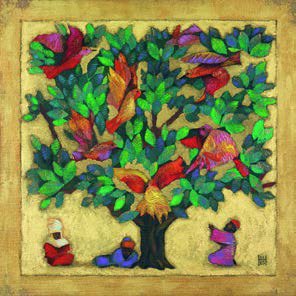
32it is the smallest of all the seeds, but when it has grown it is the greatest of shrubs and becomes a tree, so that the birds of the air come and make nests in its branches.”
The Greek and Hebrew phrases that are often translated as “birds of the air” in English “refer to the undomesticated song birds or wild birds, to be distinguished in a number of languages from domesticated fowl. In Tzeltal these former are ‘field birds’.” (source: Bratcher / Nida)
Q’anjob’al also uses an established term for non-domesticated birds. Newberry and Kittie Cox (in The Bible Translator 1950, p. 91ff. ) explain: “Qʼanjobʼal has two distinct terms, one to identify domesticated birds and the other non-domesticated birds. The additional descriptive phrase ‘of the air’ seemed entirely misleading, for Qʼanjobʼal speakers had never heard of such creatures. Actually, of course, all that was necessary was the term for non-domesticated birds, for that is precisely the meaning of the Biblical expression.”
In Elhomwe they are just translated as “birds” or “birds of the bush” (i.e., wild birds) to “not give the impression that these are special type of birds.” (Source: project-specific translation notes in Paratext)
The Greek that is translated as “the greatest of all shrubs” or similar in English is translated in Chuj as “larger than all the plants we plant each year,” and in Shuar as “larger than all weeds” (Some “weeds” grow to over ten feet.) (Source: B. Moore / G. Turner in Notes on Translation 1967, p. 1ff.)
In Gbaya, the notion of small quantities (often in relation to divisions) or something very small (such as a mustard seed) is emphasized in the referenced verses with the ideophone kɛ̧́ɛ̧́.
Ideophones are a class of sound symbolic words expressing human sensation that are used as literary devices in many African languages. (Source: Philip Noss)
Following are a number of back-translations of Matthew 13:32:
Uma: “That seed was very tiny, smaller than other seeds. But when it grew, it was bigger than the other vegetables. It grew like a tree, with the result that birds came and made their nests in its branches.'” (Source: Uma Back Translation)
Yakan: “This seed is very small but when it grows, it becomes bigger than all plants and becomes a tree. Therefore the birds can go and make their nests on it’s branches.'” (Source: Yakan Back Translation)
Western Bukidnon Manobo: “A person plants this in his field, and when it sprouts and gets big, it becomes the largest of the vegetable plants. It’s like a tree and the birds can light in it and can build their nests in its branches.'” (Source: Western Bukidnon Manobo Back Translation)
Kankanaey: “This is the smallest of all seeds, but when it grows and matures, this is the largest of all plants, whose size is like a tree, and it is possible for birds to make-nests in its branches.'” (Source: Kankanaey Back Translation)
Tagbanwa: “It really is the smallest seed of all plants, but when it has been-planted/taken-root, on sprouting it grows bigger than all other vegetables, and becomes a tree. Without anything further, its branches will then be nested in by birds.'” (Source: Tagbanwa Back Translation)
Tenango Otomi: “This seed truly is the smallest of all the other seeds. But when it grows, then it is a larger plant than all the other plants in the plant garden. There in its branches birds make nests.” (Source: Tenango Otomi Back Translation)
Living Water is produced for the Bible translation movement in association with Lutheran Bible Translators. Lyrics derived from the ESV® Bible (The Holy Bible, English Standard Version®).
It is the smallest of all seeds is translated “There is no smaller seed” by Die Bibel im heutigen Deutsch. Although the mustard seed is not actually the smallest of all seeds, some commentators note that the mustard seed was used in a proverb common among Jewish teachers to denote the smallest thing or the smallest amount possible. In Jesus’ time mustard was cultivated both for its seed and as a vegetable. Translators need to be sure it is clear that the text is referring to mustard seeds in general, not to the specific seed the man sows in the parable. Hence some translations will say “the seed of a mustard plant is the smallest of any kind of seed.”
But when it has grown draws the contrast between the small seed and the large plant which it produces upon maturity. No concern is given to the process or growth. In languages where it is not seeds that grow, it may be necessary to say “But when the plant has grown.”
Shrubs (Good News Translation “plants,” New English Bible “garden-plant”) refers to edible garden plants, that is, vegetables. If a language has a general word for “plants” that can be used for shrubs, that is best. However, “bushes” or “plants people grow (for food)” are other possibilities. Each language divides the various sizes and types of plants into categories differently, rarely corresponding to English categories of “bush,” “shrub,” and “tree.” Translators will have to use whatever term from their language seems to be most appropriate.
When fully grown, the mustard plant becomes a tree of eight to twelve feet in height. Birds of the air (better “birds”; see comment at 6.26) are attracted to the mustard tree because of it shade and its fruit, though they do not normally nest in it. Commentators note that the reference to a huge tree in which birds come to roost is used symbolically in the Scriptures of a powerful kingdom which protects its dependent states (see Ezek 17.23; 31.6; Dan 4.20-22). In apocalyptic literature and in the writings of Jewish teachers, birds sometimes represent Gentiles who come to seek refuge with Israel.
There are languages that have no word for tree in general, naming instead each particular species. In that case translators should pick some local tree that is about the same height and say “grows to be like __________,” using the name of the local tree.
Quoted with permission from Newman, Barclay M. and Stine, Philip C. A Handbook on the Gospel of Matthew. (UBS Handbook Series). New York: UBS, 1988. For this and other handbooks for translators see here .
it is the smallest of all seeds: The Greek text is literally “which is smaller than all the seeds.” The Greek text exaggerates the smallness of the seed to emphasize its smallness. This helps teach the point about the kingdom of God starting with only a few people.
Here are some other ways to translate this:
• Translate literally. For example:
It is the smallest of all seeds (Good News Translation)
• Explain the exaggeration. For example:
it is the smallest of all ⌊garden⌋ seeds
• Indicate in a general way that the mustard seed is a very small seed. For example:
It’s one of the smallest seeds (God’s Word)
-or-
It is a very small seed.
13:32b
yet: There is something unexpected here. We would expect a small seed to grow into a small plant. But a small mustard seed grows into a large plant.
Here are some ways to introduce this unexpected thing:
• Use a conjunction in 13:32b. For example:
However, when it has grown (God’s Word)
• Use a conjunction in 13:32a. For example:
32a Although it is the smallest of all seeds, 32bit grows larger (Contemporary English Version)
Use whatever is natural in your language to indicate that something unexpected is about to be said.
it grows into the largest of garden plants: The Greek word that the Berean Standard Bible translates as garden plants refers to vegetable and herb plants. These plants do not normally grow more than one meter high. However, the mustard plant can grow as high as three meters high. It was the largest plant that the Jews planted in their vegetable gardens.
Here are some other ways to translate this clause:
when it has grown, it is taller than the garden plants (God’s Word)
-or-
when it has grown, it is bigger than all the other plants in the vegetable garden
13:32c
becomes a tree: A mustard plant can grow up to three meters tall, and it has branches. It is more like a large shrub than a tree. Jesus said becomes a tree to make a strong connection to the Old Testament symbol of a great kingdom. (See more on this issue under the General Comment below.)
Here are some other ways to translate this phrase:
it grows into a tree (New Living Translation (2004))
-or-
it grows big enough to be ⌊considered/called⌋ a tree
so that the birds of the air come: The phrase the birds of the air is the Jewish way of referring to “birds.” In many languages, it will be more natural to just say “birds.” For example:
so that birds come (Good News Translation)
-or-
that is large enough for birds (God’s Word)
and nest in its branches: The Greek word that the Berean Standard Bible translates as nest means “live, dwell, settle.” Most English versions translate this word as “make nests” or as the verb “nest.”
Here are some other ways to translate this word:
perch in its branches (New International Version)
-or-
shelter in its branches (New Jerusalem Bible)
General Comment on 13:32
When a Jew heard about a tree so large that birds could come and make their nests in it, he would immediate think of some Old Testament passages (Ezekiel 17:23, Daniel 4:20–22) that had similar wording. Such passages were about great kingdoms. So a Jew would understand that Jesus was talking about the kingdom of heaven/God becoming a great kingdom.
You may need a footnote to explain the Jewish symbolism for the tree and birds. Here is a sample footnote:
In the Old Testament, God compared several great kingdoms to great trees that were so large that birds came and nested in its branches. When Jesus spoke of God’s kingdom being like a tree with birds perching in its branches, the Jews would quickly understand that God’s kingdom would become great as well.

Leave a Reply
You must be logged in to post a comment.