Painting by Wang Suda 王肅達 (1910-1963),
Copyright by the Catholic University Peking, China
Text under painting translated from Literary Chinese into English: Raising a Girl
Proof that Jesus is the true God
Image taken from Chinese Christian Posters . For more information on the “Ars Sacra Pekinensis” school of art, see this article , for other artworks of that school in TIPs, see here.
Jesus got into the boat and they sailed back. When they arrived, Jesus got out of the boat. There were a lot of people crowded together. One man named Jairus was in charge. He kept order in the synagogue — it was a house of prayer for the Jews who gathered there on the Sabbath. Jairus came to Jesus, knelt down and begged him, My daughter is dying. She is only twelve years old. Please come and touch my daughter with your hand and she will not die, she will be saved.
Jesus said: Let’s go.
And the two of them went. They went. There was a crowd of people around. In the crowd was a woman who had been bleeding for twelve years. And they couldn’t cure her. She had gone to many doctors, spent a lot of money on treatment, but she was getting worse.
She thought: If I go to Jesus and just touch his clothes, I will be well.
She thought so and went. And there were a lot of people there. She made her way through the crowd and finally came close to Jesus. Jesus had on a long robe.
The woman thought, I just want to touch the edge of the robe!
She reached out and touched and realized that her bleeding stopped immediately. And she backed up. Jesus stopped. He felt his power had gone somewhere. He looked at the crowd and asked: Who touched my robe?
The disciples were puzzled and began to say to Jesus, Look how many people are here! And you ask who touched your clothes!
The woman was afraid. But then she decided to come out of the crowd. She knelt before Jesus and said: I have suffered from bleeding for twelve years, so I have come to touch your garment to get well.
Jesus said to her: O woman! Your faith that you dared to touch my garment, it has saved you. God is with you! Be at ease, your torment is over.
Then the men of Jairus’ house came and said, Your daughter is already dead. So you don’t need to bring Jesus to the house. Jairus was very upset.
Jesus heard and said to Jairus, Don’t be sad, keep on believing.
He told the crowd to disperse. Jesus took Jairus and the three disciples with him — Peter, John, and James. Jesus said: Come with me to Jairus’ house.
They went into Jairus’ house. There was a multitude of people there crying and shouting, The girl is dead!
Jesus came and said, There is no reason for you to cry! The girl is not dead, she is sleeping.
The people began to say to Jesus: Why are you mocking us? She is not sleeping, she is dead!
And they kept crying. Jesus told everyone to move out of the way, taking only the girl’s father and mother and his disciples with him, and they went into the room where the girl was lying. Jesus entered the room, looked at the twelve-year-old girl, took her by the hand and said: Girl, I command you — get up!
The girl immediately opened her eyes, stood up. The parents and the three disciples were amazed to see that she was alive. Jesus said, You don’t have to tell everyone that the girl came back to life after death. And feed the girl!
Original Russian back-translation (click or tap here):
Иисус сел в лодку, и они поплыли обратно. Когда они приплыли, Иисус вышел из лодки. Столпилось множество народа. Один человек по имени Иаир был начальником. Он следил за порядком в синагоге — это дом молитвы для евреев, которые собирались там по субботам. Иаир подошел к Иисусу, встал на колени и стал молить Его: Моя дочь при смерти. Ей всего двенадцать лет. Пожалуйста, приди, коснись рукой моей дочери, и она не умрет, будет спасена.
Иисус сказал: Пойдем.
И они пошли вдвоем. Они пошли. Вокруг была толпа народа. В толпе была одна женщина, которая уже двенадцать лет болела кровотечением. И никак не могли ее вылечить. Она ходила по многим врачам, истратила на лечение много-много денег, но ей становилось только хуже.
Она подумала так: Если я подойду к Иисусу и хотя бы только прикоснусь к Его одежде, то я буду здорова.
Она так подумала и пошла. А там было очень много народа. Она пробиралась сквозь толпу, наконец, приблизилась к Иисусу. У Иисуса была длинная одежда.
Женщина подумала: Мне бы только края одежды коснуться!
Она протянула руку и дотронулась и поняла, что у нее кровотечение остановилось тут же. И она попятилась назад. Иисус остановился. Он почувствовал, что его сила куда-то ушла. Он посмотрел на толпу и спросил: Кто прикоснулся к моей одежде?
Ученики в недоумении стали говорить Иисусу: Посмотри, сколько здесь народу! И ты спрашиваешь, кто дотронулся до твоей одежды?!
Женщина боялась. Но потом все-таки решилась выйти из толпы. Она встала на колени перед Иисусом и сказала: Я в течение двенадцати лет страдаю от кровотечений, поэтому я пришла, чтобы дотронуться до твоей одежды, чтобы выздороветь.
Иисус сказал ей: О женщина! Твоя вера, что ты решилась дотронуться до моей одежды, она спасла тебя. Бог с тобою! Будь спокойна, твои мучения закончились.
Тут пришли люди из дома Иаира и говорят: Твоя дочь уже умерла. Поэтому ненужно уже приводить в дом Иисуса. Иаир очень расстроился.
Иисус, услышав, сказал Иаиру: Не печалься! Продолжай верить!
Он велел толпе расступиться. Иисус взял с собой Иаира и трех учеников — Петр, Иоанн, Иаков. Иисус сказал: Пойдем со мной в дом Иаира.
Они вошли в дом Иаира. Там было множество народа, которые плакали и кричали: Девочка умерла!
Иисус подошел и сказал: Нет причины вам плакать! Девочка не умерла, она спит.
Люди стали говорить Иисусу: Ты что же издеваешься над нами? Она не спит, она умерла!
И они продолжали плакать. Иисус велел всем отойти в сторону, взял с собой только отца и мать девочки и своих учеников, и они пошли в комнату, где лежала девочка. Иисус вошел в комнату, посмотрел на двенадцатилетнюю девочку, взял ее за руку и сказал: Девочка, я повелеваю тебе — вставай!
Девочка тут же открыла глаза, встала. Родители и три ученика изумились, видя, что она жива. Иисус сказал: Не нужно всем рассказывать, что девочка ожила после смерти. И покормите девочку!
Retrotraducciones en español (haga clic o pulse aquí)
El barco iba y cuando llegó Jesús y los discípulos salieron del barco y muchas personas venían, una multitud se atestaba.
Un hombre, (llamado) Jairo, un líder del templo, vio a Jesús y caminó hacia él entre la multitud y se arrodilló.
Dijo: “Jesús, mi hija de doce años de edad está por morir, pon las manos sobre ella y la vida de mi hija será salvo, ¡por favor ven!”
Jesús acordó y Jairo se paró, y muchas personas, una gran multitud, fueron con ellos.
Dentro (de la multitud), por detrás una mujer desconocida que tenía una enfermedad de menstruación, perdiendo sangre, vio a Jesús y caminó hacia él, haciendo un paso por la multitud.
La mujer agarró la ropa de Jesús y alivió, estaba sana.
Jesús sentía que curación había salido de él y miraba alrededor: “¿Quién tocó mi ropa?”
Los discípulos (pensaron que era) absurdo y dijeron: “Tú sabes que hay muchas personas atestandose, ¿cómo (sabes) que uno te toca?”
Jesús miraba alrededor de él y la mujer lo vio: caray, y miedosa con las rodillas temblando se acercó a él y se arrodilló, y dijo: “yo agarré tu ropa, porque antes estaba sangrando de mi regla por doce años.
He ido a diferentes doctores, pero ellos (dijeron): “Perdón, no sabemos”, he gastado todo mi dinero, pero sufría peor y peor del sangrado de menstruación.
Después vi todas las personas que me lo decían y yo lo creía que tú, Jesús, puedes sanar, y yo tan sólo agarré tu ropa y estoy sana, por eso.”
Jesús la miraba y sentía cariño (y dijo): “Tu fe ya te sanó, ahora ya no sigues enferma, basta, vete tranquilamente.”
Por allá venía un grupo de gente, y dijeron a Jairo: “Dile a Jesús que ya no lo molestes, dejalo, porque tu hija ya ha muerto.”
Jesús lo oyó y se volteó a verlo y le dijo: “Jairo, no te desesperes, ten fe, un momentito: ¡vengan Pedro, Jacobo y Juan, vengan!”
El grupo fue a la casa y Jesús miraba alrededor de él y vio a las personas desesperadas, llorando y gritando. Jesus dijo: “¿Porqué gritan y lloran? La niña no está muerta, sólo está dormida.”
Las personas (pensaban que era) absurdo, y ahora se reían. Jesús miraba alrededor de él (y dijo que) todos se fueran, y la multitud se alejaba.
Jesús llamó Jairo, su esposa y los tres discípulos y el grupo entró el cuarto.
Jesús miró a la niña prostrada en la cama y caminó hacia ella, le agarró de la mano y dijo: “Talita cum”, que significa: “Te dijo, niña que te levantes.” La niña abrió los ojos y se levantó y caminaba.
Los padres y los discípulos estaban asombrados y asustados, Jesús les advirtió: “Todas las personas no saben (lo que pasó) y uds. no les cuenten, guarden silencio, es un secreto.”
Dijo: “Ahora dale comida a tu hija.”
The boat sailed and when it arrived Jesus and the disciples got out and many people came, a great crowd thronged them.
A man (named) Jairus, a leader of the temple, saw Jesus and walked up to him through the crowd and knelt down.
He said: “Jesus, my daughter who is twelve years old is dying, lay your hands on her and her life will be saved, please come!”
Jesus agreed and Jairus got up and many people, a great crowd, went with them.
From within (the crowd), from behind a strange woman who had an menstruation illness so that she was bleeding, saw Jesus and walked up to him, making a way through the crowd.
The woman took hold of Jesus’ clothes and she was relieved, healed.
Jesus felt that healing had gone out of him and he looked around: “Who touched my clothes?”
The disciples (thought it) absurd and said: “You know that many people are crowding around, how (do you know) that one touched you?”
Jesus kept looking around and the woman saw it: Ay, and with shaky knees, faint hearted, she approached him and knelt down and said: “I took hold of your clothes, because I have had menstruation bleeding for twelve years.
“I have been to various doctors, but they (said): ‘Sorry, we don’t know,’ I have spent all my money, but I suffered worse and worse from the menstruation bleeding.
“Afterwards I saw all these people and they told me, and I believed it, that you Jesus can heal, and I merely took hold of your clothes, and I was healed, that’s why.”
Jesus looked at her and felt affection (and said): “Your faith has healed you, now you will no longer be sick, it’s enough, go peacefully.”
Over there came a group of people and they told Jairus: “Tell Jesus that you will not bother him anymore, leave it, because you your daughter has died.”
Jesus heard him and turned around to look at him and said: “Jairus, don’t despair, have faith, just a moment: Come Peter, James and John, come here!”
The group went to the house and Jesus looked around and saw the people in despair, crying and wailing. Jesus said: “Why are you wailing and crying? The girl is not dead, she is just asleep.”
The people (thought it was) ridiculous, and now they were laughing. Jesus looked around (and told) them all to go away, and the whole crowd went away.
Jesus beckoned Jairus, his wife and the three disciples and the group entered the room.
Jesus looked at the girl lying on the bed and walked over to her, took her by the hand and said: “Talita cum”, which means: “I tell you, girl, to get up.” The girl opened her eyes, got up and walked around.
The parents and the disciples were amazed and shocked and Jesus warned them: “All the people don’t know (what has happened) and don’t tell them, keep silent, it’s a secret.”
He said: “Now give your daughter something to eat.”
Following is a 1973 painting of the JESUS MAFA project, a response to New Testament readings from the Lectionary by a Christian community in Cameroon, Africa. Each of the readings was selected and adapted to dramatic interpretation by the community members. Photographs of their interpretations were made, and these were then transcribed to paintings:
From Art in the Christian Tradition, a project of the Vanderbilt Divinity Library, Nashville, TN. Image retrieved March 23, 2026. Original source: librairie-emmanuel.fr.
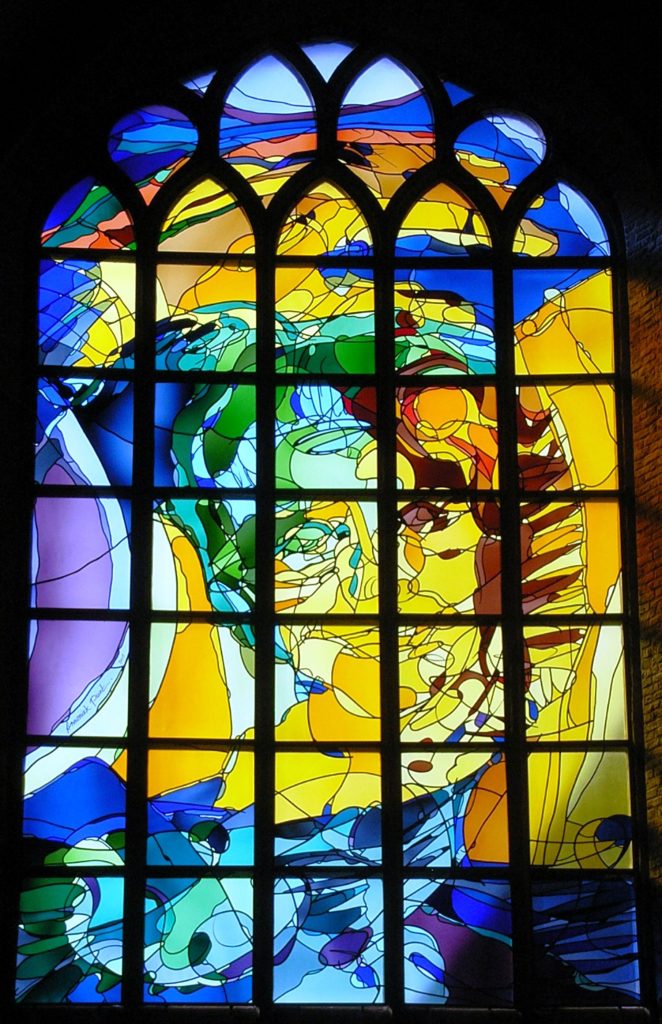
The following is a 2006 stained glass window by Annemiek Punt from the Nieuwe Kerk, Delft, Netherlands:
Stained glass is not just highly decorative, it’s a medium which has been used to express important religious messages for centuries. Literacy was not widespread in the medieval and Renaissance periods and the Church used stained glass and other artworks to teach the central beliefs of Christianity. In Gothic churches, the windows were filled with extensive narrative scenes in stained glass — like huge and colorful picture storybooks — in which worshipers could ‘read’ the stories of Christ and the saints and learn what was required for their religious salvation. (Source: Victoria and Albert Museum )
Following are a number of back-translations of Mark 5:38:
Uma: “Arriving at Yairus’ house, what should he hear but how noisy the people were, they were just weeping and wailing at full strength.” (Source: Uma Back Translation)
Yakan: “When they arrived there at the house of Jairus, he saw the people who were there in a noisy-confusion. They were crying and wailing loudly.” (Source: Yakan Back Translation)
Western Bukidnon Manobo: “And when they arrived there in the house of Jairus, Jesus saw that the people were in a state of confusion. He heard them wailing and weeping.” (Source: Western Bukidnon Manobo Back Translation)
Kankanaey: “When they arrived at Jairus’ house, Jesus saw the noise-making many-people weeping-bitterly and wailing.” (Source: Kankanaey Back Translation)
Tagbanwa: “On their arrival at the house of that overseer, Jesus saw that there were very many people there who were crying and making a lot of noise with their crying.” (Source: Tagbanwa Back Translation)
Living Water is produced for the Bible translation movement in association with Lutheran Bible Translators. Lyrics derived from the ESV® Bible (The Holy Bible, English Standard Version®).
eis ton oikon ‘into the house (home),’ ‘to the house (home)’: eis here probably means ‘to,’ since in v. 39 it is said ‘and he went in’ (into the house), while in v. 40 we read ‘and he entered (the room) where the child was,’ eis ton oikon may mean literally ‘into the house’ or, ‘into (the courtyard of) the house’: the meaning accepted by Revised Standard Version, Translator’s New Testament and others, however, seems to be the preferred one.
oikos ‘house’ or ‘home.’
theōrei (cf. 3.11) thorubon (14.2) ‘he sees a tumult’: the word thorubos means ‘turmoil,’ ‘excitement,’ ‘uproar.’
kai klaiontas kai alalazontas polla ‘and (people) crying and lamenting much’: this phrase describes in detail the thorubon ‘turmoil’ Jesus saw. The two masculine participles are in the accusative case, as the object of the verb theōrei ‘he sees,’ and both refer to people crying and people wailing.
klaiō (5.39; 14.72; 16.10) ‘weep,’ ‘cry.’
alalazō (only here in Mark) ‘wail,’ ‘cry out,’ ‘lament.’
It may be well at this point to specify he more exactly as ‘Jesus’ because of the intervening third person referents. Tumult is ‘many people making a lot of noise.’
Weeping and wailing is equivalent to ‘crying and yelling out’ (Yucateco) or ‘crying and making a noise’ (Central Tarahumara). Wailing appears to most peoples as quite appropriate at the time of death, but in some tribes wailing is carefully avoided so as not to prevent unduly the passage of the spirit from this world to the next.
Quoted with permission from Bratcher, Robert G. and Nida, Eugene A. A Handbook on the Gospel of Mark. (UBS Handbook Series). New York: UBS, 1961. For this and other handbooks for translators see here .
Jesus saw the commotion and the people weeping and wailing loudly: The Greek word that the Berean Standard Bible translates as commotion refers here to noisy, confused activity. In some languages, it may be more natural to say that Jesus heard a commotion rather than saw a commotion.
weeping and wailing The verbs weeping and wailing describe the nature of the commotion. Use a natural way in your language to indicate this. For example:
Jesus saw the confusion and heard all the loud crying and wailing (Good News Bible) -or-
he saw noisy confusion and people weeping and wailing loudly (NET Bible)
weeping and wailing loudly: The Greek words that the Berean Standard Bible translates as weeping and wailing loudly are very similar in meaning. The word weeping refers to crying as an outward expression of grief or sorrow. The word wailing refers to intense or loud weeping. It is emphasized by the word that the Berean Standard Bible translates as loudly.
Use words in your language that describe the way that people weep and cry out when they mourn over someone’s death. If you have one word that describes this kind of weeping and wailing, you could use it instead of two different words.
Made available under the terms of a Creative Commons Attribution-ShareAlike 4.0 License (CC BY-SA) creativecommons.org/licenses/by-sa/4.0
All Scripture quotations in this publication, unless otherwise indicated, are from The Holy Bible, Berean Standard Bible.
BSB is produced in cooperation with Bible Hub, Discovery Bible, OpenBible.com, and the Berean Bible Translation Committee.




Leave a Reply
You must be logged in to post a comment.