The Greek that is translated as “thorns” in English is translated in Low German with Dießeln or “thistles” which are familiar to speakers of Low German (translation by Johannes Jessen, publ. 1933, republ. 2006).
See also thistles.

καὶ ἄλλο ἔπεσεν εἰς τὰς ἀκάνθας, καὶ ἀνέβησαν αἱ ἄκανθαι καὶ συνέπνιξαν αὐτό, καὶ καρπὸν οὐκ ἔδωκεν.
7Other seed fell among thorns, and the thorns grew up and choked it, and it yielded no grain.
The Greek that is translated as “thorns” in English is translated in Low German with Dießeln or “thistles” which are familiar to speakers of Low German (translation by Johannes Jessen, publ. 1933, republ. 2006).
See also thistles.
The parable of The Parable of the Sower is illustrated for use in Bible translations in West Africa by Wycliffe Cameroon like this:

Illustration 1999 Mbaji Bawe Ernest, © Wycliffe Bible Translators, Inc. Used with permission.
The following artwork is part of a series of 56 paintings on biblical themes by Kazakh artist Nelly Bube (born 1949):
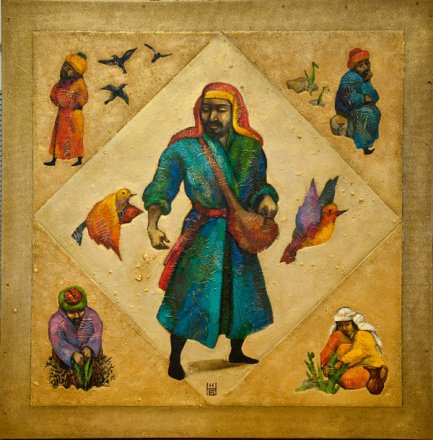
Copyright by Norwegian Bible Society , used with permission.
For other images of Nelly Bube in TIPs, see here.
Following is the translation of Mark 4:1-9 into Russian Sign Language with a back-translation underneath:
Source: Russian Bible Society / Российское Библейское Общество
Jesus came to the Lake of Galilee again. Many people followed Jesus. Jesus was teaching the people and there were more and more people. There were so many people that Jesus didn’t even have anywhere to stand. He was by a lake. There was a boat on the lake. Jesus got into the boat and the people crowded on the shore to listen to Jesus’ words. Jesus began to speak. He taught the people in parables.
Jesus said:
— Listen! There was a sower who sowed seeds. The seeds went to different places. The first place. There was a road nearby. Some of the seeds fell on the road. Birds saw them, flew in, pecked them all up.
Second place: rocky soil. A little bit of earth on top, mostly rocks. The seeds that fell here sprouted a little, but they couldn’t take root because the rocks were in the way. And then the sun came up, it got hot, and the sprouts dried up. The third place is where a lot of weeds grew. The seeds that fell here sprouted, but the weeds killed them, and they could not grow, but withered. The fourth place: good soil. The seeds that fell here grew and gave a bountiful harvest. Some yielded 30 times as much, some 60 times as much, and some 100 times as much. Those of you who ponder this will understand. [See also Costa Rica Sign Language under Let anyone with ears to hear listen]
Иисус снова пришел к Галилейскому озеру. За Иисусом следовало множество народа. Иисус учил народ, а людей становилось все больше. Народу было так много, что Иисус даже некуда было встать. Он был возле озера. На озере была лодка. Иисус встал в лодку, а народ столпился на берегу, чтобы послушать слова Иисуса. Иисус начал говорить. Он учил народ притчами.
Иисус сказал:
— Послушайте! Вот был сеятель, который сеял семена. Семена попали в разные места. Первое место. Там рядом проходила дорога. Некоторые семена упали на дорогу. Птицы увидали, прилетели, склевали семена полностью.
Второе место — каменистая почва. Немного земли сверху, а в основном — камни. Семена, которые упали сюда, немного проросли, но корни пустить не смогли, потому что камни мешали. И вот взошло солнце, стало припекать, и ростки высохли. Третье место — там, где росло множество сорняков. Семена, которые сюда упали, проросли, но сорняки их погубили, и они не смогли вырасти, но тоже завяли. Четвертое место — хорошая почва. Семена, которые сюда упали, выросли и дали обильный урожай. Некоторые дали урожай в 30 раз больше, некоторые в 60, а некоторые в 100 раз больше. Тот из вас, кто обдумает это, поймет.
Back-translation by Luka Manevich
<< Mark 3:31-35 in Russian Sign Language
Mark 4:10-12 in Russian Sign Language >>
Following is the translation of Mark 4:1-9 into Mexican Sign Language with back-translations into Spanish and English underneath:
© La Biblia en LSM / La Palabra de Dios
Jesús empezó a explicar y muchas personas venían, cerca del lago, y Jesús caminó a un barco y se sentó.
Dijo: “Por favor, pongan atención” y les explicó una historia, que es como un ejemplo.
En un campo con tierra buena un hombre estaba arando y después sembró semillas.
Allá en el camino, donde la tierra está dura, algunas semillas cayeron por accidente y los pájaros los comieron y acabaron todo.
Por allá había piedras en la tierra y una capa delgada de tierra, muy poco. Las semillas cayeron y las plantas crecían rápidamente, pero no podían profundizar los raíces porque sólo había piedras abajo de la tierra, y con el fuerte calor del sol las plantas marchitaban.
En otra parte había malas hierbas que cubrían la tierra, y las semillas cayeron en la tierra, y las plantas crecían pero no maduraron.
En otra parte la tierra era buena y las semillas cayeron y las plantas crecían y maduraron 30 y en otro lugar 60 plantas maduraron, y en otro lugar 100 plantas maduraron.
Cuando había acabado la historia Jesús dijo: “Esta historia que ahorita me veían (contar), uds necesitan intentar a resolverlo.”
Jesus began to explain and many people came to him, near the lake, and Jesus walked over and sat down in a boat.
He said: “Pay attention please” and he explained them a story, which is like an example.
“In a field with good soil a man was plowing and then sowed seeds.
“There on the road, where the ground is hard, some seeds fell by accident and the birds came and ate them all.
“In another place there were stones in the ground and only a thin layer of soil, very little. The seeds fell and the plants quickly grew, but they could not put down their roots because there were only rocks in the ground, and when the sun got very hot the plants withered.
“In another part there were weeds that covered the ground and the seeds fell on the ground and the plants grew but did not ripen.
“In another place the soil was good and the seeds fell and the plants grew and 30 ripened, and in another place 60 ripened and in another place 100 ripened.”
When the story was finished Jesus said: “This story that you’ve just seen me (tell), you need to try and work it out.” [See also Costa Rica Sign Language under Let anyone with ears to hear listen]
Source: La Biblia en LSM / La Palabra de Dios
<< Mark 3:20-35 in Mexican Sign Language
Mark 4:10-20 in Mexican Sign Language >>
Following are a number of back-translations of Mark 4:7:
Exegesis:
eis tas akanthas ‘among the thorns’: in clearing the ground for planting, the roots of these thorns and weeds had not been removed, and in time they sprang up and choked the tender plants (cf. Rawlinson).
akanthai (4.8) ‘thorns,’ ‘thistles,’ ‘weeds.’
eis ‘among.’
anebēsan (cf. 1.10) ‘came up’: here as a synonym of exanatellō (v. 5) ‘spring up,’ ‘sprout.’
kai sunepnixan auto ‘and they choked it,’ i.e. the plant sprouting from the seed which had been sown, not (clearly) the seed itself in the ground.
sumpnigō (4.19) ‘crowd together,’ ‘choke off.’
karpon ouk edōken ‘it yielded no fruit’: referring to grain, “yielded no grain” (Goodspeed, Revised Standard Version), “bore no crop” (cf. Translator’s New Testament).
karpos (4.8, 29; 11.14; 12.2) ‘fruit.’
Translation:
Other seed (which is collective) may be rendered as ‘other seeds’ or ‘other grains.’ In Highland Oaxaca Chontal one may say ‘two and three seeds,’ for this is the idiomatic way of saying ‘some.’ In Tzeltal the equivalent expression is ‘another hand-full of seeds.’
These seeds did not actually fall among thorns, in the sense of growing plants, but where thorns had been growing or where there were roots of thorn plants, for note that the effect upon the seed is not seen until the “thorns grew up.” In some languages, therefore, one may translate ‘where thorn plants had been’ or ‘where thorn-plant roots were.’
Choked is a good idiom in English and Greek, but not acceptable in many languages. In Kekchí one must say, ‘the thorns grew up and made a shadow’ (thus preventing the growth of the grain). In Tzeltal one may say ‘the plants made it to stop growing’; in Central Tarahumara and Southern Subanen ‘made them unable to grow’; in San Mateo del Mar Huave ‘shaded them under’; in Tabasco Chontal ‘took them under’; in Toraja-Sa’dan and Javanese ‘they held it under’ and in Pamona ‘they overshadowed it.’
Quoted with permission from Bratcher, Robert G. and Nida, Eugene A. A Handbook on the Gospel of Mark. (UBS Handbook Series). New York: UBS, 1961. For this and other handbooks for translators see here .
4:7a
Other seed fell among thorns: The phrase among thorns probably refers to soil where roots or seeds of thorny plants were present. It is also possible that these seeds fell along the edge of the field where thorny plants were already growing. So when the seeds began to grow, the thorn plants also grew.
Here are some other ways to translate this:
Some other seeds fell where thornbushes grew up (Contemporary English Version)
-or-
Other seeds fell where thorns habitually grow
-or-
Other seeds fell upon soil with thorn seeds/roots
fell: The Greek verb that the Berean Standard Bible translates as fell is the same verb as in 4:4b and 4:5a. Consider whether it is natural in your language to use the same verb or another verb with a similar meaning.
thorns: The Greek word that the Berean Standard Bible translates as thorns can refer to any kind of thorny plant. In this context, this word probably refers to the seeds or roots of thorny plants. Or it may refer to young thorny plants.
Here are some other ways to translate the word thorns:
• Use a general term in your language for thorny plants or for undesirable plants that compete with grain plants. For example:
young thorny plants/bushes
-or-
thorn seeds/roots
-or-
weeds
• Use a specific word that describes a strong, fast-growing plant from your area that is annoying to farmers. If you choose a specific plant, try to choose one that has thorns.
Do not use a word for a plant that only grows close to the ground (see the note in 4:7b).
4:7b
which grew up: The phrase which grew up refers to the thorn plants growing tall, perhaps one meter or more.
choked the seedlings: The Greek word that the Berean Standard Bible translates as choked here refers to the way that the thorns crowded the seedlings. These young plants did not have enough room, soil, water, or sunlight to grow well.
Here are some other ways you could translate this:
crowded the grain/good plants
-or-
kept the grain from growing to maturity
the seedlings: The Greek word that the Berean Standard Bible translates as the seedlings is literally “it” (as in the Revised Standard Version). This pronoun refers to the seeds and the plants that grew from those seeds. The New International Version uses the words “the plants.” Use a natural form in your language here.
4:7c
and: The Greek conjunction that the Berean Standard Bible translates as and here introduces the result of what happened in 4:7b. Use a natural way in your language to indicate that 4:7c is the result of 4:7b.
they yielded no crop: The Greek words that the Berean Standard Bible translates as yielded…crop refer to producing a harvest. No grain grew from the seeds, so the farmer did not get any harvest from them.
Here are some other ways to translate this:
So those plants did not produce a crop. (New Century Version)
-or-
they did not yield any grain
Use a natural expression in your language for this process.
© 2008 by SIL International®
Made available under the terms of a Creative Commons Attribution-ShareAlike 4.0 License (CC BY-SA) creativecommons.org/licenses/by-sa/4.0
All Scripture quotations in this publication, unless otherwise indicated, are from The Holy Bible, Berean Standard Bible.
BSB is produced in cooperation with Bible Hub, Discovery Bible, OpenBible.com, and the Berean Bible Translation Committee.
No comments yet.
Leave a Reply
You must be logged in to post a comment.