Jesus came to the Lake of Galilee again. Many people followed Jesus. Jesus was teaching the people and there were more and more people. There were so many people that Jesus didn’t even have anywhere to stand. He was by a lake. There was a boat on the lake. Jesus got into the boat and the people crowded on the shore to listen to Jesus’ words. Jesus began to speak. He taught the people in parables.
Jesus said:
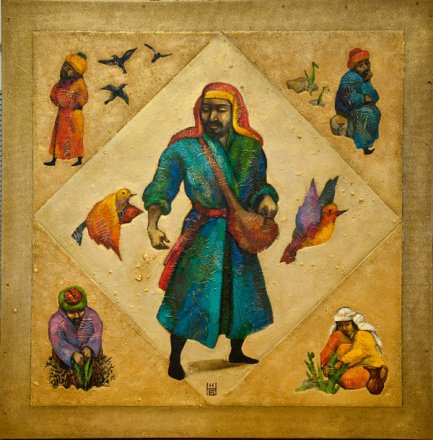
— Listen! There was a sower who sowed seeds. The seeds went to different places. The first place. There was a road nearby. Some of the seeds fell on the road. Birds saw them, flew in, pecked them all up.
Second place: rocky soil. A little bit of earth on top, mostly rocks. The seeds that fell here sprouted a little, but they couldn’t take root because the rocks were in the way. And then the sun came up, it got hot, and the sprouts dried up. The third place is where a lot of weeds grew. The seeds that fell here sprouted, but the weeds killed them, and they could not grow, but withered. The fourth place: good soil. The seeds that fell here grew and gave a bountiful harvest. Some yielded 30 times as much, some 60 times as much, and some 100 times as much. Those of you who ponder this will understand. [See also Costa Rica Sign Language under Let anyone with ears to hear listen]
Original Russian back-translation (click or tap here):
Иисус снова пришел к Галилейскому озеру. За Иисусом следовало множество народа. Иисус учил народ, а людей становилось все больше. Народу было так много, что Иисус даже некуда было встать. Он был возле озера. На озере была лодка. Иисус встал в лодку, а народ столпился на берегу, чтобы послушать слова Иисуса. Иисус начал говорить. Он учил народ притчами.
Иисус сказал:
— Послушайте! Вот был сеятель, который сеял семена. Семена попали в разные места. Первое место. Там рядом проходила дорога. Некоторые семена упали на дорогу. Птицы увидали, прилетели, склевали семена полностью.
Второе место — каменистая почва. Немного земли сверху, а в основном — камни. Семена, которые упали сюда, немного проросли, но корни пустить не смогли, потому что камни мешали. И вот взошло солнце, стало припекать, и ростки высохли. Третье место — там, где росло множество сорняков. Семена, которые сюда упали, проросли, но сорняки их погубили, и они не смогли вырасти, но тоже завяли. Четвертое место — хорошая почва. Семена, которые сюда упали, выросли и дали обильный урожай. Некоторые дали урожай в 30 раз больше, некоторые в 60, а некоторые в 100 раз больше. Тот из вас, кто обдумает это, поймет.
Retrotraducciones en español (haga clic o pulse aquí)
Jesús empezó a explicar y muchas personas venían, cerca del lago, y Jesús caminó a un barco y se sentó.
Dijo: “Por favor, pongan atención” y les explicó una historia, que es como un ejemplo.
En un campo con tierra buena un hombre estaba arando y después sembró semillas.
Allá en el camino, donde la tierra está dura, algunas semillas cayeron por accidente y los pájaros los comieron y acabaron todo.
Por allá había piedras en la tierra y una capa delgada de tierra, muy poco. Las semillas cayeron y las plantas crecían rápidamente, pero no podían profundizar los raíces porque sólo había piedras abajo de la tierra, y con el fuerte calor del sol las plantas marchitaban.
En otra parte había malas hierbas que cubrían la tierra, y las semillas cayeron en la tierra, y las plantas crecían pero no maduraron.
En otra parte la tierra era buena y las semillas cayeron y las plantas crecían y maduraron 30 y en otro lugar 60 plantas maduraron, y en otro lugar 100 plantas maduraron.
Cuando había acabado la historia Jesús dijo: “Esta historia que ahorita me veían (contar), uds necesitan intentar a resolverlo.”
Jesus began to explain and many people came to him, near the lake, and Jesus walked over and sat down in a boat.
He said: “Pay attention please” and he explained them a story, which is like an example.
“In a field with good soil a man was plowing and then sowed seeds.
“There on the road, where the ground is hard, some seeds fell by accident and the birds came and ate them all.
“In another place there were stones in the ground and only a thin layer of soil, very little. The seeds fell and the plants quickly grew, but they could not put down their roots because there were only rocks in the ground, and when the sun got very hot the plants withered.
“In another part there were weeds that covered the ground and the seeds fell on the ground and the plants grew but did not ripen.
“In another place the soil was good and the seeds fell and the plants grew and 30 ripened, and in another place 60 ripened and in another place 100 ripened.”
When the story was finished Jesus said: “This story that you’ve just seen me (tell), you need to try and work it out.” [See also Costa Rica Sign Language under Let anyone with ears to hear listen]
Following are a number of back-translations of Mark 4:5:
Uma: “There was also some that fell on rocky ground with just a little dirt. These seeds quickly grew because the ground was thin.” (Source: Uma Back Translation)
Yakan: “Other seeds fell onto bedrock (batu pãnas), it didn’t have much soil. The seed sprouted easily because the soil wasn’t deep.” (Source: Yakan Back Translation)
Western Bukidnon Manobo: “There was also that which he was planting which fell on very thin soil on top of stones, and the plant sprouted immediately because the soil was thin.” (Source: Western Bukidnon Manobo Back Translation)
Kankanaey: “Others that he sowed fell on a rocky-area. Because its soil was shallow, they quickly-sprouted.” (Source: Kankanaey Back Translation)
Tagbanwa: “As for others, where they got scattered was rocky-ground. They sprouted immediately for the soil was only superficial over those rocks.” (Source: Tagbanwa Back Translation)
Living Water is produced for the Bible translation movement in association with Lutheran Bible Translators. Lyrics derived from the ESV® Bible (The Holy Bible, English Standard Version®).
epi to petrōdes hopou ouk eichen gēn pollēn ‘on rocky (stony) ground where it did not have much soil’: what is meant is a shallow layer of soil covering the outcropping of an underlying bedrock.
Grammatically allo ‘other (seed)’ is the subject of ouk eichen ‘it had not’ and to mē echein ‘not to have’: this other portion of seed did not have much soil, and it sprang up immediately because it did not have any depth of soil. The same meaning, however, may be achieved in another way: ‘where there was not much soil … because there was no depth of soil’ (cf. Goodspeed, O Novo Testamento de Nosso Senhor Jesus Cristo. Revisdo Autorizada).
euthus exaneteilen ‘immediately it sprang up,’ ‘quickly it sprouted.’
hote aneteilen ho hēlios (16.2) ‘when the sun rose,’ ‘after the sun had risen’ (cf. 1.32 ‘when the sun set’). This does not mean ‘at sunrise’: what is meant is that the sun, high in the sky, was sufficiently hot to scorch the newly sprouted plant.
ekaumatisthē (only here in Mark) ‘it was burned,’ ‘it was scorched.’
dia to mē echein rizan ‘because it had no root’: dia ‘on account of’ with the infinitive indicates cause.
riza (4.17; 11.20) ‘root’: due to lack of soil the roots barely developed.
exēranthē (cf. 3.1) ‘it was withered,’ ‘it was shriveled up.’
Translation:
Rocky ground in this passage must be translated in such a way that people understand it not as soil having many stones, but as soil consisting of a thin overlayer on bedrock. This is done in some languages by saying ‘fell into thin soil which was lying on huge rocks’ (as a way of combining the first two clauses into one).
Some translators have failed to translate the second part of verse 5 correctly because they themselves did not understand it. This passage refers to the fact that in the spring of the year thin soil over bedrock or near outcroppings becomes warm faster than deep soil. This contributes to the more rapid germination of the seed. Hence, the seeds do actually spring up quickly, precisely because the soil is thin.
In the English text the seed is referred to collectively, and the pronominal reference in the singular it identifies the portion of seeds which fell in one place or another. In many languages, however, plurals are required, e.g. ‘other seeds fell … and immediately they sprang up….’
When the sun rose should not be restricted merely to the position of the sun in the eastern sky (a typical mistake), but to the sun high in the heavens, scorching the vegetation (the early morning sun is not likely to scorch any vegetation).
In verse 6 it refers to the germinated seeds, hence, ‘the plants.’ Accordingly, in some languages one must speak of ‘the seeds’ in verse 5 and ‘the small plants’ in verse 6.
Since it had no root must not be taken in the absolute sense, or these plants would be quite miraculous. The meaning therefore is ‘because they did not have much root’ or ‘because they did not have deep roots.’
It might seem that in indicating the extent to which a translator is required in some languages to be more specific than the text we are being unnecessarily pedantic or quibbling. This is not the case. We are only calling to the attention of the translator the fact that in many languages, especially of predominantly horticultural peoples, lexical distinctions between words require the selection of forms which are more specific than the corresponding Greek text.
Quoted with permission from Bratcher, Robert G. and Nida, Eugene A. A Handbook on the Gospel of Mark. (UBS Handbook Series). New York: UBS, 1961. For this and other handbooks for translators see here .
Some: The Greek word that the Berean Standard Bible translates as Some is literally “Others.” It refers to another group of seeds.
Here are some other ways to translate this word:
Other seed (New Living Translation) -or-
Some of the seeds
fell: The verb fell is the same verb as in 4:4b. You can translate the verb here in the same way as you did there. In some languages, it may be good style to use words with similar meanings rather than to use exactly the same word for “fell” each time it appears. Do what is natural in your language.
rocky ground, where it did not have much soil: The Greek word that the Berean Standard Bible translates as rocky ground refers to a place on the ground that has solid rock underneath it. This kind of ground did not have much soil over the solid rock.
Here are some other ways to translate this:
shallow soil with underlying rock (New Living Translation) -or- solid rock with a thin layer of soil
it did not have much soil: The Greek phrase that the Berean Standard Bible translates as it did not have much soil means “there was not much soil in which the seed/seeds could grow.” In some languages it may not be necessary to mention the seeds explicitly. For example the New Century Version says:
where there wasn’t much dirt
4:5b
It sprang up quickly because the soil was shallow: In some languages it may be natural to reverse the order of the phrases in this verse part. For example:
The soil was shallow and so it sprang up quickly. -or-
Since the soil was shallow, it sprang up quickly. -or-
The soil was shallow and that is why the seed sprang up quickly.
It sprang up quickly: The phrase It sprang up quickly refers to the seeds quickly sprouting and becoming seedling plants.
Here are some other ways to translate this:
The seeds soon sprouted (Good News Bible) -or-
The plants came up quickly
because: The conjunction because introduces the reason why the seeds sprang up quickly. The seeds sprang up quickly because the soil was shallow.
the soil was shallow: The clause the soil was shallow has almost the same meaning as “it did not have much soil” in 4:5a.
Made available under the terms of a Creative Commons Attribution-ShareAlike 4.0 License (CC BY-SA) creativecommons.org/licenses/by-sa/4.0
All Scripture quotations in this publication, unless otherwise indicated, are from The Holy Bible, Berean Standard Bible.
BSB is produced in cooperation with Bible Hub, Discovery Bible, OpenBible.com, and the Berean Bible Translation Committee.


Leave a Reply
You must be logged in to post a comment.