
The Greek in Luke 6:48 that is translated as “a man building a house” in English is translated in Tampulma as “a man who built his house” since he was building the house for himself. (Source: Callow 1972, p. 35)
parable of the wise builder
The parable of the wise builder is translated in Yaosakor Asmat as “the wise builder is like the person who builds a house on stilts made of iron wood which last a long time, while the foolish builder is the one who builds a house on stilts made of white wood which will rot quickly.”
Daud Soesilio (in Noss 2007, p. 175) explains: “In Pirimapun, a swampy area on the southern coast of Indonesian Papua, the parable of the wise builder who builds on stone foundation and the foolish builder who builds on sand was rendered into the Asmat language as ‘the wise builder is like the person who builds a house on stilts made of iron wood which last a long time, while the foolish builder is the one who builds a house on stilts made of white wood which will rot quickly.’ This adaptation is necessary since one cannot find a single stone in this swampy area, and all houses are built on stilts. They use iron wood stilts for their more permanent houses, and they only use white wood stilts for the temporary houses that they use when they go hunting. White wood will not last. It is also interesting to point out that they use sand from the beach to make their walking paths firm.”
foundation on rock
The Greek in Luke 6:48 that is translated in English as “foundation on rock” or similar is translated in Uripiv as “on good firm ground” (to hold a post). (Source: Ross McKerras)
See also foundation and cornerstone.
The Two House Builders
The following artwork is part of a series of 56 paintings on biblical themes by Kazakh artist Nelly Bube (born 1949):
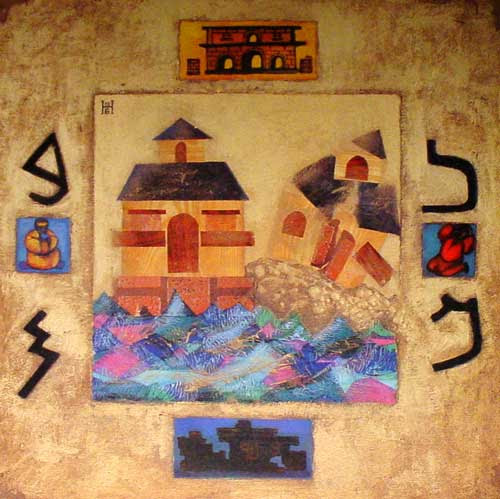
Copyright by Norwegian Bible Society , used with permission.
For other images of Nelly Bube in TIPs, see here.
complete verse (Luke 6:48)
Following are a number of back-translations of Luke 6:48:
- Noongar: “He is like a man building his house; he dug a deep hole and he stood his house on rock. The river overflowed and struck that house but the water could not shake the house, because he built the house well. (Source: Warda-Kwabba Luke-Ang)
- Uma: “A person built a house, he dug the ground he made deep and he planted a strong foundation-stone. Big rain and a flood came and struck that house, but it did not shake because its foundation-stone was strong.” (Source: Uma Back Translation)
- Yakan: “He is like a person building a house. He makes a deep hole until he reaches a rock. Then he erects the posts of his house on the rock. When the house is finished the river floods and the house is reached by the strong flood but his house does not move, for the place-for-standing it/it’s foundation is good.” (Source: Yakan Back Translation)
- Western Bukidnon Manobo: “he is like a person who builds a strong house on top of a great stone. He dug the holes deeply in order to set the posts, and when that house was finished, a typhoon came and the water became deep, and that house was struck by strong-flowing water, but it did not fall because it was built strongly.” (Source: Western Bukidnon Manobo Back Translation)
- Kankanaey: “He is like a person who built his house on a rock. He properly chipped-out-the-rock-for the foundation, then he erected his house. The water in the river then increased and it struck-against that house, but (expression of reassurance) it was not shaken, because its construction was firm/strong.” (Source: Kankanaey Back Translation)
- Tagbanwa: “He is like a person who built a house, putting its posts down really deep in ground which had rocks mixed in it. When bad weather came, when there was a big flood and his house was engulfed in it, nothing bad happened to it, for he had truly made it really sturdy.” (Source: Tagbanwa Back Translation)
Sung version of Luke 6
Translation commentary on Luke 6:48
Exegesis:
anthrōpō oikodomounti oikian hos eskapsen kai ebathunen ‘a man building a house who dug deep.’ The participle in the present tense oikodomounti refers to the general process, i.e. that of building a house, in which the specific acts take place, to which eskapsen kai ebathunen (aorist tense) refer.
skaptō (also 13.8) ‘to dig,’ here intransitive.
bathunō ‘make deep,’ or, ‘go deep,’ here used as a hendiadys together with eskapsen and expressing together one concept, i.e. that of digging deep.
ethēken themelion epi tēn petran ‘he laid the foundation on the rock.’ The article tēn before petran is generic, cf. “upon rock” (Revised Standard Version, Translator’s New Testament).
themelios ‘foundation,’ ‘basis,’ here of the foundation of a building.
plēmmurēs de genomenēs ‘when there came a flood.’ de marks the transition to the next part of the story. genomenēs is inceptive, hence the translation ‘came.’ plēmmura. The picture is that of an overflowing river, as ho potamos shows.
proserēxen ho potamos tē oikia ekeinē ‘the river broke against that house.’
prosrēsso (also v. 49), intransitive, ‘to burst upon,’ ‘to break against.’ Here its meaning is determined by the picture of the overflowing river.
potamos (also v. 49) ‘river.’ The article does not imply a reference to a specific river but to the river which the parable presupposes.
kai ouk ischusen saleusai autēn ‘and was unable to shake it.’
ischuō ‘to have power,’ ‘to be able,’ ‘to be strong enough,’ with following infinitive.
dia to kalōs oikodomēsthai autēn lit. ‘because of its having been well built,’ articular accusative and infinitive.
Translation:
In order to bring out that the point of comparison is not in the building but in the subsequent acts that some adjustments may be necessary, e.g. ‘he is like a housebuilder, who dug…’ (Bahasa Indonesia RC; similarly Marathi, which renders the relative clause as a co-ordinated sentence), ‘he resembles a man who, when (he was) building a house, dug…’ (cf. Bible de Jérusalem); or where co-ordination is preferable, ‘his case is like this: a housebuilder dug…, or, a man was building a house; he dug….’ To build (also in 6.49; 7.5; 11.47f; 12.18; 14.28, 30; 17.28; 20.17) is sometimes rendered by a basically more generic term, e.g. ‘to erect/cause-to-stand’ (Bahasa Indonesia, Trukese, Pohnpeian), ‘to make’ (Javanese, Barrow Eskimo), ‘to bind/tie’ (West Nyanja).
To dig deep, i.e. to make deep holes/cavities, to remove much earth.
And laid the foundation upon rock may require rather radical adaptations, e.g. ‘caused it to receive strength on rock’ (Tzeltal), ‘till he reached rock’ (Shona 1966, similarly Toraja-Sa’dan), ‘its posts reaching-down to the rock’ (Tae’). Foundation, or, ‘base,’ ‘support’ (Sranan Tongo, lit. stone-foot). Upon rock, or, ‘upon strong stones’ (Sranan Tongo). Where rock is unknown one may use ‘upon a solid layer underneath’ (such as sand under marshy ground); or, with more radical adjustments, ‘deep the holes for his posts’ (Tboli, where all houses are built off the ground, and deep holes make sturdy houses).
A flood arose, or, ‘flooding water came,’ ‘a/the river started to flood/overflow.’
The stream, or, ‘the river,’ ‘the/its water,’ or simply, ‘it,’ the pronoun referring back to the flood or river.
And could not shake it, or, ‘but it (i.e. the flooding river) could not shake that house,’ or, ‘it (i.e. the house) did not shake because of it’ (Marathi, shifting to an intransitive construction). Shake, or, ‘cause to totter’ (Nieuwe Vertaling), ‘cause-to-move’ (Batak Toba, Pohnpeian).
Because it had been well built, or, ‘because the man had built it/his house well.’
Quoted with permission from Reiling, J. and Swellengrebel, J.L. A Handbook on the Gospel of Luke. (UBS Handbook Series). New York: UBS, 1971. For this and other handbooks for translators see here . Make sure to also consult the Handbook on the Gospel of Mark for parallel or similar verses.
SIL Translator’s Notes on Luke 6:48
6:48a–b
He is like a man building a house, who dug down deep and laid his foundation on the rock: Jesus compared the person who obeys his teaching to a man who built a house on a solid foundation. The focus is on the foundation, not the house.
In Israel, a builder who wanted a solid foundation for his house would dig into the soil until he reached a layer of rock. Then he would begin building the foundation directly on the rock.
6:48b
dug down deep: The Greek phrase that the Berean Standard Bible translates as dug down deep consists of two verbs. It is literally “dug and went/made deep.” Most English versions, such as the Berean Standard Bible, New International Version, and Revised Standard Version, combine these two verbs into one. However, using two verbs gives greater emphasis on the effort the man gave to be sure his house had a strong foundation. For example:
dug, and dug deep (New Jerusalem Bible)
Use the word or phrase that is natural in your language for digging a long way down into the earth.
laid his foundation: The Greek phrase that the Berean Standard Bible translates as laid his foundation is literally “placed/put the foundation.” In English, building a foundation is called “laying a foundation.” The foundation supports the house. It could also be called the “base” or the “support” of the house.
If building methods are different in your region, you could adapt this parable to fit your culture. Describe here what a man would do to build a house that was sturdy and strong. For example, where houses are built of wood and supported by posts, you could say:
he dug deep holes for his posts
the rock: The Greek word that the Berean Standard Bible translates as rock means “bedrock.” It does not refer to loose stones on top of the ground. It refers to a solid rock mass or layer under the surface of the ground. This layer of bedrock varies in depth. It could be as little as twenty centimeters from the surface, or it could be several meters below it. This explains the need to dig deep.
6:48c
When the flood came, the torrent crashed against that house: The Greek word that the Berean Standard Bible translates as flood refers to high water. A flood occurs when a river overflows its banks because of heavy rain. Apparently the man had built his house near a river. Some other ways to translate this are:
When the flood came and the river rushed against the house (Contemporary English Version)
-or-
The river flooded over and hit that house (Good News Translation)
-or-
When the river was in flood, it burst upon that house (Revised English Bible)
the torrent: The Greek word that the Berean Standard Bible translates as torrent implies in this context a strong, fast-flowing stream of water. For example:
stream (English Standard Version)
crashed against that house: The Greek word that the Berean Standard Bible translates as crashed against describes a great force of water striking against the house. This is a violent and vivid image. Some other ways to translate this are:
rushed against (Contemporary English Version)
-or-
break against (New Living Translation (2004))
-or-
pushed against (God’s Word)
-or-
tried to wash the house away (New Century Version)
6:48d
but: The Greek conjunction that the Berean Standard Bible here translates as but is often translated as “and,” and several English versions translate it that way. Here this conjunction introduces something unexpected. Despite the power of the flood waters, the house was not destroyed. Some other ways to translate this are:
in spite of that
-or-
however
-or-
nevertheless
could not shake it: The Greek phrase that the Berean Standard Bible translates as could not shake it means “was not able to move it” or “was not strong enough to cause it to fall.” Some other ways to translate this are:
it could not shift it (Phillips’ New Testament in Modern English)
-or-
it stands firm (New Living Translation (2004))
because it was well built:
The clause because it was well built states the reason why the floodwaters could not destroy the house.
It is a passive clause. In some languages, it may be natural to use an active verb and supply a subject:
because ⌊the man⌋ built it well
© 2009, 2010, 2013 by SIL International®
Made available under the terms of a Creative Commons Attribution-ShareAlike 4.0 License (CC BY-SA) creativecommons.org/licenses/by-sa/4.0.
All Scripture quotations in this publication, unless otherwise indicated, are from The Holy Bible, Berean Standard Bible.
BSB is produced in cooperation with Bible Hub, Discovery Bible, OpenBible.com, and the Berean Bible Translation Committee.
Leave a Reply
You must be logged in to post a comment.