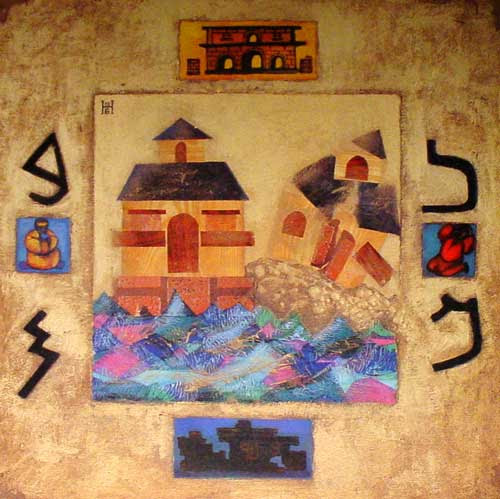
49But the one who hears and does not act is like a man who built a house on the ground without a foundation. When the river burst against it, it quickly collapsed, and great was the ruin of that house.”
Gbaya uses a lot of ideophones (words that express what is perceived by the five senses) which naturally also has an impact on translation. In the case of the two different versions of Jesus’ parable of two house builders in Matthew and Luke, two different ideophones are used to capture the fall of the house and differences in the Greek text.
Philip Noss (in The Bible Translator 1985, p. 423ff. ) explains: “The story is short and dramatic, building up from the wisdom of the first man to the foolishness of the second. In addition to using literary and dramatic narrative style to recount the plot line, the Gbaya translators used ideophones to depict the final drama of both versions of the account.
Matt. 7:27: ɓɛɛ tua’i gbin a nù gɛ́tɛ́-gɛ́tɛ́ (‘… and it fell — and great was its fall!’ [New Revised Standard Version, updated edition])
Luke 6:49: ɓɛɛ tua’i gbin a nù nɛ oi-aa lɛŋ mútú-mútú (‘… and it quickly collapsed, and great was the ruin of that house.’ [New Revised Standard Version, updated edition])
“In both accounts [many English versions] use the verb ‘fall.’ Gbaya also has a verb ‘to fall,’ but it cannot be used here because the houses did not fall from anywhere. They were on the ground and they broke apart or collapsed. This is expressed in Gbaya by a serial verb construction ‘break-put ground.’ To express Luke’s stronger form of the Greek verb, the Gbaya team added ‘completely.’
“Following the Greek text, [most] English versions add a final emphatic clause which Gbaya expresses by an ideophone. To translate Matthew’s version, the Gbaya team said gɛ́tɛ́-gɛ́tɛ́ which depicts the action of breaking apart, of scattering in small pieces. To emphasize Luke’s portrayal of collapse and total ruin, the Gbaya team said mútú-mútú which describes total destruction, something being crushed and ground to pieces. The Gbaya use of the ideophone is more economical and direct than the Greek original and the English translation which both require an additional term and, in the latter, even an exclamation mark.”
The parable of the wise builder is translated in Yaosakor Asmat as “the wise builder is like the person who builds a house on stilts made of iron wood which last a long time, while the foolish builder is the one who builds a house on stilts made of white wood which will rot quickly.”
Daud Soesilio (in Noss 2007, p. 175) explains: “In Pirimapun, a swampy area on the southern coast of Indonesian Papua, the parable of the wise builder who builds on stone foundation and the foolish builder who builds on sand was rendered into the Asmat language as ‘the wise builder is like the person who builds a house on stilts made of iron wood which last a long time, while the foolish builder is the one who builds a house on stilts made of white wood which will rot quickly.’ This adaptation is necessary since one cannot find a single stone in this swampy area, and all houses are built on stilts. They use iron wood stilts for their more permanent houses, and they only use white wood stilts for the temporary houses that they use when they go hunting. White wood will not last. It is also interesting to point out that they use sand from the beach to make their walking paths firm.”
In Gbaya, the notion of being “torn apart” is emphasized with mútú-mútú, an ideophone used to describes the act of being torn apart, destroyed.
Ideophones are a class of sound symbolic words expressing human sensation that are used as literary devices in many African languages. (Source: Philip Noss)
Following are a number of back-translations of Luke 6:49:
Noongar: “But a person who hears my words but doesn’t do what I say, he is like a man building his house, but the house did not stand on rock. The river overflowed and struck that house and the house fell suddenly. The house fell very badly!” (Source: Warda-Kwabba Luke-Ang)
Uma: “But the people who hear my words and do not follow, they are like a person who built a house on just land/the ground without a foundation-stone. A flood came and struck that house, it fell down, and its destruction was great.'” (Source: Uma Back Translation)
Yakan: “Now if a person listens to my words but does not obey them he is like a person building a house, but does not make a hole for the posts and does not stand them on rock. When the strong flood comes immediately the house falls and breaks to pieces.” (Source: Yakan Back Translation)
Western Bukidnon Manobo: “Now the person who just listens to my advice but he does not act upon it, he is like the person who built a house on the sand, and when that house was finished, it also was hit by a typhoon, and the house was struck by the force of strong water, and the house fell and was completely broken up.'” (Source: Western Bukidnon Manobo Back Translation)
Kankanaey: “But the person who has been listening to what I say and he doesn’t believe/obey it, he is compared to a person who built his house on the soil and he didn’t carve out from the rock a place-upon-which-to-set its foundation. So when the water struck-against that house of his, it fell-down and was totally destroyed.'” (Source: Kankanaey Back Translation)
Tagbanwa: “But as for that person who, although he hears my teaching, doesn’t obey it, he is like a person who only did a shoddy job when building his house, for he didn’t make it sturdy by putting the posts down deep in the ground. Well when the flood came, it also was engulfed. What else but for the reason that it wasn’t sturdy, it fell at once and was totally broken up.'” (Source: Tagbanwa Back Translation)
ho de akousas kai mē poiēsas ‘but he who has listened but not done,’ or, ‘but he who hears but does not do’ (treating the aorist as gnomic, i.e. expressing a general truth). The former rendering is preferable.
anthrōpō oikodomēsanti oikian epi tēn gēn chōris themeliou ‘a man who built on the ground without foundation,’ i.e. without digging at all and without laying any foundation. chōris.
hē proserēxen ho potamos ‘against which the river broke.’ hē refers to oikian.
kai euthus sunepesen ‘and immediately it collapsed.’ sumpiptō.
kai egeneto to rēgma tēs oikias ekeinēs mega ‘and the ruin of that house was great.’ mega is used here in a qualifying sense. Its position at the end is emphatic.
rēgma ‘ruin,’ i.e. the collapsing. It refers to the same event as sunepesen.
Translation:
Who hears and does not do them, or, ‘who has listened to my words and has not done them.’ The aspect is momentaneous, as against the durative aspect in v. 47.
Who built a house on the ground without a foundation, the opposite of “who dug … upon rock”, but worded more briefly. On the ground, or, ‘simply on the ground/soil,’ i. e. without any digging (Malay, Sranan Tongo), ‘not at all deep the holes for his posts’ (Tboli). Without a foundation, or, ‘but had not made a foundation/basis (for it),’ ‘not having founded it, or, set it on a solid layer underneath.’
Against which the stream broke …, usually better in a new sentence, e.g. ‘The flood/river broke against it and immediately it fell,’ cf. also “when the flood hit that house it fell at once” (Good News Translation).
The ruin of that house was great, or, ‘the total destruction of that house took place’ (Marathi), ‘it fell down, or, was destroyed, completely’ (cf. Trukese, East and Toraja-Sa’dan).
Quoted with permission from Reiling, J. and Swellengrebel, J.L. A Handbook on the Gospel of Luke. (UBS Handbook Series). New York: UBS, 1971. For this and other handbooks for translators see here . Make sure to also consult the Handbook on the Gospel of Mark for parallel or similar verses.
But: The Greek conjunction that the Berean Standard Bible translates as But introduces an opposite example. Another way to translate this conjunction is:
However
the one who hears My words and does not act on them: The person described in this clause does not obey Jesus’ teaching. Translate this clause in a way that shows this man to be the direct opposite of the man in 6:47b–c. For example:
the person who hears what I say but does not obey -or-
the person who hears what I tell him to do but does not do it
and: The Greek word that the Berean Standard Bible translates as and connects two actions: hearing Jesus’ words and not obeying them. Normally we would expect someone who comes to Jesus and hears his teaching to be ready to obey it. This person does not obey Jesus’ teaching.
In some languages, it may be more natural to use a contrast connector like “but.” For example:
hears my words but does not obey
Connect these clauses in a natural way in your language.
6:49c–d
is like a man who built his house on ground without a foundation: Unlike the man in 6:48a–b, this man did not build a solid foundation for his house. Instead, he built it directly on the surface of the earth. He did not dig down to the bedrock.
6:49e
The torrent crashed against that house, and immediately it fell: In Greek, the structure of this clause is parallel to what happened to the first house in 6:48c–d. Some other ways to translate this are:
As soon as the river rushed against that house, it was smashed (Contemporary English Version) -or-
As soon as the river burst upon it, the house collapsed (Revised English Bible)
It may be good style in some languages to keep the examples of the two houses similar in structure.
fell: The Greek word that the Berean Standard Bible translates as fell here means “fell down.” The river washed out the earth from under the house, and it quickly fell down. For example:
the house quickly fell (New Century Version)
6:49f
great was its destruction: The phrase great was its destruction means “it was completely destroyed.”
In some languages, there may be an idiom or a more descriptive way to express that the house was completely destroyed. For example:
it was smashed to pieces (Contemporary English Version) -or-
collapse into a heap of ruins (New Living Translation (2004))
If it is more natural in your language to use an active verb, you could say:

Leave a Reply
You must be logged in to post a comment.