
mustard seed

The Greek that is translated in English as “mustard seed” is translated in Muna as “wonolita seed.” René van den Berg explains: “The mustard plant rarely exceeds 50 cm in height. A wonolita is a big forest tree growing from a tiny seed.”

In the Bislama and Uripiv translations it is translated as “banyan.” “The banyan tree is one of the biggest in the islands, and it grows from a tiny seed. We (Uripiv) added a footnote to explain to more advanced readers what we had done: ‘Here Matthew compares the kingdom of God to a mustard seed, but since mustard doesn’t grow here, we put banyan, so that Matthew’s meaning will be clear.’” (Source: Ross McKerras)

In Elhomwe it is translated as “tree seed.” (Source: project-specific translation notes in Paratext)

In Gbaya is is translated with the ideophone kɛ̧́ɛ̧́ which “denotes a very tiny and barely visible object. (…) The Gbaya team applied it to faith instead of referring to a mustard seed which is unknown to Gbaya readers.” Ideophones are a class of sound symbolic words expressing human sensation that are used as literary devices in many African languages. (Source: Philip Noss)

See also mustard.
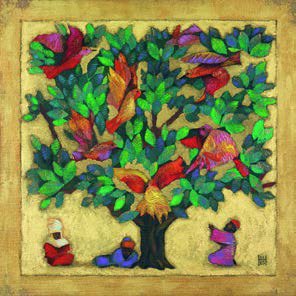
birds of the air

The Greek and Hebrew phrases that are often translated as “birds of the air” in English “refer to the undomesticated song birds or wild birds, to be distinguished in a number of languages from domesticated fowl. In Tzeltal these former are ‘field birds’.” (source: Bratcher / Nida)

Q’anjob’al also uses an established term for non-domesticated birds. Newberry and Kittie Cox (in The Bible Translator 1950, p. 91ff. ) explain: “Qʼanjobʼal has two distinct terms, one to identify domesticated birds and the other non-domesticated birds. The additional descriptive phrase ‘of the air’ seemed entirely misleading, for Qʼanjobʼal speakers had never heard of such creatures. Actually, of course, all that was necessary was the term for non-domesticated birds, for that is precisely the meaning of the Biblical expression.”

In Elhomwe they are just translated as “birds” or “birds of the bush” (i.e., wild birds) to “not give the impression that these are special type of birds.” (Source: project-specific translation notes in Paratext)

See also birds of the air / fish of the sea and birds or four-footed animals or reptiles.

mustard

There is by no means full agreement about the precise identity of the plant in Jesus’ famous references to the mustard seed. Two types of mustard grow in the Holy Land and probably grew there in Bible times: Black Mustard Brassica nigra and White Mustard Sinapis alba. Both species were either cultivated or gathered in Bible times, probably more for the oil, which was used in medicine and cooking, than as a spice. Both types are cultivated today.

Mustard plants are related to some other well-known food plants, such as collards, broccoli, cauliflower, Brussels sprouts, rutabaga, and Chinese cabbage. They are planted and harvested each year. They grow to 2 meters (7 feet) in height and have branches like a tree. At the ends of the branches there are bright yellow flowers with four petals, like nearly all the members of the Brassicaceae family. The seeds are small among the seeds of garden plants, being about 2 millimeters (1/12 inch) in diameter, but they are not by any means the smallest of all seeds.

The point of the mustard seed parable of Jesus is that something small can produce something very large and complex, like the kingdom of God, or like the amazing deeds of a person with faith.

At least thirty kinds of mustard are known in the world, twenty-one of them in Europe. Others are found in Northeast Africa, India, Japan, and China. The quality in focus in all of the Gospel references is the smallness of the mustard seed compared to the large size of the resulting plant. The translator must keep that in mind, even if a relative of the mustard is found. If no effective equivalent is available, it will be necessary to transliterate “mustard” from a major language.

White mustard plants, photo by Nigel Hepper
Mustard seeds with pin, photo by Ray Pritz

Source: Each According to its Kind: Plants and Trees in the Bible (UBS Helps for Translators)

See also mustard seed.

complete verse (Luke 13:19)

Following are a number of back-translations of Luke 13:19:

  • Noongar: “It is like this. A man took one tiny seed and planted the seed in the ground. The seed grew and became a tree, and birds could build their nests in the branches.'” (Source: Warda-Kwabba Luke-Ang)
  • Uma: “A person took a mustard-green seed, he went to plant it in his garden. That seed grew bigger and bigger, until it become a tree, and birds made their nests in its branches.'” (Source: Uma Back Translation)
  • Yakan: “The ruling of God over his people,’ said Isa, ‘is figuratively like one kind of very small seed that a person plants in his garden. It sprouts and becomes a tree. And the birds make their nests on it’s branches.'” (Source: Yakan Back Translation)
  • Western Bukidnon Manobo: “The increase of those whom God rules over is like a plant which has a very small seed. A person plants this in the field and when it sprouts, it becomes large and it becomes as big as a tree, and the birds light in it and they build their nests in its branches.'” (Source: Western Bukidnon Manobo Back Translation)
  • Kankanaey: “It can be compared to a small mustard seed which a person planted in his field. It grew until its size was like a tree and birds were able to nest in its branches.'” (Source: Kankanaey Back Translation)
  • Tagbanwa: “It’s like a mustasa’ seed which was planted by a person in his garden. Well, it grew till it became a tree. Without anything else, its branches were then nested in by the birds.'” (Source: Tagbanwa Back Translation)

Translation commentary on Luke 13:19

Exegesis:

homoia estin kokkō sinapeōs ‘it is like a mustard seed.’ kokkos sinapeōs also 17.6.

hon labōn anthrōpos ebalen eis kēpon heautou ‘which a man took and put in his garden.’ ballō lit. ‘to throw,’ is used here in a weakened sense, ‘to put.’ The aorist tense of ebalen and the other verbs in v. 19 is gnomic and due to the parable-character of the passage. It does not refer to a past event but to a present reality.

kēpos ‘garden.’

kai ēuxēsen ‘and it grew,’ change of subject. For auxanō cf. on 1.80.

kai egeneto eis dendron ‘and it became a tree.’ ginomai eis with accusative means ‘to become.’

kai ta peteina tou ouranou kateskēnōsen en tois kladois autou ‘and the birds of the air nested in its branches.’ For ta peteina tou ouranou cf. on 8.5.

kataskēnoō ‘to nest.’

klados ‘branch.’

Translation:

A grain of mustard seed, i.e. a single seed of the mustard plant. One should keep in mind that in Rabbinic literature the mustard seed was proverbial for an insignificant size or amount (also in the Koran, S. 21.47; 31.16). A close equivalent in Indonesia is the Brassica juncea (or, rugose), which is botanically related with the Sinapis nigra, has an equivalent function (its leaves being used for spicing food), can reach a length of 1.25 M., and is typical for insignificance (it being said, for instance, in a Malay literary work that heaven and earth are “no bigger than a seed of the brassica when compared with Allah’s Throne”, and in a Balinese proverb that bad people “see the sins of the righteous, although they are as Brassica seeds, but do not see their own sins, although they are as madja-fruits”). In some cases, however, a reference to mustard seed, or to a close botanical and functional equivalent does not fit the context, e.g. because its plant is small, so that it would be ridiculous to say that the birds nestle in its branches, or because another seed is proverbial for insignificance. Then one may consider a generic rendering, such as ‘tiny seed,’ or a cultural equivalent, e.g. seed of a fig tree (used in Yao), or of a banyan tree (suggested but not used in Gujarati)—with an explanatory footnote, if thought necessary. For seed see 8.5.

Which a man took and sowed in his garden is sometimes better changed into a conditional or temporal clause going with what follows, ‘when a man takes it (or, that seed) and sows it in his garden, it grows….’ A man, or, where sowing is not done by men, ‘somebody,’ the sex not being relevant here. For to sow see references on 8.5. Garden, or, ‘field,’ ‘plot of ground.’

It grew, or, using a more specific verb, ‘it sprouted’ (Balinese), or shifting to what comes from the seed, ‘the plant grew.’ Cf. also 1.80.

And became a tree, or, ‘till it had-a-stem’ (Balinese). That tree is used rather hyperbolically may be indicated by saying ‘a tree so to say,’ but a word for ‘bush,’ or, ‘shrub’ may be more appropriate for the plant in question.

The birds of the air, see 8.5.

To make nests, or, ‘to nest,’ ‘to make/have a place to live,’ ‘to live.’

In its branches, or, ‘among its branches/twigs/leafstalks,’ ‘under its leaves,’ etc. depending again on what is normally said in connexion with the plant chosen, or even, ‘in its shade’ (Malay).

Quoted with permission from Reiling, J. and Swellengrebel, J.L. A Handbook on the Gospel of Luke. (UBS Handbook Series). New York: UBS, 1971. For this and other handbooks for translators see here . Make sure to also consult the Handbook on the Gospel of Mark for parallel or similar verses.

SIL Translator’s Notes on Luke 13:19

13:19a–c

The Berean Standard Bible and most other English versions translate the parable in this verse using past-tense verbs such as “tossed,” “grew,” and “became.” A few versions, such as the Contemporary English Version and Good News Translation, use present-tense verbs such as “takes,” “plants,” and “grows.” Use whatever verb forms are natural in your language for this kind of parable.

13:19a

It is like a mustard seed: The clause It is like a mustard seed is a simile. It compares the kingdom of God to what happens when a mustard seed is planted. The Jewish people considered the mustard seed to be a symbol of smallness. However, the mustard plant grew to be a tree as large as three meters (ten feet) high.

The point of similarity in this comparison is the growth from something small to something large. Like the mustard plant, the kingdom of God is very small at its beginning, but it becomes very large.

The following may be a good model because it makes clear that the comparison describes the whole growth process, not just what the seed is like:

It is like what happens when someone plants a mustard seed in a garden. (Contemporary English Version)

mustard seed: If people in your language group do not know about mustard seeds or plants, here are some ways to translate mustard seed:

Use a loan-word along with a general term if necessary. For example:

a seed of ⌊the plant/tree called⌋ mustard

Use a descriptive phrase. For example:

a tiny seed

Use the name of a local seed that is known to be very small, but which grows into a tree. If you use this option, you may want to indicate the literal name in a footnote. For example, you could say in the footnote:

The Greek text is literally “a mustard seed.”

Regardless of the way you translate mustard seed, you may want to add a footnote that explains the significance of mustard seed in the Jewish culture. For example:

For the Jews, the mustard seed was a symbol of something that was very small. But the mustard seed that was planted in the country of the Jews grew into a tree that was three meters high.

a man tossed into his garden: The Greek phrase that the Berean Standard Bible translates as a man tossed is literally “taking, a man threw.” The word “taking” means that the man picked up the seed with his hand. In some languages it may be more natural to leave this action implicit. The Greek word that the Berean Standard Bible translates as tossed here means to sow or scatter seed on the ground. The method of planting is not in focus here. You may use whatever term is natural in your language for planting this kind of seed in a vegetable garden or field.

13:19b

It grew and became a tree: The Greek word that the Berean Standard Bible translates as tree may refer to either a tree or bush. Most English versions have tree. However, another way to translate this is:

When it was fully grown, it became a large bush (New American Bible)

In some languages it may not be possible to refer to a mustard plant as a “tree” and there may not be a term such as “bush” or “shrub.” If that is true in your language, you may describe the growth of the mustard using other terms. For example:

grows as big as a tree (Contemporary English Version)
-or-
grew until it was a very large plant

13:19c

the birds of the air: The Greek phrase that the Berean Standard Bible translates as the birds of the air was a common way to refer to wild birds that can fly. In some languages it may be more natural to simply use a general word. For example:

birds (Good News Translation)

The same phrase occurs in 8:5.

nested in its branches: The Greek word that the Berean Standard Bible translates as nested usually means “made a home.” In this context it may also refer to roosting or finding temporary shelter. Some ways to translate this verb are:

make their nests (Good News Translation)
-or-
sheltered (New Jerusalem Bible)
-or-
came to roost (Revised English Bible)
-or-
perched (New International Version)

Use a natural term in your language that describes what birds might do in a plant of this size.

© 2009, 2010, 2013 by SIL International®
Made available under the terms of a Creative Commons Attribution-ShareAlike 4.0 License (CC BY-SA) creativecommons.org/licenses/by-sa/4.0.
All Scripture quotations in this publication, unless otherwise indicated, are from The Holy Bible, Berean Standard Bible.
BSB is produced in cooperation with Bible Hub, Discovery Bible, OpenBible.com, and the Berean Bible Translation Committee.