The Hebrew and Greek that is translated as “barren” in English is translated with two different terms in Sranan Tongo: “unable to get a child” (used in Luke 1:7) and “closed womb/belly” (because of old age) (used in Luke 1:36). (Source: Reiling / Swellengrebel)
For the translation into Upper Guinea Crioulo, it was not possible to translate with a purely descriptive term. David Frank (in this blog post ) explains:
“The [translation] team is doing a great job, but there were some challenges. Luke 1:7 is supposed to say that Elizabeth was barren, but they said that while their word for barren might be used for animals, it would not be polite to use for people. They translated it as Deus ka da Isabel bambaran, which means ‘God hadn’t given Elizabeth a bambaran,’ which refers to the cloth a woman uses to carry an infant on her back.”
In Southern Zazaki it is translated as “blind chimney.” (Source: Werner 2012, p. 128)
The name that is transliterated as “Elizabeth” or “Elisabeth” in English means “God of the oath,” “God is her oath,” a worshiper of God,” “my God has sworn.” (Source: Cornwall / Smith 1997 )
Following is a Serbian Orthodox icon of the Annunciation to Mary from the 14th century (found in the Church of Theotokos the Perivleptos, Ohrid, today in the National Museum of Serbia).
Orthodox Icons are not drawings or creations of imagination. They are in fact writings of things not of this world. Icons can represent our Lord Jesus Christ, the Virgin Mary, and the Saints. They can also represent the Holy Trinity, Angels, the Heavenly hosts, and even events. Orthodox icons, unlike Western pictures, change the perspective and form of the image so that it is not naturalistic. This is done so that we can look beyond appearances of the world, and instead look to the spiritual truth of the holy person or event. (Source )
Tibbs (2025, p. 51ff.) writes about the annunciation icon: “The archangel is seen entering from the left, moving toward the right, which is the typical direction of narrative action in icons. One reason for this is that the icon is read similarly to the Greek text in the New Testament, from left to right.
“The are no walls in the icon to suggest that Gabriel had entered an indoor space, as would have been presser in naturalistic art. The absence of enclosing walls in iconography is also intentional since the icon has no dimension or physical boundaries. There is no light source, and therefore, there are no shadows. The absence of both walls and light sources serves to convey that the event itself expands beyond its natural earthbound limits. Evdokimov writes that the icon is ‘never a window on nature,’ not even on a specific place, ‘but rather an opening onto the beyond.’
“It is the red drape that sets the scriptural event within its actual indoor historical setting, with the color red representing the earthly setting of this event. The red drape affirms that this event took place at a specific moment in history, in a specific indoor space in Nazareth, between a specific angel, Gabriel, and a specific young woman, Mary, in the ‘sixth month’ after Elizabeth conceived (Luke 1:26-27, 36). Yet the icon goes beyond the historical setting to encompass the cosmic significance of this event: the eternal God enters human history.”
Following are a number of back-translations of Luke 1:36:
Noongar: “You remember (lit.: “ear-hold”) Elizabeth, your relative? People say this one can’t bear a child, yet now she is pregnant six months — and she is an old woman.” (Source: Warda-Kwabba Luke-Ang)
Uma: “Listen: your (sing.) relative Elisabet who is very old, and whom others call barren is six months pregnant! She will give birth to a male child.” (Source: Uma Back Translation)
Yakan: “Look also at your relative Elisabet. She is pregnant now even though she is old. The woman they said couldn’t give birth is now in the sixth month of her pregnancy.” (Source: Yakan Back Translation)
Western Bukidnon Manobo: “And this is not the only news I have for you, because your aunt Elizabeth, even though she is already very old, she has become pregnant. It is already six months now that she is pregnant, she whom the people long ago thought that she could not give birth.” (Source: Western Bukidnon Manobo Back Translation)
Kankanaey: “Think-of your (sing.) relative Elizabet. Even though they thought/said she was barren and she was moreover an old-woman, she became-pregnant nonetheless, and her pregnancy (lit. fetus) is six months now.” (Source: Kankanaey Back Translation)
Tagbanwa: “And isn’t it so that you have a relative who is Elisabet? It’s clear to everyone that as for her, she is a non-child-bearing woman. But now/today, this is the sixth month of her pregnancy, even though she is old already.” (Source: Tagbanwa Back Translation)
Image taken from the Wiedmann Bible. For more information about the images and ways to adopt them, see here . For other images of Willy Wiedmann paintings in TIPs, see here.
Following is a contemporary tempera / gouache on leather painting by an unknown Ethiopian artist:
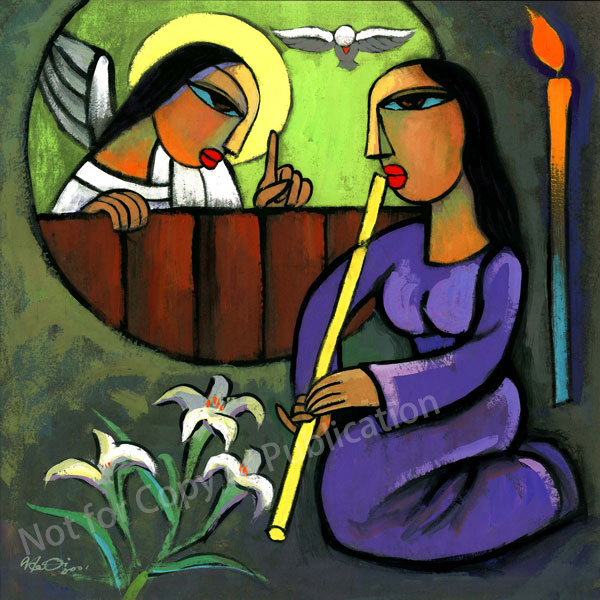
Image taken from He Qi Art . For purchasing prints of this and other artworks by He Qi go to heqiart.com . For other images of He Qi art works in TIPs, see here.
Following is an artwork by Sister Marie Claire , SMMI (1937–2018) from Bengaluru, India:
(Note that supernatural beings are always portrayed with this type of upraised scarf and white circle.)
For more information about images by Sister Marie Claire and ways to purchase them as lithographs, see here . For other images of Sister Marie Claire paintings in TIPs, see here.
The following is a contemporary stained glass window from Our Lady of Pity in Swaffham, United Kingdom:
Stained glass is not just highly decorative, it’s a medium which has been used to express important religious messages for centuries. Literacy was not widespread in the medieval and Renaissance periods and the Church used stained glass and other artworks to teach the central beliefs of Christianity. In Gothic churches, the windows were filled with extensive narrative scenes in stained glass — like huge and colorful picture storybooks — in which worshipers could ‘read’ the stories of Christ and the saints and learn what was required for their religious salvation. (Source: Victoria and Albert Museum )
Click or tap here to see the rest of this insight.
Like a number of other East Asian languages, Japanese uses a complex system of honorifics, i.e. a system where a number of different levels of politeness are expressed in language via words, word forms or grammatical constructs. These can range from addressing someone or referring to someone with contempt (very informal) to expressing the highest level of reference (as used in addressing or referring to God) or any number of levels in-between.
One way Japanese shows different degree of politeness is through the choice of a third person singular and plural pronoun (“he,” “she,” “it” and their various forms) as shown here in the widely-used Japanese Shinkaiyaku (新改訳) Bible of 2017. While it’s not uncommon to avoid pronouns altogether in Japanese, there are is a range of third person pronouns that can be used. In these verses a number of them are used that pay particularly much respect to the referred person (or, in fact, God, as in Exodus 15:2), including kono kata (この方), sono kata (その方), and ano kata (あの方), meaning “this person,” “that person,” and “that person over there.”
suggenis feminine form of suggenēs ‘of the same kin’; it implies blood-relationship but does not define its degree.
kai autē ‘she also,’ or ‘even she,’ (not ‘herself’), serves to reinforce Elisabet.
suneilēphen ‘has conceived,’ see on vv. 24 and 31 but here with object. The perfect tense refers to some fact of the past which has brought about a still prevailing situation.
en gērei autēs ‘in her old age.’ gēras.
kai houtos mēn hektos estin ‘this is the sixth month,’ not ‘this month is the sixth’; houtos takes the gender of the predicate.
autē tē kaloumenē steira ‘for her who was said to be barren’; tē kaloumenē steira is in apposition to autē, but is usually translated as a relative or concessive clause.
kaloumenē ‘being called’; the present participle of the passive of kaleō, ‘to call,’ when not used to indicate a name, expresses what one is thought to be or what one really is (cf. Schonfield, “who was barren”). Both interpretations are possible here.
steira ‘barren,’ see on v. 7.
Translation:
Your kinswoman or a word for ‘cousin’ (relative of one’s own generation), or preferably, ‘aunt’ (in its classificatory sense indicating relatives of the generation of one’s parents). If the language uses distinctive terms for relatives of patrilineal or matrilineal descent, Mary and Elizabeth can best be taken to belong to different patrilineal groups. — In languages without a category of gender it is in this context superfluous, or even slightly ridiculous, expressly to indicate the sex, as done in one version.
Has conceived a son, or, ‘is pregnant with a son.’ In several languages the usual expression for ‘to conceive,’ or, ‘to be pregnant’ cannot take ‘son/daughter’ as its object or qualification. In such cases one will have to use here another rendering of the verb than in v. 24, e.g. ‘there-is a male foetus (lit. what-is-carried-inside)’ (Javanese), ‘being-with-life-of a son’ (Batak Toba), ‘there-is her son that-makes-abdomen’ (Tboli), ‘she is with abdomen; she will give birth to a son’ (Kituba, similarly Tae’).
In her old age, or, ‘old though she is.’
This is the sixth month with her, i.e. of her pregnancy, as made explicit e.g. in ‘having-conceived, it has monthed/full-mooned six-times’ (Navajo, Apache), cf. also on v. 26.
Who was called barren, or, ‘whom they (indefinite) regarded to be barren’ (Thai), ‘even though she is barren, they (indefinite) say’ (Cuyono); or, reversing the clause order, ‘she who formerly was called barren, now has-reached her sixth month’ (Balinese). For barren see above on v. 7.
Quoted with permission from Reiling, J. and Swellengrebel, J.L. A Handbook on the Gospel of Luke. (UBS Handbook Series). New York: UBS, 1971. For this and other handbooks for translators see here . Make sure to also consult the Handbook on the Gospel of Mark for parallel or similar verses.
Look: The Greek word that the Berean Standard Bible translates as Look is the same word that it translates as “now” in 1:20 and as “Behold” in 1:31. This word often functions to focus attention on what follows and to indicate that this is important or amazing. Here it draws attention to the fact that Elizabeth is pregnant. This is something completely unexpected.
Some ways to translate the word in this context are:
And behold (English Standard Version) -or-
And listen -or-
And I tell you this too (New Jerusalem Bible)
even Elizabeth: The Greek word that the Berean Standard Bible translates as even means “also.” In this context it emphasizes something amazing that is true of Elizabeth as well as of Mary. Elizabeth is another example of someone who became pregnant through God’s power, since she was too old to have children. Use a natural way in your language to express this emphasis. Other ways to do this in English are:
has herself conceived a son (Revised English Bible) -or-
has also become pregnant with a son
your relative: The text does not say how Elizabeth and Mary were related. So it is good to translate relative in a general way. Another way to translate this is:
kinswoman (Revised English Bible)
has conceived a son: Some other ways to translate the Greek phrase that the Berean Standard Bible translates as has conceived a son are:
is…pregnant with a son (New Century Version) -or-
is going to have a child (New International Version)
in her old age: The phrase in her old age means “even though she is old.” Mary already knew Elizabeth and knew that she was past the normal age of childbearing. The angel did not tell her new information concerning Elizabeth’s age.
1:36b
she who was called barren: The Greek phrase that the Berean Standard Bible translates as she who was called barren indicates how people described Elizabeth because she did not have any children. It is also an idiom. She was not just called barren; she had actually been barren.
Some other ways to translate this are:
Everyone thought she could not have a baby (New Century Version) -or-
She was not able to have children before (NLV) -or-
It is said that she cannot have children (Good News Translation)
Notice that the Berean Standard Bible uses a past tense form here, but the Greek uses a present form. The Good News Translation reading quoted just above reflects this. Use a natural form in your language for this context.
barren: The word barren describes a woman who is not able to conceive or bear a child. Among the Jews it was considered disgraceful for a married woman to be barren. Many Jewish women felt ashamed if they were not able to have children. Translate using language that will be sensitive and respectful for public reading.
is in her sixth month: The phrase is in her sixth month means that Elizabeth had begun her sixth month of being pregnant.





Leave a Reply
You must be logged in to post a comment.