14they and every wild animal of every kind and all domestic animals of every kind and every creeping thing that creeps on the earth and every bird of every kind.
The Hebrew and Ge’ez that is translated in English as “livestock” (or “cattle”) is translated in Newari as “living beings brought up in a house” or “living beings cared for in a house” (source: Newari Back Translation). Specifically “cattle” is “cows and oxen.”
In Kwere it is “animals that are being kept.” (Source: Pioneer Bible Translators, project-specific translation notes in Paratext)
The Hebrew, Latin, Ge’ez, and Greek that is translated in English as “wild animal” or “wild beast” is translated in Newari as “animal that lives in the jungle.” (Source: Newari Back Translation)
The Hebrew, Latin, Ge’ez, and Greek that is translated in English as “reptiles” or “creeping things” or similar is translated as “those which crawl along upon their stomach” in San Mateo del Mar Huave, “those that crawl the way they travel” in Chichimeca-Jonaz, and “animals that crawl on the ground” in Lalana Chinantec. (Source: Viola Waterhouse in Notes on Translation August 1966, p. 86ff.)
In Nyamwezi it is translated as as vitundwa vya ku’yu’mba or “creatures that move.” (Source: Pioneer Bible Translators, project-specific translation notes in Paratext)
The Hebrew words zachal and remes literally mean “creeping [things]” or “crawling [things]”, which is the Hebrew way of referring to small unclean creatures, reptiles in particular. The Greek word herpeton is also a general word for reptile; it includes snakes and lizards. All of the Hebrew, Greek, and Latin words usually exclude fish.
The Hebrew words carry the connotation of uncleanness.
In languages which have a word meaning “reptile”, this will fit most contexts. In languages which do not, phrases such as “snakes and lizards”, “wriggling things”, and so forth could be used.
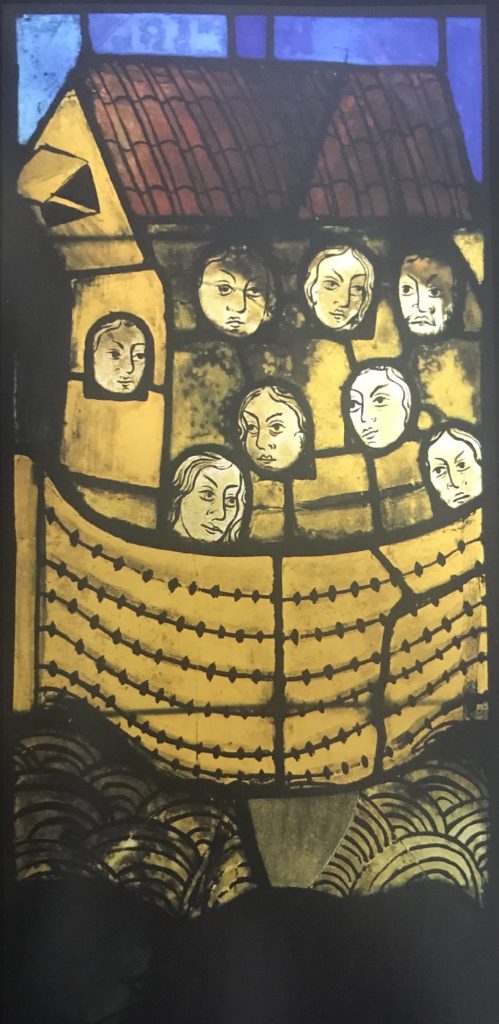
The following is a stained glass window from the Three choir windows in the Marienkirche, Frankfurt (Oder), Germany, of the 14th century, depicting Noah’s ark
Source: Der gläserne Schatz: Die Bilderbibel der St. Marienkirche in Frankfurt (Oder), Neuer Berlin Verlag, 2005, hosted by Wikimedia Commons under a public domain license
Stained glass is not just highly decorative, it’s a medium which has been used to express important religious messages for centuries. Literacy was not widespread in the medieval and Renaissance periods and the Church used stained glass and other artworks to teach the central beliefs of Christianity. In Gothic churches, the windows were filled with extensive narrative scenes in stained glass — like huge and colorful picture storybooks — in which worshipers could ‘read’ the stories of Christ and the saints and learn what was required for their religious salvation. (Source: Victoria and Albert Museum )
While the Greek word strouthion is certainly the name for the sparrow, the Hebrew tsippor is actually an inclusive word that refers to sparrow-sized birds in general. These small birds, especially sparrows, were caught in nets and traps and were an important part of the diet of poor people.
There are three types of sparrow that are common in Israel, the House Sparrow Passer domesticus, the Spanish Sparrow Passer hispaniolensis, and the Dead Sea Sparrow Passer moabiticus. All three are small speckled brown birds. Additional small birds that abound around towns and settlements are members of the bunting, finch, and tit families. Sparrows in particular are usually found in fairly large numbers roosting and nesting together. All are seed eaters and live mainly on grass seeds and grain.
Sparrows were considered clean birds and were associated with the poor.
Sparrows or sparrow-like small birds are found all over the world. Finding a local word is not usually difficult. The reference to “a lonely bird on the housetop” in Psalms 102:7 takes on additional meaning if the sparrow was intended, since it is a bird that is seldom seen alone. It would then indicate the psalmist’s sense of loneliness at being separated from those with whom he belongs.
Following are a number of back-translations as well as a sample translation for translators of Genesis 7:14:
Kankanaey: “including all the kinds of animals and birds that God commanded, who were the time and the wild, the large and the small that were male and female.” (Source: Kankanaey Back Translation)
Newari: “With them went all kinds of domesticated animals, wild animals, beings that creep on the ground, and all kinds of birds.” (Source: Newari Back Translation)
Hiligaynon: “Also going-with them were all kinds of animals: the (ones-that)-walk, the (ones-that)-crawl, and the (ones-that)-fly.” (Source: Hiligaynon Back Translation)
English: “They had already put in the boat some of every kind of wild animal and every kind of livestock and every kind of bird and every other creature that has wings.” (Source: Translation for Translators)
Verse 14 in Hebrew repeats according to its kind after each category of creature, four times, and Revised Standard Version follows this. For discussion of this expression see 1.11; 6.20. They and every beast means that Noah and his family along with the animals went into the boat.
The classification of animals in verse 14 is as in 1.25, except for the birds. Every beast according … means every kind of wild animal. All the cattle according … means every kind of domestic animal. Every creeping thing that creeps … according to its kind means every kind of small animal. Every bird according … means every kind of bird. Every bird of every sort is a repetition, adds nothing to the statement about birds, and is often not translated.
Bird in the two previous phrases translates two different Hebrew words. The former is used first in 1.20. The second term, although used frequently in the Old Testament, is used in Genesis only here and in 15.10. There is no evident distinction made in their use in this context. The Septuagint omits every bird of every sort; however, this form is in the Hebrew text and is translated in the more literal versions.
Quoted with permission from Reyburn, William D. and Fry, Euan McG. A Handbook on Genesis. (UBS Helps for Translators). New York: UBS, 1997. For this and other handbooks for translators see here .


,_14th_century.jpg)
Leave a Reply
You must be logged in to post a comment.