The Hebrew that is transliterated as “Japheth” in English is translated in Spanish Sign Language with a sign that signifies “Europe,” referring to the fact that Japheth traditionally is seen as the forefather of the European people. (Source: Steve Parkhurst)
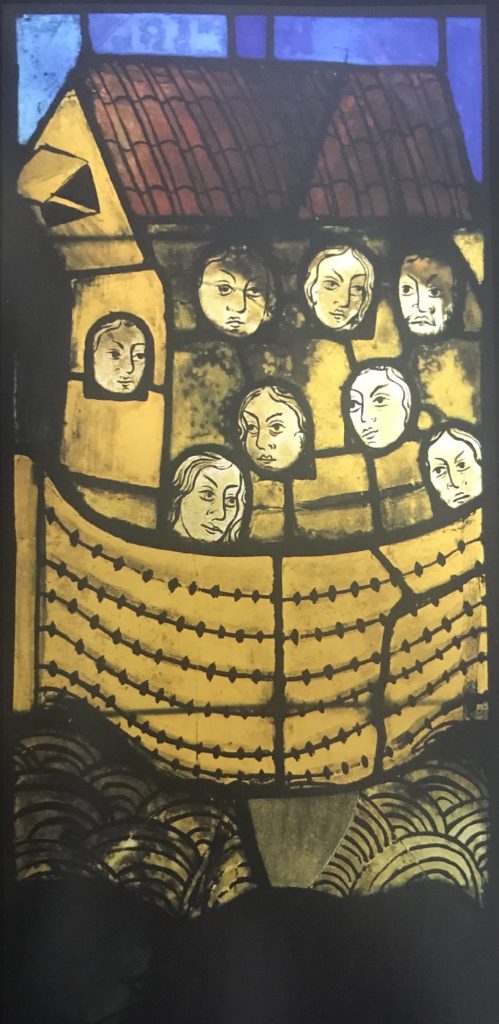
The following is a stained glass window from the Three choir windows in the Marienkirche, Frankfurt (Oder), Germany, of the 14th century, depicting Noah’s ark
Source: Der gläserne Schatz: Die Bilderbibel der St. Marienkirche in Frankfurt (Oder), Neuer Berlin Verlag, 2005, hosted by Wikimedia Commons under a public domain license
Stained glass is not just highly decorative, it’s a medium which has been used to express important religious messages for centuries. Literacy was not widespread in the medieval and Renaissance periods and the Church used stained glass and other artworks to teach the central beliefs of Christianity. In Gothic churches, the windows were filled with extensive narrative scenes in stained glass — like huge and colorful picture storybooks — in which worshipers could ‘read’ the stories of Christ and the saints and learn what was required for their religious salvation. (Source: Victoria and Albert Museum )
In the Tuvan Bible translation project, the official policy (…) was to keep the spelling of names of major characters the same as in the Russian Synodal translation. However, the translation team and representatives of local Tuvan churches agreed that deviation in proper name spelling from the RST would be allowed on a case-by-case basis if there was a concrete need to do so.
Such a need arose with the name of Noah’s son Ham (חָ֥ם) in Genesis and elsewhere in the Old Testament.
In Russian, as in English, this is transliterated with three letters — Хам (Kham). In Russian, the name of this character has entered the language with the meaning of “boorish lout, impudent person” because of how Ham treated his father; in Tuvan, however, the word Хам (Kham) already means “shaman.” Since the Tuvan people continue to practice their traditional religion in which shamans play a major role, the translation team felt that leaving the transliteration of this name with the exact spelling as in Russian might cause needless offense to Tuvan sensibilities by unwittingly causing the text of Gen. 9:20-27 to portray shamans as the targets of Noah’s curse. Therefore, the translation team chose to avoid this potential stumbling block while continuing to maintain a close sound correspondence with the name of the biblical character as Tuvan Christians already knew it from the RST text. This was done by doubling the vowel — Хаам. Tuvan has long vowel phonemes that are written with a double vowel, so this is perfectly acceptable from the point of view of Tuvan orthographic conventions.
The correspondence of the Tuvan version of the name to the Russian Synodal spelling is still recognizable, but hopefully, the wrath of Tuvan shamans and their supporters has been averted by this small disliteration.
The rationale behind such an approach to spelling changes in names is concisely described in the foreword to the Tuvan Bible for the sake of transparency
Apparently, the similarity of the English version of this name to the food item (as in “I’ll have a ham and cheese sandwich”) is not deemed offensive enough to the meat-packing industry for a similar disliteration to be performed in English Bible translations.
The name “Shem” is transliterated in English means “name,” “celebrated,” “distinguished,” “renown.” (Source: Cornwall / Smith 1997 )
It is translated in Spanish Sign Language with a sign that signifies “Arab,” referring to the fact that Shem traditionally is seen as the forefather of Semitic people, including Abraham and his descendants (see Genesis 11:26 et al.) (Source: Steve Parkhurst)
Note that the terms “Semite” and “Semitic” are derived from “Shem.”
The following is a stained glass window depicting Noah by Endre Odon Hevezi and Gyula Bajo from 1965 for the Debre Libanos Monastery, Oromia, Ethiopia:
Photo by Timothy A. Gonsalves, hosted by Wikimedia Commons under a Creative Commons Attribution-Share Alike 4.0 International license
Stained glass is not just highly decorative, it’s a medium which has been used to express important religious messages for centuries. Literacy was not widespread in the medieval and Renaissance periods and the Church used stained glass and other artworks to teach the central beliefs of Christianity. In Gothic churches, the windows were filled with extensive narrative scenes in stained glass — like huge and colorful picture storybooks — in which worshipers could ‘read’ the stories of Christ and the saints and learn what was required for their religious salvation. (Source: Victoria and Albert Museum )
Following are a number of back-translations as well as a sample translation for translators of Genesis 7:13:
Kankanaey: “But as for plural Noe by-contrast, they all in the family had entered the ark OK,” (Source: Kankanaey Back Translation)
Newari: “On that day Noah and his wife entered the ship, taking [their] three sons, Shem, Ham and Japheth and their wives.” (Source: Newari Back Translation)
Hiligaynon: “On the very day the rain started, Noe and his wife and their three children Shem, Ham, and Jafet together-with their wives entered/went-into the ship.” (Source: Hiligaynon Back Translation)
English: “On the day that it started to rain, Noah went into the boat with his wife, and his three sons, Shem, Ham, and Japheth and their wives.” (Source: Translation for Translators)
On the very same day refers to the day mentioned in verse 11. In some languages there may be confusion resulting from referring to a particular day here, when the previous line speaks of forty days and forty nights. Therefore it may be necessary to say, for example, “On the day the rain began to fall, Noah and his sons….”
The word order Noah and his sons, Shem and Ham and Japheth, and Noah’s wife and the three wives of his sons is a fixed formula and follows the same order as in 6.18; 7.7. The names of Noah’s sons are added here; and wherever the names of the three sons are used, they occur in the same order, implying that Shem is the oldest and Japheth the youngest. See 6.18 for discussion of three wives of his sons.
Entered the ark: that is, “got into the boat.”
Quoted with permission from Reyburn, William D. and Fry, Euan McG. A Handbook on Genesis. (UBS Helps for Translators). New York: UBS, 1997. For this and other handbooks for translators see here .



,_14th_century.jpg)

Leave a Reply
You must be logged in to post a comment.