
kos / little owl

Owls are found worldwide except in the Antarctic and on some islands. They are active at night and are characterized by flat faces and short hooked beaks that they can open very wide. They swallow their prey whole and later regurgitate the undigested parts as small balls. They also have the ability to turn their heads more than 180 degrees.

There are two basic owl families, both of which are found in the land of Israel. One family is the Tytonidae, which are the Barn and Grass Owls. They have heart-shaped whitish faces, usually outlined by a dark line, and small dark eyes. The other family is the Strigidae, the typical owls. This family contains a large variety of species, all of which have large eyes that may vary in color from light brown through orange to yellow. This family includes the eared or horned owls, the fairly rare fishing owls, and owls that vary in size from the midget scops owl (less than 20 centimeters [8 inches]) through to the giant eagle owl (over 70 centimeters [28 inches]).

Eight species of owl are fairly common in the land of Israel. Most are very seldom seen by humans, but they are quite well known by their different and distinct calls. In biblical times the nights would have been much quieter than in most modern places, and the strange night sounds probably would have interested people, causing some speculation about what was making the sound. The different owls would thus probably have had different names even if people had never seen them. In fact it is unlikely that they would have been able to associate most of the calls with the owls that were seen.

Traditionally kos has been translated as “little owl”, and this is the meaning in modern Hebrew. The case for this translation is probably the strongest, even though not conclusive. If we accept this identification, the lists of unclean birds has a rather neat structure with this the smallest of the owls being paired with nets, the smallest of the birds of prey.

The Little Owl Athene noctua is, as its name suggests, a small owl, which feeds at night mainly on insects and nestlings. It is about 25 centimeters (10 inches) in length and has a short tail. It does not have ear tufts. It nests in holes in banks or termite hills. It is often seen in the daytime, usually being chased by a group of small birds.

It is listed as an unclean bird.

The little owl is found in southeastern Europe, the Middle East, and northeast Africa. Elsewhere one may use the name of a small species of owl or the phrase “little owl”.
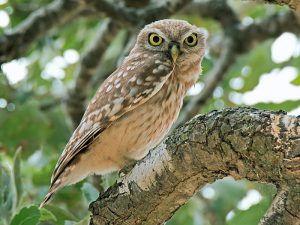
Little owl, Wikimedia Commons

Source: All Creatures Great and Small: Living things in the Bible (UBS Helps for Translators)

complete verse (Psalm 102:7)

Following are a number of back-translations as well as a sample translation for translators of Psalm 102:7:

  • Chichewa Contempary Chichewa translation, 2002/2016:
    “I lie down without finding sleep; I have become
    like a bird that stays alone on the roof.” (Source: Mawu a Mulungu mu Chichewa Chalero Back Translation)
  • Newari:
    “As for my sleep, [I] have lost it.
    I have become like a lone bird on a roof.” (Source: Newari Back Translation)
  • Hiligaynon:
    “I can- not -sleep; I (am) like a bird alone on a roof of a house.” (Source: Hiligaynon Back Translation)
  • Laarim:
    “I slept and wake up, I become
    like a bird that stay alone on top of the house.” (Source: Laarim Back Translation)
  • Nyakyusa-Ngonde (back-translation into Swahili):
    “Nalala macho niko kama vile ndege,
    ambaye yuko peke yake juu katika nyumba.” (Source: Nyakyusa Back Translation)
  • English:
    “I lie awake at night;
    because there is no one to comfort me,
    I am like a lonely bird sitting on a housetop.” (Source: Translation for Translators)

sparrow

While the Greek word strouthion is certainly the name for the sparrow, the Hebrew tsippor is actually an inclusive word that refers to sparrow-sized birds in general. These small birds, especially sparrows, were caught in nets and traps and were an important part of the diet of poor people.

There are three types of sparrow that are common in Israel, the House Sparrow Passer domesticus, the Spanish Sparrow Passer hispaniolensis, and the Dead Sea Sparrow Passer moabiticus. All three are small speckled brown birds. Additional small birds that abound around towns and settlements are members of the bunting, finch, and tit families. Sparrows in particular are usually found in fairly large numbers roosting and nesting together. All are seed eaters and live mainly on grass seeds and grain.

Sparrows were considered clean birds and were associated with the poor.

Sparrows or sparrow-like small birds are found all over the world. Finding a local word is not usually difficult. The reference to “a lonely bird on the housetop” in Psalms 102:7 takes on additional meaning if the sparrow was intended, since it is a bird that is seldom seen alone. It would then indicate the psalmist’s sense of loneliness at being separated from those with whom he belongs.

Source: All Creatures Great and Small: Living things in the Bible (UBS Helps for Translators)

Translation commentary on Psalm 102:6 - 102:8

The psalmist compares himself to a vulture (verse 6a), an owl (verse 6b), a lonely bird (verse 7b). As the Revised Standard Version footnote indicates, there is uncertainty over the identification of the bird in verse 6a; the Septuagint has “pelican”; New English Bible, New Jerusalem Bible, and New American Bible “desert owl”; New Jerusalem Bible “great-owl.” The bird in verse 6b is an owl; in verse 7b bird translates the word which in 84.3a is translated “sparrow.” For translation suggestions for wilderness (Good News Translation “desert”) see comments on 29.8. The Hebrew for waste places (Good News Translation “abandoned ruins”) most likely refers to abandoned cities or buildings that have been destroyed, where an owl may live, but there are no people. Waste places and “desert” must sometimes be rendered “places where people do not live.”

In verse 7b the Masoretic text is “and I am”; some emend this to “I wail” (New English Bible), or “I moan” (New American Bible), or “I groan” (Bible de Jérusalem, New Jerusalem Bible), joining it to the preceding I lie awake. This does make for a better balanced line, but the Masoretic text as it is can be translated. A lonely bird on the housetop may be understood by readers in some cultures to refer to witchcraft. Where this idea is common, it may be necessary to add a note to explain that the psalmist is speaking of his lonely condition, in which he has no one to comfort him.

In verse 8 the psalmist complains of his enemies, who scoff at him (see similar language in 89.51). In some languages All the day or “All day long” may be taken as excluding the nighttime. In such cases it may be better to say “All the time” or “Day and night.” In line b, instead of the Masoretic text those who deride me, the Septuagint, Syriac, and Vulgate have “those who (used to) praise me,” which is followed by Bible de Jérusalem, New Jerusalem Bible; but the Masoretic text better parallels the preceding line. Hebrew Old Testament Text Project prefers the Masoretic text, which it translates “those who become mad against me.”

Use my name for a curse means that the psalmist’s enemies call down upon others the same misfortunes and disasters that have befallen him; for an example of this see Jeremiah 29.22. Some, however, take it to mean that they curse the psalmist himself. For a curse and “in cursing” are both ambiguous. Therefore it will be necessary in some languages to adjust this statement by saying, for example, “curse others by using my name” or “when they curse other people, they do it by pronouncing my name.”

Quoted with permission from Bratcher, Robert G. and Reyburn, William D. A Handbook on the Book of Psalms. (UBS Helps for Translators). New York: UBS, 1991. For this and other handbooks for translators see here .