The Greek and Hebrew that is translated in English as “hate” or a form thereof is translated in Tabasco Chontal as “don’t want to see [the person who is hated].” (Source: John Beekman & Harwood Hess in Notes on Translation, March 1963, p. 1ff.)
The name that is transliterated as “Joseph” in English means “may God add,” “he shall add,” “increasing.” (Source: Cornwall / Smith 1997 )
It is translated in American Sign Language with a sign that relates to a) the coat he wore (see Gen 37:3), b) the holding of his clothes by Potiphar’s wife (see Gen 39:12), and c) the many times Joseph experienced grief. (Source: Ruth Anna Spooner, Ron Lawer)
“Joseph” in American Sign Language, source: Deaf Harbor
In Spanish Sign Language it is translated with a sign that signifies “dream,” referring to Jacob’s dream at Bethel (see Genesis 28:10 and the following verses). (Source: Steve Parkhurst)
The Greek and Hebrew that is translated as “brother” in English is translated in Kwere as sekulu, in Elhomwe as mbalaawo´, and in Mandarin Chinese as gēgē (哥哥), all “older brother.”
Note that Kwere also uses lumbu — “older sibling” in some cases. (Source for Kwere and Elhomwe: Pioneer Bible Translators, project-specific translation notes in Paratext; Chinese: Jost Zetzsche)
In Lama it is translated as “older or younger brother.” (Source: Neal Brinneman)
Following are a number of back-translations as well as a sample translation for translators of Genesis 37:5:
Kankanaey: “On one-occasion, there-was something-that- Jose -dreamed and he related-it to his brothers” (Source: Kankanaey Back Translation)
Newari: “Once Joseph had a dream. He told his dream to his elder brothers. His elder brothers hated him all the more.” (Source: Newari Back Translation)
Hiligaynon: “Now Jose dreamed. When- he -told his dream to his siblings, they became- even more extremely -angry with him.” (Source: Hiligaynon Back Translation)
English: “One night Joseph had a dream. He told his brothers about the dream.” (Source: Translation for Translators)
Verses 3 and 4 show that the conflict between Joseph and his brothers has resulted in a severe strain in family relations.
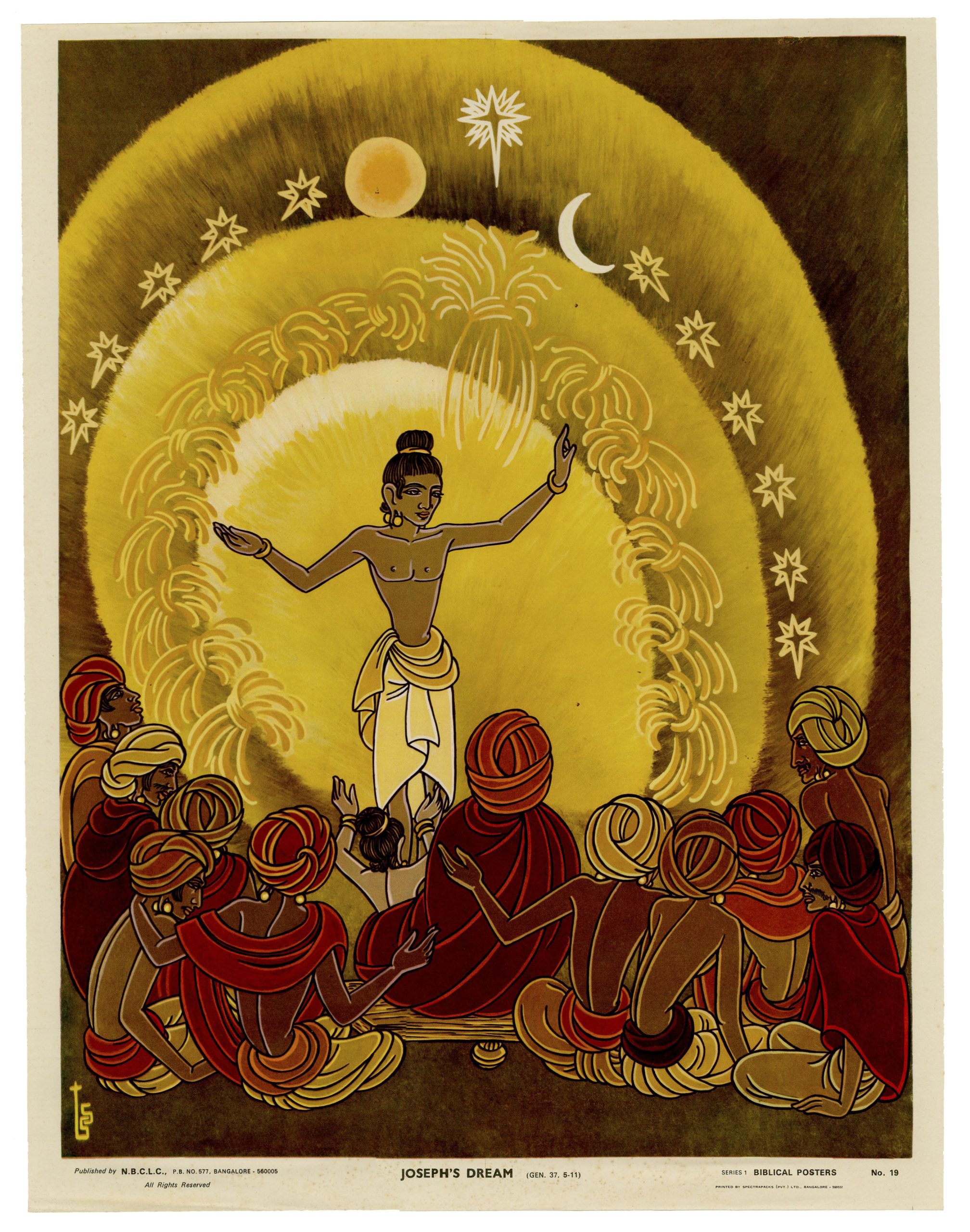
In verses 5-11 the tension continues to mount to a crisis, which the brothers attempt to resolve by getting rid of Joseph. In these verses Joseph has two dreams that he retells to his brothers. Both of these dreams suggest the future greatness of Joseph, something which Joseph knows nothing about at this time.
Now Joseph had a dream: as in verse 3, Revised Standard Version uses the transitional Now to render the Hebrew connective. At this point of the narrative, its function is to indicate the resumption of the story line following the background information given in verses 3-4. Note that Good News Translation again starts a new paragraph and opens this part of the story with “One time….” Some may find “One night” is more suitable for the setting of a dream.
They only hated him the more: this clause is omitted in some modern versions and in the Septuagint. Many interpreters believe that it has been copied from Gen 37.8. Hebrew Old Testament Text Project classifies it as {B} and keeps it; and the Handbook recommends the same to translators. However, in many languages the clause must be placed after verse 7 in any case, for discourse reasons, since it reports what the brothers’ feelings were after Joseph told them his dream. If that is done, then and when he told … should be rendered “and he told….”
Quoted with permission from Reyburn, William D. and Fry, Euan McG. A Handbook on Genesis. (UBS Helps for Translators). New York: UBS, 1997. For this and other handbooks for translators see here .

Leave a Reply
You must be logged in to post a comment.