The Hebrew that is translated as “(he is) our body” in English is translated in Bura-Pabir with the existing idiom as “(he is) our blood.” (Source: Andy Warren-Rothlin)
In Elhomwe it is translated with the idiomatic mbalaaka, literally “of my knee.” (Source: project-specific translation notes in Paratext)
The Greek and Hebrew that in the referenced verses is translated as “brother” in English is translated in Mandarin Chinese as dìdì (弟弟) or “younger brother.”
The Hebrew and Greek that is translated as “sell” in English is translated in Noongar as wort-bangal or “away-barter.” Note that “buy” is translated as bangal-barranga or “get-barter.” (Source: Bardip Ruth-Ang 2020)
Many languages distinguish between inclusive and exclusive first-person plural pronouns (“we”). (Click or tap here to see more details)
The inclusive “we” specifically includes the addressee (“you and I and possibly others”), while the exclusive “we” specifically excludes the addressee (“he/she/they and I, but not you”). This grammatical distinction is called “clusivity.” While Semitic languages such as Hebrew or most Indo-European languages such as Greek or English do not make that distinction, translators of languages with that distinction have to make a choice every time they encounter “we” or a form thereof (in English: “we,” “our,” or “us”).
For this verse, the Jarai and the Adamawa Fulfulde translation both use the inclusive pronoun, including everyone.
Following are a number of back-translations as well as a sample translation for translators of Genesis 37:27:
Kankanaey: “How-about if we sell him (immediacy particle) to those descendants of Ismael so that we won’t kill-him, because he is emphatically of-course our younger-sibling who is the child of our father.'” (Source: Kankanaey Back Translation)
Newari: “Rather, we will sell him into the hand of the Ishmaelites. [We] however, will not lift a hand [against] him. No matter what happens, he is our younger brother, our [own] flesh [and] blood.’ All of them listened to his proposal.” (Source: Newari Back Translation)
Hiligaynon: “Perhaps (it is) yet better (if) we (incl.) sell him to those Ishmaelinhon. Let- us (incl.) not -kill him for he (is) our sibling.’ The siblings of Juda agreed with him.” (Source: Hiligaynon Back Translation)
English: “So, instead of harming him, let’s sell him to these men who are descendants of Ishmael. Don’t forget, he is our own younger brother!’ So they all agreed to do that.” (Source: Translation for Translators)
Click or tap here to see the rest of this insight.
Like a number of other East Asian languages, Japanese uses a complex system of honorifics, i.e. a system where a number of different levels of politeness are expressed in language via words, word forms or grammatical constructs. These can range from addressing someone or referring to someone with contempt (very informal) to expressing the highest level of reference (as used in addressing or referring to God) or any number of levels in-between. One way Japanese shows different degree of politeness is through the choice of a third person singular and plural pronoun (e.g. he and they and their various forms) as shown here in the widely-used Japanese Shinkaiyaku (新改訳) Bible of 2017. While it’s not uncommon to avoid pronouns altogether in Japanese, there are is a range of third person pronouns that can be used.
In these verses a number of them are used that pay particularly much respect to the referred person (or, in fact, God, as in Exodus 15:2), including koitsu (こいつ), soitsu (そいつ), and aitsu (あいつ), meaning “this person/one,” “that person/one,” and “that person/one over there.” (Source: S. E. Doi, see also S. E. Doi in Journal of Translation, 18/2022, p. 37ff. )
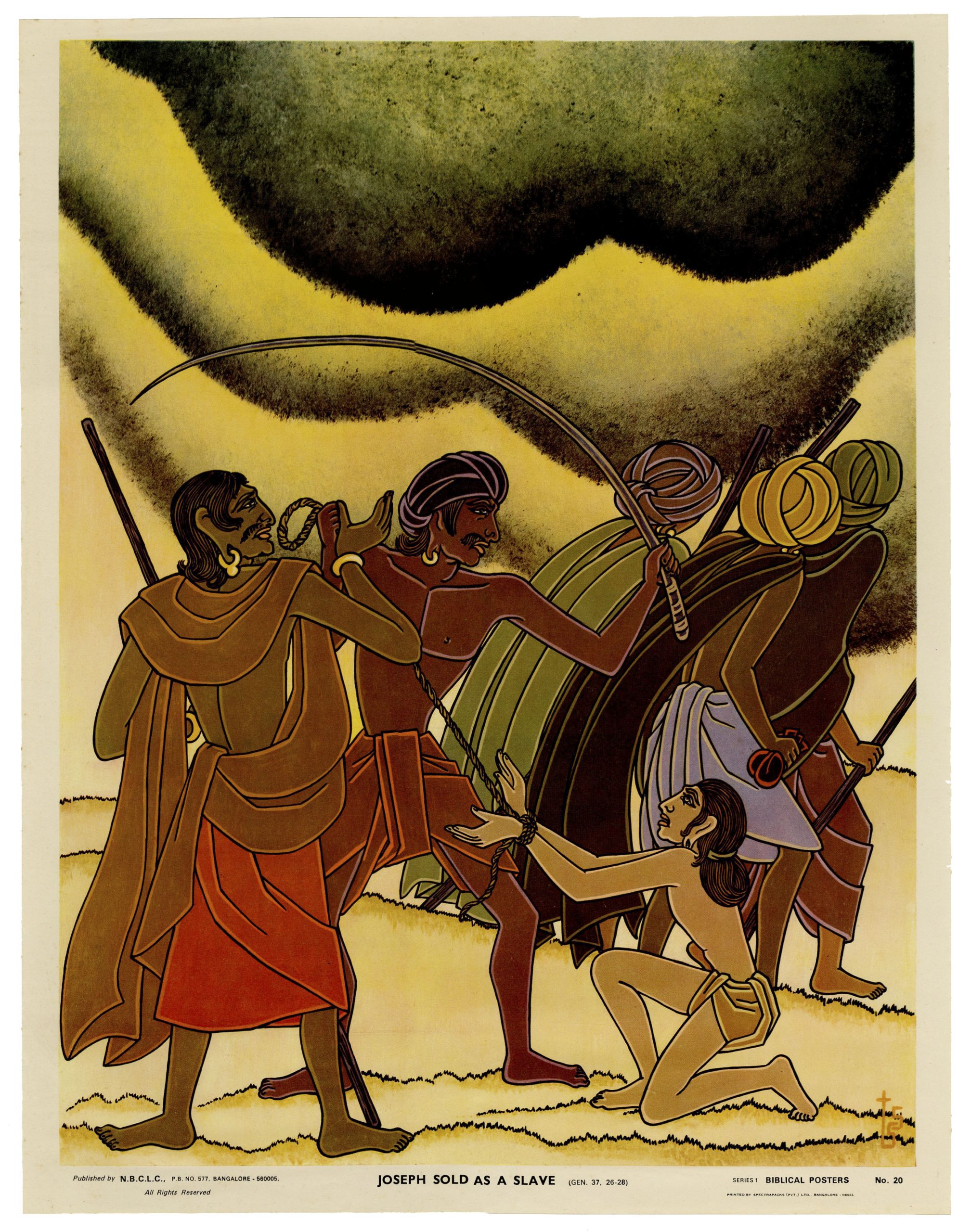
Come, let us sell him to the Ishmaelites: Come may be rendered as in verse 20. In some languages it may be necessary to express the idea of selling Joseph as an alternative to killing him; for example, “Instead of killing him, let’s sell him to those Ishmaelite traders.”
Let not our hand be upon him: a similar idiom was used in verse 21, where it meant to rescue or save Joseph. Here the sense is “Let us not harm [injure or kill] him.”
For he is our brother, our own flesh: these statements affirm that Joseph is related to them as a close kinsman. For a similar expression see 29.14. In some languages it may be necessary to state the reason before the consequence; for example, “He is our brother, our close kin; so let’s not kill him. Instead let’s sell him to those Ishmaelite traders.”
His brothers heeded him: him refers to Judah, and it may be better to say “Judah’s brothers agreed to do what he said.” In some languages this is more natural in direct speech: “All his brothers said, ‘All right, we will do what you say.’ ”
Quoted with permission from Reyburn, William D. and Fry, Euan McG. A Handbook on Genesis. (UBS Helps for Translators). New York: UBS, 1997. For this and other handbooks for translators see here .

Leave a Reply
You must be logged in to post a comment.