39So Peter got up and went with them, and when he arrived, they took him to the room upstairs. All the widows stood beside him, weeping and showing tunics and other clothing that Dorcas had made while she was with them.
The Hebrew and Greek that is translated with “clothes” or similar in English is translated in Enlhet as “crawling-in-stuff” (source: Jacob Loewen in The Bible Translator 1971, p. 169ff. ) and in Noongar as bwoka or “Kangaroo skin” (source: Warda-Kwabba Luke-Ang).
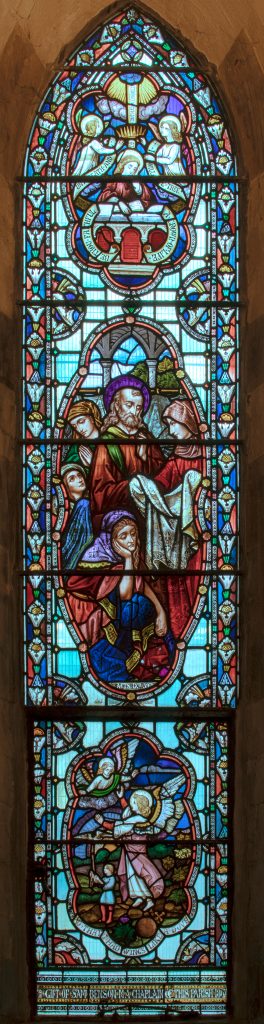
The top scene bears the inscription ‘Be thou faithful unto death and I will give thee a crown of life’; below St Peter is shown healing Tabitha at Joppa, and below again is the inscription ‘O that I had wings like a dove’ (Psalm 55) with a small boy and his kite. (Source: Southwark Cathedral website )
Stained glass is not just highly decorative, it’s a medium which has been used to express important religious messages for centuries. Literacy was not widespread in the medieval and Renaissance periods and the Church used stained glass and other artworks to teach the central beliefs of Christianity. In Gothic churches, the windows were filled with extensive narrative scenes in stained glass — like huge and colorful picture storybooks — in which worshipers could ‘read’ the stories of Christ and the saints and learn what was required for their religious salvation. (Source: Victoria and Albert Museum )
In Gbaya, the notion of several people crying and/or shouting in the associated verses is emphasized with the ideophone ŋgúr-ŋgúr, which refers to several people crying and shouting at the same time.
Ideophones are a class of sound symbolic words expressing human sensation that are used as literary devices in many African languages. (Source: Philip Noss)
The Hebrew, Ge’ez, and Greek that is translated as “widow” in English is translated in West Kewa as ona wasa or “woman shadow” (source: Karl J. Franklin in Notes on Translation 70/1978, pp. 13ff.) and in Newari as “husband already died ones” or “ones who have no husband” (source: Newari Back Translation).
In Cherokee the term is gender neutral and translates to “one who has lost someone.” (Source: Bender / Belt 2025, p. 100)
The etymological meaning of the Hebrewalmanah (אַלְמָנָה) is likely “pain, ache,” the Greekchéra (χήρα) is likely “to leave behind,” “abandon,” and the Englishwidow (as well as related terms in languages such as Dutch, German, Sanskrit, Welsh, or Persian) is “to separate,” “divide” (source: Wiktionary).
Orthodox Icons are not drawings or creations of imagination. They are in fact writings of things not of this world. Icons can represent our Lord Jesus Christ, the Virgin Mary, and the Saints. They can also represent the Holy Trinity, Angels, the Heavenly hosts, and even events. Orthodox icons, unlike Western pictures, change the perspective and form of the image so that it is not naturalistic. This is done so that we can look beyond appearances of the world, and instead look to the spiritual truth of the holy person or event. (Source )
Following is a hand colored stencil print on momigami of Peter by Sadao Watanabe (1970):
Image taken with permission from the SadaoHanga Catalogue where you can find many more images and information about Sadao Watanabe. For other images of Sadao Watanabe art works in TIPs, see here.
Following are a number of back-translations of Acts 9:39:
Uma: “So, Petrus did follow along with them. When they arrived in Yope, they immediately accompanied him going to the wake for the dead person. All the widows surrounded Petrus. They cried and showed him the shirts and clothes that Dorkas had sewn for them while she was still alive.” (Source: Uma Back Translation)
Yakan: “When Petros knew that, immediately he got ready and went with them. When (they) arrived at Joppa, they took him to the room upstairs. All the widows surrounded him weeping. They showed to him the shirts and jackets that Dorkas had sewn for them when she was alive.” (Source: Yakan Back Translation)
Western Bukidnon Manobo: “And Peter left, going with them. And when Peter arrived he went with them to the room up above. And there were there some widow women and they gathered around crying. And they showed him the shirts that Dorcas had sewed while she was still alive.” (Source: Western Bukidnon Manobo Back Translation)
Kankanaey: “Then Pedro stood-up and went-with them. Upon their arrival, they led (him) to the room where the dead-one was located. And then the weeping widows who were there crowded-around (him), while showing-and-showing him the clothes that Dorcas had sewed before her death.” (Source: Kankanaey Back Translation)
Tagbanwa: “Therefore, when it had been told to Pedro, he went with them. When he arrived in Jope, he was taken to that upstairs room where the one who had died was laid out. When he had gone in, the widow women all approached him who were crying there. They showed him all the kinds of clothes which Dorcas had sewn, which was her aid to them while she was still alive.” (Source: Tagbanwa Back Translation)
In the expression shirts and coats, the first word describes the garment which was worn next to the body, while the second term refers to the outer garment (the same word as was used in 7.58). Shirt and coat (see New English Bible and An American Translation*) seem to be the nearest natural equivalents in modern English. On the other hand, it is important not to employ terms which only designate clothing worn by men. After all, the clothing was most certainly for the widows.
Was alive is the meaning of “while she was with them.”
Quoted with permission from Newman, Barclay M. and Nida, Eugene A. A Handbook on The Acts of the Apostles. (UBS Handbook Series). New York: UBS, 1972. For this and other handbooks for translators see here .
Living Water is produced for the Bible translation movement in association with Lutheran Bible Translators. Lyrics derived from the ESV® Bible (The Holy Bible, English Standard Version®).



Leave a Reply
You must be logged in to post a comment.