Hand colored stencil print on momigami by Sadao Watanabe (1989).
Image taken with permission from the SadaoHanga Catalogue where you can find many more images and information about Sadao Watanabe. For other images of Sadao Watanabe art works in TIPs, see here.
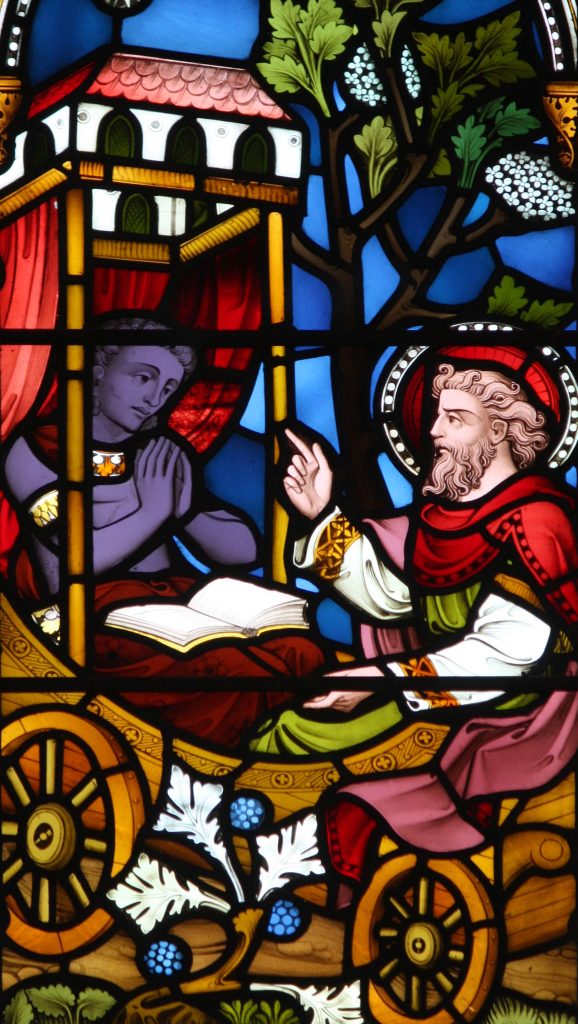
The following is a stained glass window from the Exeter College Chapel in Oxford:
Stained glass is not just highly decorative, it’s a medium which has been used to express important religious messages for centuries. Literacy was not widespread in the medieval and Renaissance periods and the Church used stained glass and other artworks to teach the central beliefs of Christianity. In Gothic churches, the windows were filled with extensive narrative scenes in stained glass — like huge and colorful picture storybooks — in which worshipers could ‘read’ the stories of Christ and the saints and learn what was required for their religious salvation. (Source: Victoria and Albert Museum )
The Hebrew, Latin, Ge’ez, and Greek that is translated into English as “chariot” is translated into Anuak as “canoe pulled by horse.” “Canoe” is the general term for “vehicle” (source: Loren Bliese). Similarly it is translated in Lokạạ as ukwaa wạ nyanyang ntuuli or “canoe that is driven by horses.” (Source: J.A. Naudé, C.L. Miller Naudé, J.O. Obono in Acta Theologica 43/2, 2023, p. 129ff. )
Other translations include:
Chichicapan Zapotec: “ox cart” (in Acts 8) (ox carts are common vehicles for travel) (source: Loren Bliese)
Chichimeca-Jonaz, it is translated as “little house with two feet pulled by two horses” (source: Viola Waterhouse in Notes on Translation August 1966, p. 86ff.)
HausaCommon Language Bible as keken-doki or “cart of donkey” (source: Andy Warren-Rothlin)
Following are a number of back-translations of Acts 8:29:
Uma: “The Spirit of the Lord God spoke to Filipus, he said: ‘You (sing.) go get close to that cart over there.'” (Source: Uma Back Translation)
Yakan: “The Holy Spirit said to Pilip, ‘Go near that kalesa alongside.'” (Source: Yakan Back Translation)
Western Bukidnon Manobo: “The Holy Spirit said to Philip, he said, ‘Go over there and get near to that cart.'” (Source: Western Bukidnon Manobo Back Translation)
Kankanaey: “The Holy Spirit, he said to Felipe, ‘Go approach that calesa.'” (Source: Kankanaey Back Translation)
Tagbanwa: “Without anything further, Felipe was inspired by the Espiritu Santo, who said, ‘Approach there and go along side that vehicle.'” (Source: Tagbanwa Back Translation)
Click or tap here to see the rest of this insight.
Like a number of other East Asian languages, Japanese uses a complex system of honorifics, i.e. a system where a number of different levels of politeness are expressed in language via words, word forms or grammatical constructs. These can range from addressing someone or referring to someone with contempt (very informal) to expressing the highest level of reference (as used in addressing or referring to God) or any number of levels in-between.
One way to do this is through the usage (or a lack) of an honorific prefix as shown here in the widely-used Japanese Shinkaiyaku (新改訳) Bible of 2017. When the referent is God, the “divine” honorific prefix mi- (御 or み) can be used, as in mi-tama (御霊) or “Spirit (of God)” in the referenced verses.
Click or tap here to see the rest of this insight.
Like a number of other East Asian languages, Japanese uses a complex system of honorifics, i.e. a system where a number of different levels of politeness are expressed in language via words, word forms or grammatical constructs. These can range from addressing someone or referring to someone with contempt (very informal) to expressing the highest level of reference (as used in addressing or referring to God) or any number of levels in-between.
One way Japanese shows different degree of politeness is through the usage of an honorific construction where the morpheme are (され) is affixed on the verb as shown here in the widely-used Japanese Shinkaiyaku (新改訳) Bible of 2017. This is particularly done with verbs that have God as the agent to show a deep sense of reverence. Here, iw-are-ru (言われる) or “say” is used.
Illustration by Horst Lemke (1922-1985) for the GermanGute Nachricht für Sie – NT68, one of the first editions of the Good News Bible in German of 1968. Lemke was a well-known illustrator who illustrated books by Erich Kästner , Astrid Lindgren and many others.
An angel of the Lord had supernaturally instructed Philip to go down towards Gaza, and now the Holy Spirit points out to Philip the reason for the previous instructions. In the Greek text “Holy” is not used as a modifier of Spirit in this passage, but it is evident that Luke means the Holy Spirit.
The expression stay close to that carriage is translated in a number of languages as “walk along close beside the carriage.” Obviously the eunuch was continuing his journey as he read.
Quoted with permission from Newman, Barclay M. and Nida, Eugene A. A Handbook on The Acts of the Apostles. (UBS Handbook Series). New York: UBS, 1972. For this and other handbooks for translators see here .




Leave a Reply
You must be logged in to post a comment.