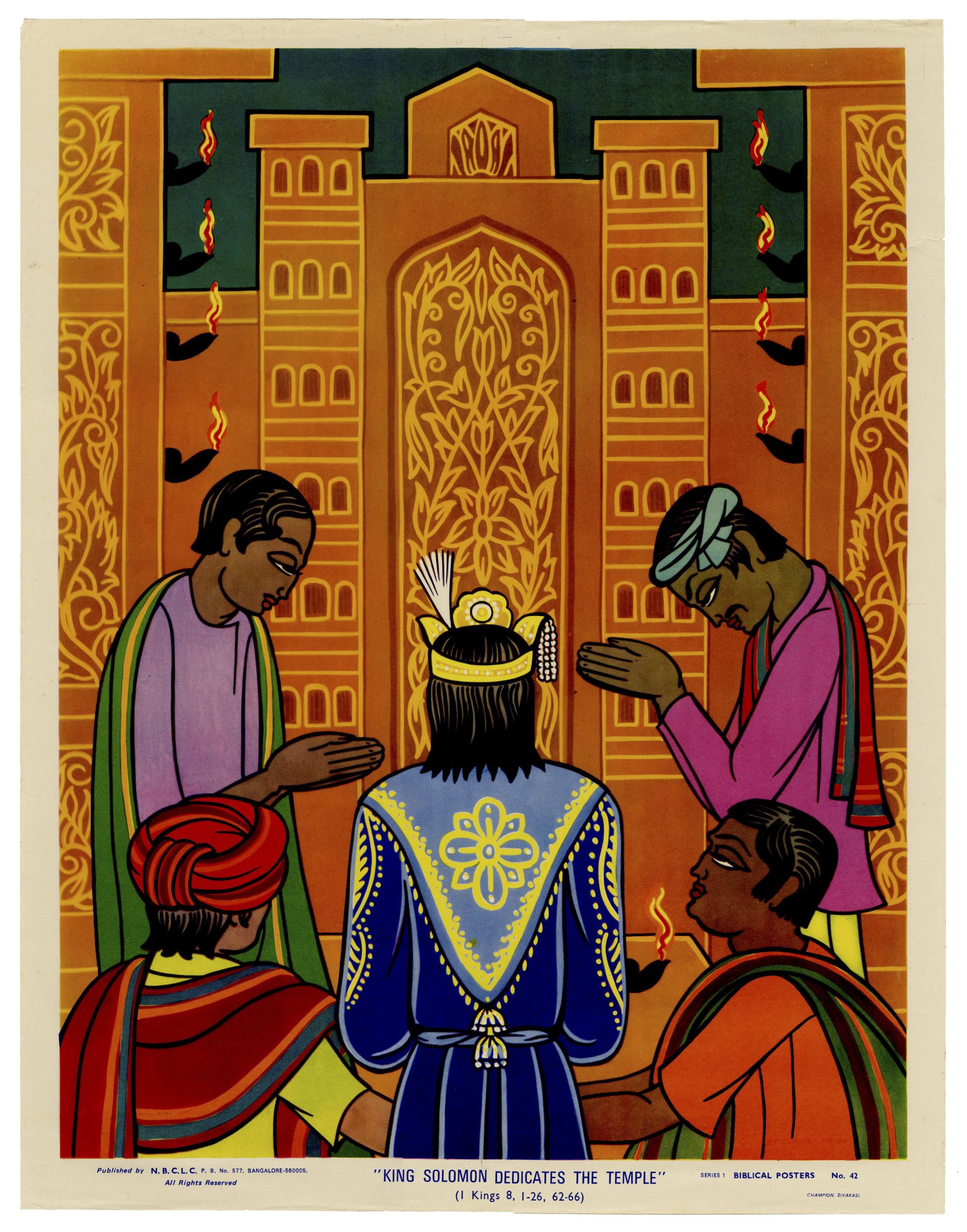
5King Solomon and all the congregation of Israel, who had assembled before him, were with him before the ark, sacrificing so many sheep and oxen that they could not be counted or numbered.
“Sheep are known throughout most of the world, even though, as in Central Africa, they are a far cry from the fleecy wool-producing animals of colder climates. Where such animals are known, even by seemingly strange names, e.g. ‘cotton deer’ (Yucateco) or ‘woolly goat’ (Inupiaq), such names should be used. In some instances, one may wish to borrow a name and use a classifier, e.g. ‘an animal called sheep.’ In still other instances translators have used ‘animal which produces wool’, for though people are not acquainted with the animals they are familiar with wool.” (Source: Bratcher / Nida)
In Dëne Súline, it is usually translated as “an evil little caribou.” To avoid the negative connotation, a loan word from the neighboring South Slavey was used. (Source: NCEM, p. 70)
Note that the often-alleged Inuktitut translation of “sheep” with “seal” is an urban myth (source Nida 1947, p. 136).
Following are a number of back-translations as well as a sample translation for translators of 1 Kings 8:5:
Kupsabiny: “Then, king Solomon and the elders of Israel stood in front of the Box of the Covenant and made sacrifices using numerous cattle and sheep.” (Source: Kupsabiny Back Translation)
Newari: “Then King Solomon, and all the Israelites who had gathered, sacrificed innumerable sheep and bulls before the ark of the covenant.” (Source: Newari Back Translation)
Hiligaynon: “King Solomon and the entire assembly of Israel sacrificed before/[lit. in front of] the Box of the Covenant. They offered so many cows and sheep; these can- not -be-counted.” (Source: Hiligaynon Back Translation)
English: “Then King Solomon and many of the Israeli people who had gathered in front of Yahweh’s Sacred Chest sacrificed a huge amount of sheep and oxen. No one was able to count the sacrifices because there were so many.” (Source: Translation for Translators)
Some languages do not have a concept of kingship and therefore no immediate equivalent for the Greek, Hebrew, Ge’ez, Aramaic, and Latin that is translated as “king” in English. Here are some (back-) translations:
Ninia Yali: “big brother with the uplifted name” (source: Daud Soesilio in Noss 2007, p. 175)
Nyamwezi: mutemi: generic word for ruler, by specifying the city or nation it becomes clear what kind of ruler (source: Pioneer Bible Translators, project-specific translation notes in Paratext)
Ghomála’: Fo (“The word Fo refers to the paramount ruler in the kingdoms of West Cameroon. He holds administrative, political, and religious power over his own people, who are divided into two categories: princes (descendants of royalty) and servants (everyone else).” (Source: Michel Kenmogne in Theologizing in Context: An Example from the Study of a Ghomala’ Christian Hymn))
Faye Edgerton retells how the term in Navajo (Dinė) was determined:
“[This term was] easily expressed in the language of Biblical culture, which had kings and noblemen with their brilliant trappings and their position of honor and praise. But leadership among the Navajos is not accompanied by any such titles or distinctions of dress. Those most respected, especially in earlier days, were their headmen, who were the leaders in raids, and the shaman, who was able to serve the people by appealing for them to the gods, or by exorcising evil spirits. Neither of these made any outward show. Neither held his position by political intrigue or heredity. If the headman failed consistently in raids, he was superceded by a better warrior. If the shaman failed many times in his healing ceremonies, it was considered that he was making mistakes in the chants, or had lost favor with the gods, and another was sought. The term Navajos use for headman is derived from a verb meaning ‘to move the head from side to side as in making an oration.’ The headman must be a good orator, able to move the people to go to war, or to follow him in any important decision. This word is naat’áanii which now means ‘one who rules or bosses.’ It is employed now for a foreman or boss of any kind of labor, as well as for the chairman of the tribal council. So in order to show that the king is not just a common boss but the highest ruler, the word ‘aláahgo, which expresses the superlative degree, was put before naat’áanii, and so ‘aláahgo naat’áanii ‘anyone-more-than-being around-he-moves-his-head-the-one-who’ means ‘the highest ruler.’ Naat’áanii was used for governor as the context usually shows that the person was a ruler of a country or associated with kings.”
King Solomon and all the congregation … sacrificing so many sheep and oxen: It is not clear from the Hebrew whether Solomon and the people of Israel were stopping along the way to offer sacrifices or whether verse 5 refers to a single large sacrifice just before the ark was taken into the Temple. As Good News Translation has translated the Hebrew, it seems to suggest one single occasion. If the example of David in 2 Sam 6.13 was followed, then it seems more likely that the king and the people were offering sacrifices along the way. Compare Moffatt: “while king Solomon and all the community of Israel which had gathered round him walked in front of the ark, sacrificing sheep and oxen.”
The Hebrew noun rendered congregation refers to a gathering. The purpose of the gathering must be determined by the context. Here the purpose is for worship.
For sacrificing see the comments at 1 Kgs 1.9.
For the translation of the words sheep and oxen, see the comments on 1 Kgs 1.9.
They could not be counted or numbered: There is no real difference in meaning between counted and numbered in this context (see the comments on 1 Kgs 3.8). For this reason the two verbs may be translated by a single verb in many languages without any loss of meaning (so Good News Translation). But if the receptor language has two synonymous terms that may be used together naturally, the cumulative effect strengthens the sense. New Jerusalem Bible, for example, says that they were “countless, innumerable.” And, of course, the passive construction of Revised Standard Version may be rendered actively; for example, “no one could count them….”
Quoted with permission from Omanson, Roger L. and Ellington, John E. A Handbook on 1-2 Kings, Volume 1. (UBS Helps for Translators). New York: UBS, 2008. For this and other handbooks for translators see here .
8:5a There, before the ark, King Solomon and the whole congregation of Israel who had assembled with him
King Solomon and all the Israelites who had come together around him ⌊walked⌋ in front of the ⌊covenant⌋ box. -or-
King Solomon went in front of the ⌊sacred⌋ chest, and with him went the great crowd of the people of Israel.
8:5b sacrificed so many sheep and oxen that they could not be counted or numbered.
⌊As they went⌋, they sacrificed numerous/innumerable sheep and cattle, more than anyone could count. -or-
⌊Along/On the way⌋ they offered as sacrifices very many sheep and cattle. No one could count the number of sacrifices/animals!

Leave a Reply
You must be logged in to post a comment.