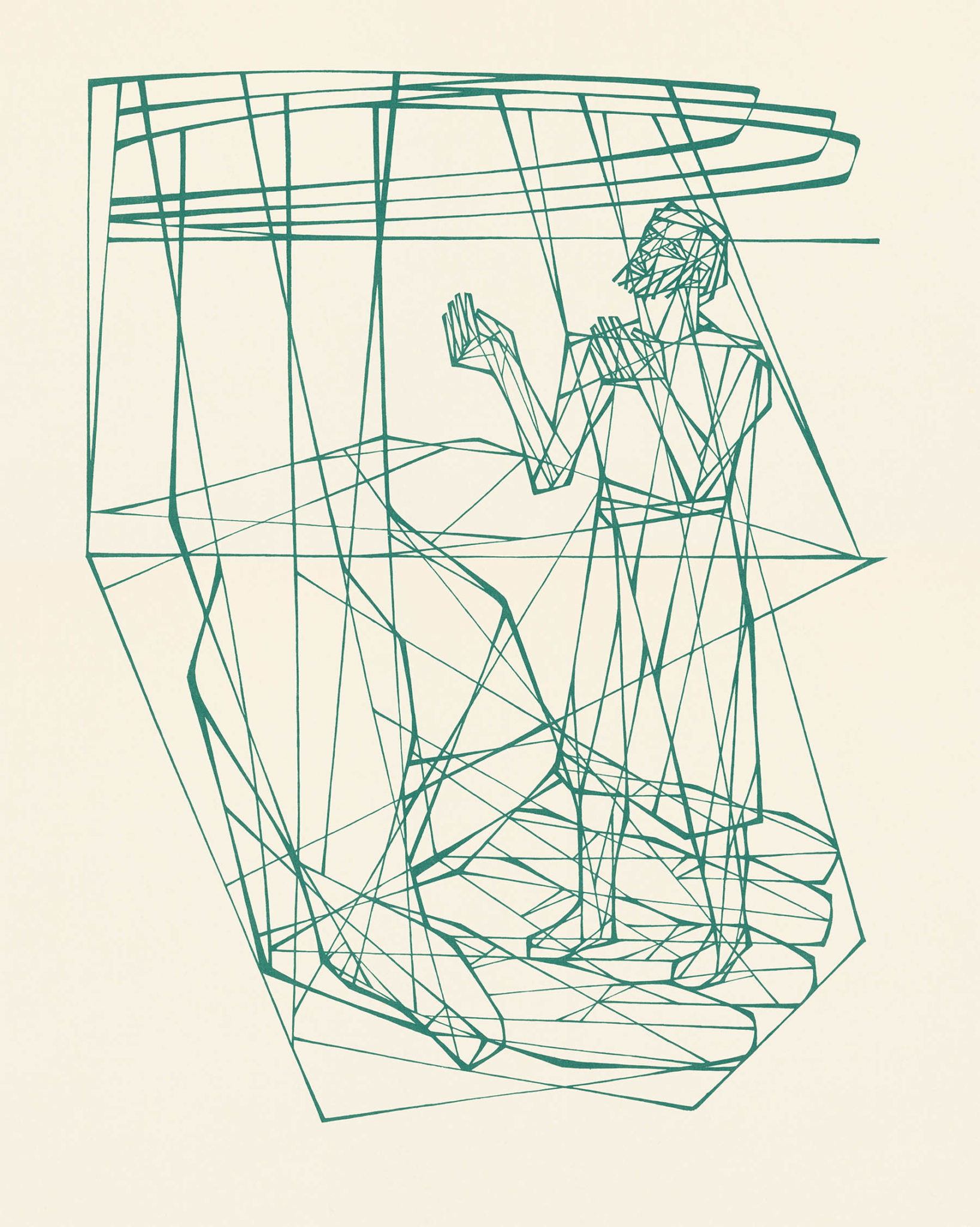
Drawing by Ismar David from The Psalms: A new English translation, linked with permission from Ismar David Archive .
For other images of Ismar David drawings, see here.

גַּם־שָׁ֭ם יָדְךָ֣ תַנְחֵ֑נִי וְֽתֹאחֲזֵ֥נִי יְמִינֶֽךָ׃
10even there your hand shall lead me,
and your right hand shall hold me fast.
Drawing by Ismar David from The Psalms: A new English translation, linked with permission from Ismar David Archive .
For other images of Ismar David drawings, see here.
Translators of different languages have found different ways with what kind of formality God is addressed.
Like many languages (but unlike Greek or Hebrew or modern English), Tuvan uses a formal vs. informal 2nd person pronoun (a familiar vs. a respectful “you”). Unlike other languages that have this feature, however, the translators of the Tuvan Bible have attempted to be very consistent in using the different forms of address in every case a 2nd person pronoun has to be used in the translation of the biblical text.
As Voinov shows in Pronominal Theology in Translating the Gospels (in: The Bible Translator 2002, p. 210ff. ), the choice to use either of the pronouns many times involved theological judgment. While the formal pronoun can signal personal distance or a social/power distance between the speaker and addressee, the informal pronoun can indicate familiarity or social/power equality between speaker and addressee.
In these verses, in which humans address God, the informal, familiar pronoun is used that communicates closeness.
Voinov notes that “in the Tuvan Bible, God is only addressed with the informal pronoun. No exceptions. An interesting thing about this is that I’ve heard new Tuvan believers praying with the formal form to God until they are corrected by other Christians who tell them that God is close to us so we should address him with the informal pronoun. As a result, the informal pronoun is the only one that is used in praying to God among the Tuvan church.”
In Gbaya, “a superior, whether father, uncle, or older brother, mother, aunt, or older sister, president, governor, or chief, is never addressed in the singular unless the speaker intends a deliberate insult. When addressing the superior face to face, the second person plural pronoun ɛ́nɛ́ or ‘you (pl.)’ is used, similar to the French usage of vous.
Accordingly, the translators of the current version of the Gbaya Bible chose to use the plural ɛ́nɛ́ to address God. There are a few exceptions. In Psalms 86:8, 97:9, and 138:1, God is addressed alongside other “gods,” and here the third person pronoun o is used to avoid confusion about who is being addressed. In several New Testament passages (Matthew 21:23, 26:68, 27:40, Mark 11:28, Luke 20:2, 23:37, as well as in Jesus’ interaction with Pilate and Jesus’ interaction with the Samaritan woman at the well) the less courteous form for Jesus is used to indicate ignorance of his position or mocking.” (Source Philip Noss)
In the most recent Manchu translation of 1835 (a revision of an earlier edition from 1822), God is never addressed with a pronoun but with “father” (ama /ᠠᠮᠠ) instead. Chengcheng Liu (in this post on the Cambridge Centre for Chinese Theology blog ) explains: “In Manchu tradition, as in Chinese etiquette, second-person pronouns could be considered disrespectful when speaking to superiors or spiritual beings. Manchu Shamanist prayers avoided si [‘you’] and sini [‘your’] for this very reason. To use them for God would be, in Lipovzoff’s [one of the two translators] words, ‘the most uncouth and indecent way to speak to the Almighty — as if He were a servant or slave.’ There was also a grammatical problem. In Manchu, si and sini could refer to both singular and plural subjects. For a faith that insisted on the singularity of God, this was potentially confusing. By contrast, repeating ama removed any ambiguity.”
In Dutch, Afrikaans, Gronings, and Western Frisian translations, God is always addressed with the formal pronoun.
See also formal pronoun: disciples addressing Jesus, female second person singular pronoun in Psalms.
Following are a number of back-translations as well as a sample translation for translators of Psalm 139:10:
The following is a lyrical rendition of Psalm 139 into English by Mary Herbert , Countess of Pembroke (née Sidney, 1561 – 1621), authored c. 1594 as part of the Sidney Psalms :
O Lord, in me there lieth nought
But to thy search revealèd lies,
For when I sit
Thou markest it;
No less thou notest when I rise;
Yea, closest closet of my thought
Hath open windows to thine eyes.
Thou walkest with me when I walk;
When to my bed for rest I go,
I find thee there,
And everywhere:
Not youngest thought in me doth grow,
No, not one word I cast to talk
But yet unuttered thou dost know.
If forth I march, thou goest before,
If back I turn, thou com’st behind:
So forth nor back
Thy guard I lack,
Nay on me too, thy hand I find.
Well I thy wisdom may adore,
But never reach with earthy mind.
To shun thy notice, leave thine eye,
O whither might I take my way?
To starry sphere?
Thy throne is there.
To dead men’s undelightsome stay?
There is thy walk, and there to lie
Unknown, in vain I should assay.
O Sun, whom light nor flight can match,
Suppose thy lightful flightful wings
Thou lend to me,
And I could flee
As far as thee the ev’ning brings:
Even led to West he would me catch,
Nor should I lurk with western things.
Do thou thy best, O secret night,
In sable veil to cover me:
Thy sable veil
Shall vainly fail;
With day unmask’d my night shall be,
For night is day, and darkness light,
O father of all lights, to thee.
Each inmost piece in me is thine:
While yet I in my mother dwelt,
All that me clad
From thee I had.
Thou in my frame hast strangely dealt:
Needs in my praise thy works must shine
So inly them my thoughts have felt.
Thou, how my back was beam-wise laid,
And raft’ring of my ribs, dost know;
Know’st every point
Of bone and joint,
How to this whole these parts did grow,
In brave embroid’ry fair array’d,
Though wrought in shop both dark and low.
Nay, fashionless, ere form I took,
Thy all-and-more beholding eye
My shapeless shape
Could not escape:
All these time-framed successively
Ere one had being, in the book
Of thy foresight enroll’d did lie.
My God, how I these studies prize,
That do thy hidden workings show!
Whose sum is such
No sum so much,
Nay, summ’d as sand they sumless grow.
I lie to sleep, from sleep I rise,
Yet still in thought with thee I go.
My God, if thou but one wouldst kill,
Then straight would leave my further chase
This cursèd brood
Inur’d to blood,
Whose graceless taunts at thy disgrace
Have aimed oft; and hating still
Would with proud lies thy truth outface.
Hate not I them, who thee do hate?
Thine, Lord, I will the censure be.
Detest I not
The cankered knot
Whom I against thee banded see?
O Lord, thou know’st in highest rate
I hate them all as foes to me.
Search me, my God, and prove my heart,
Examine me, and try my thought;
And mark in me
If ought there be
That hath with cause their anger wrought.
If not (as not) my life’s each part,
Lord, safely guide from danger brought.
Like a number of other East Asian languages, Japanese uses a complex system of honorifics, i.e. a system where a number of different levels of politeness are expressed in language via words, word forms or grammatical constructs. These can range from addressing someone or referring to someone with contempt (very informal) to expressing the highest level of reference (as used in addressing or referring to God) or any number of levels in-between.
One way to do this is through the usage (or a lack) of an honorific prefix as shown here in the widely-used Japanese Shinkaiyaku (新改訳) Bible of 2017. When the referent is God, the “divine” honorific prefix mi- (御 or み) is used here in mi-te (御手) or “hand (of God).”
(Source: S. E. Doi, see also S. E. Doi in Journal of Translation, 18/2022, p. 37ff. )
See also hand of the LORD.
In verse 9 the psalmist refers to the extreme east and the extreme west. Revised Standard Version gives the wrong impression that the actions of the two lines are part of one event, take the wings … and dwell. The Hebrew lines show two distinct events, “If I take…, if I dwell….” The exact meaning of the language in verse 9a, If I take the wings of the morning, is in dispute; in parallel with verse 9b (which clearly refers to the farthest west) it seems probable that the language is a figurative way of speaking of going to the east, where the sun comes up (so Biblia Dios Habla Hoy “if I were to fly away to the east”; Die Bibel im heutigen Deutsch has “Were I to fly to where the sun rises”; and Bible en français courant is similar). In verse 9b the uttermost parts of the sea means as far as one could go to the west; the sea is the Mediterranean, which is west of Palestine. In many languages the directions in verse 9 can best be expressed as “where the sun rises” and “where the sun sets.” However, if the translator wishes to keep the geography of Palestine in view, he may translate “west” as does Biblia Dios Habla Hoy, “the borders of the western sea.” Die Bibel im heutigen Deutsch has “to the end of the seas, where the sun sinks.”
Wherever he may go, the psalmist knows that Yahweh is there to lead him and to hold him (verse 10); the second verb in Hebrew is “to hold, grasp,” in the positive sense of helping or sustaining, not in the negative sense of seizing or arresting.
Quoted with permission from Bratcher, Robert G. and Reyburn, William D. A Handbook on the Book of Psalms. (UBS Helps for Translators). New York: UBS, 1991. For this and other handbooks for translators see here .
No comments yet.
Leave a Reply
You must be logged in to post a comment.