Many languages distinguish between inclusive and exclusive first-person plural pronouns (“we”). (Click or tap here to see more details)
The inclusive “we” specifically includes the addressee (“you and I and possibly others”), while the exclusive “we” specifically excludes the addressee (“he/she/they and I, but not you”). This grammatical distinction is called “clusivity.” While Semitic languages such as Hebrew or most Indo-European languages such as Greek or English do not make that distinction, translators of languages with that distinction have to make a choice every time they encounter “we” or a form thereof (in English: “we,” “our,” or “us”).
For this verse, the Jarai translation uses the exclusive pronoun, excluding Moses.
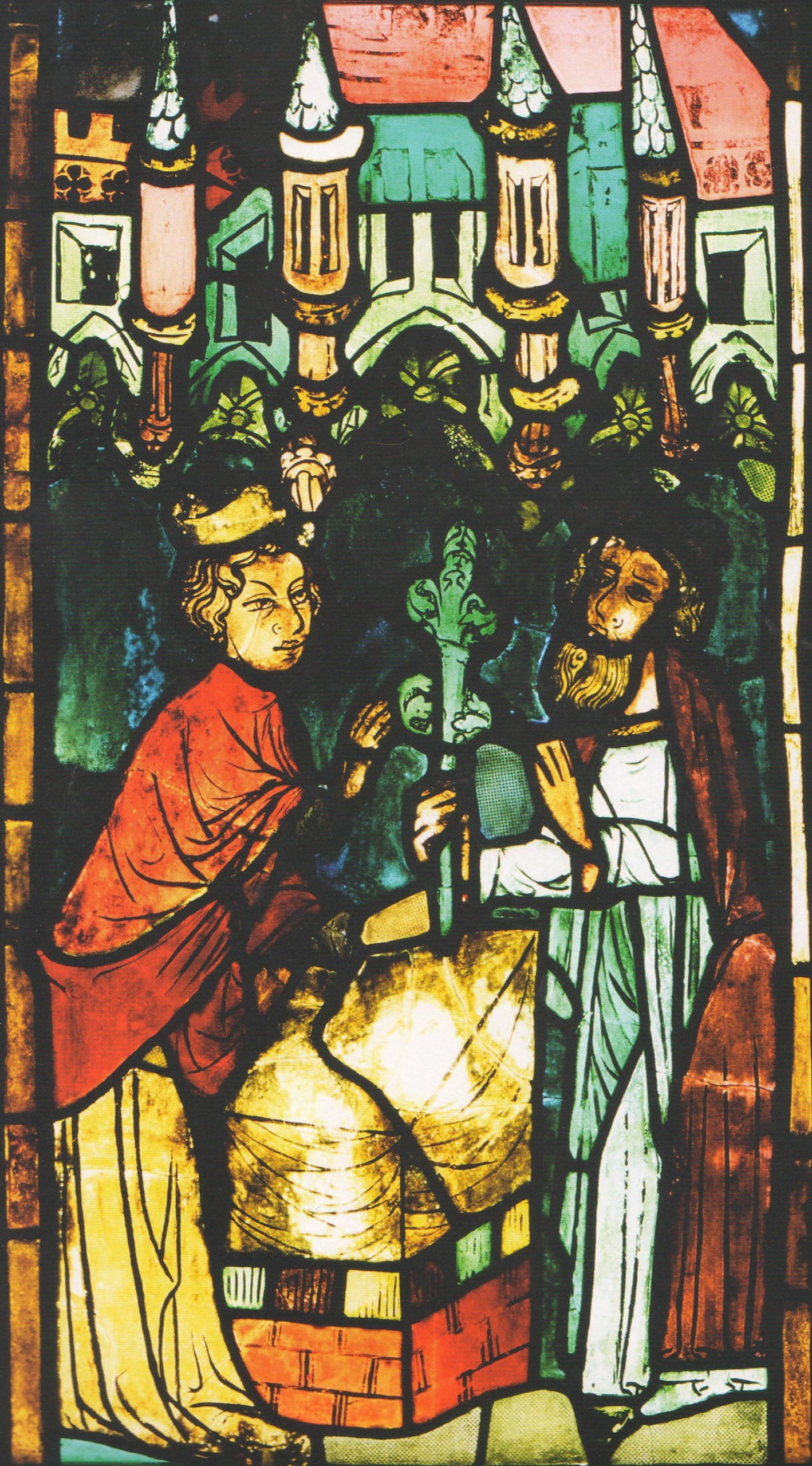
The following is a stained glass window from the Three choir windows in the Marienkirche, Frankfurt (Oder), Germany, of the 14th century, depicting the budding of Aaron’s rod:
Source: Der gläserne Schatz: Die Bilderbibel der St. Marienkirche in Frankfurt (Oder), Neuer Berlin Verlag, 2005, copyright for this image: Brandenburgisches Landesamt für Denkmalpflege und Archäologisches Landesmuseum
Stained glass is not just highly decorative, it’s a medium which has been used to express important religious messages for centuries. Literacy was not widespread in the medieval and Renaissance periods and the Church used stained glass and other artworks to teach the central beliefs of Christianity. In Gothic churches, the windows were filled with extensive narrative scenes in stained glass — like huge and colorful picture storybooks — in which worshipers could ‘read’ the stories of Christ and the saints and learn what was required for their religious salvation. (Source: Victoria and Albert Museum )
The name that is transliterated as “Moses” in English means “taken out of the water,” “saved out of the water,” “a son.” (Source: Cornwall / Smith 1997 )
American Sign Language also uses the sign depicting the horns but also has a number of alternative signs (see here ).
In French Sign Language, a similar sign is used, but it is interpreted as “radiance” (see below) and it culminates in a sign for “10,” signifying the 10 commandments:
The horns that are visible in Michelangelo’s statue are based on a passage in the Latin Vulgate translation (and many Catholic Bible translations that were translated through the 1950ies with that version as the source text). Jerome, the translator, had worked from a Hebrew text without the niqquds, the diacritical marks that signify the vowels in Hebrew and had interpreted the term קרו (k-r-n) in Exodus 34:29 as קֶ֫רֶן — keren “horned,” rather than קָרַו — karan “radiance” (describing the radiance of Moses’ head as he descends from Mount Sinai).
In Swiss-German Sign Language (and Hungarian Sign Language) it is translated with a sign depicting holding a staff. This refers to a number of times where Moses’s staff is used in the context of miracles, including the parting of the sea (see Exodus 14:16), striking of the rock for water (see Exodus 17:5 and following), or the battle with Amalek (see Exodus 17:9 and following).
In Vietnamese (Hanoi) Sign Language it is translated with the sign that depicts the eye make up he would have worn as the adopted son of an Egyptian princess. (Source: The Vietnamese Sign Language translation team, VSLBT)
“Moses” in Vietnamese Sign Language, source: SooSL
In Korean Sign Language it is translated with the sign that depicts the arms held up by Moses to assure the Israelites victory over the Amalekites (see Exodus 17:11).
And the people of Israel said to Moses: The conjunction And may be rendered “Then” (New Living Translation) to introduce this terrified response of the Israelites as the next event.
Behold, we perish, we are undone, we are all undone: The Hebrew interjection rendered Behold (hen) emphasizes the following words of the Israelites. The Hebrew verbs rendered perish and are undone are virtually synonymous. This repetition indicates how terrified the people were. There are various ways of expressing the dramatic nature of the original text here; for example, New Living Translation says “Look, we are doomed! We are dead! We are ruined!”
Every one who comes near, who comes near to the tabernacle of the LORD, shall die: The repeated phrase who comes near also conveys the terror of the people. Good News Bible says simply “who even comes near,” and New Living Translation is similar with “who even comes close.” These models will be helpful in languages where repetition would not make the translation expressive. For tabernacle, which renders the Hebrew word mishkan (literally “dwelling-place”), see 1.50.
Are we all to perish?: The people’s plaintive cry ends the way it starts (we perish … are we all to perish). This question seems to be rhetorical. New Jewish Publication Society Version uses a strong statement, saying “Alas, we are doomed to perish!” New Living Translation has “Are we all doomed to die?”
It seems that the Israelites finally got the message that nobody could enter the Tabernacle who had not been given the LORD’s authority to do so. Only Aaron and his descendants could enter the sanctuary and carry out the specific duties of the priesthood. This distressing moment precedes the next chapter, which outlines the responsibilities of the priests and Levites and the people’s obligations toward them in order to maintain the divinely ordained cultic relationship.
Quoted with permission from de Regt, Lénart J. and Wendland, Ernst R. A Handbook on Numbers. (UBS Helps for Translators). Miami: UBS, 2016. For this and other handbooks for translators see here .



Leave a Reply
You must be logged in to post a comment.