The Greek that is translated as “became dazzling white” in English is translated in Sa’a with “a specially-coined, but old word for what happened to Jesus at the transfiguration. It means ‘gloriously changed to be bright and shiny and totally unlike anything else at all.’ It is used only for Jesus’ transfiguration, and then, by extension, for what will happen to us at our resurrection. The word is ‘nu’e’ — an awful lot meaning packed into just four letters!”
In Gbaya, the notion of “very white is emphasized with ndáká-ndáká, an ideophone used to express extreme whiteness, something very white.
Ideophones are a class of sound symbolic words expressing human sensation that are used as literary devices in many African languages. (Source: Philip Noss)
In Gbaya, the notion of something shining, radiant or gleaming is emphasized in the referenced verses with lak-lak, an ideophone that describes something that shines.
Note that in Lamentations 4:7, the “shining” refers to the pure snow in the beginning oif the verse.
Ideophones are a class of sound symbolic words expressing human sensation that are used as literary devices in many African languages. (Source: Philip Noss)
The Hebrew and Greek that is translated with “clothes” or similar in English is translated in Enlhet as “crawling-in-stuff” (source: Jacob Loewen in The Bible Translator 1971, p. 169ff. ) and in Noongar as bwoka or “Kangaroo skin” (source: Warda-Kwabba Luke-Ang).
Following is a Ukrainian Orthodox icon of the Transfiguration by Ivan Rutkovych (c. 1650 – c. 1708) (for the Church of Christ’s Nativity in Zhovkva, Ukraine, today in the Lviv National Museum).
Orthodox Icons are not drawings or creations of imagination. They are in fact writings of things not of this world. Icons can represent our Lord Jesus Christ, the Virgin Mary, and the Saints. They can also represent the Holy Trinity, Angels, the Heavenly hosts, and even events. Orthodox icons, unlike Western pictures, change the perspective and form of the image so that it is not naturalistic. This is done so that we can look beyond appearances of the world, and instead look to the spiritual truth of the holy person or event. (Source )
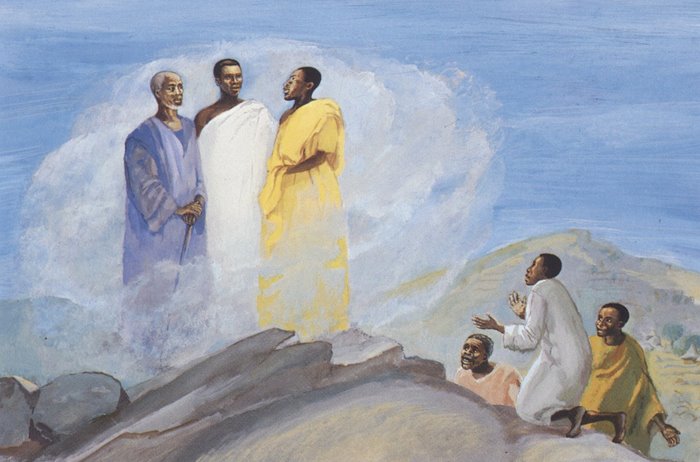
Following is a 1973 painting of the JESUS MAFA project, a response to New Testament readings from the Lectionary by a Christian community in Cameroon, Africa. Each of the readings was selected and adapted to dramatic interpretation by the community members. Photographs of their interpretations were made, and these were then transcribed to paintings:
In this theatrical representation of Jesus’ transfiguration, Jesus is robed in a dazzling white garment, as the story in the gospels describes. He appears to be greeting Moses and Elijah like old friends as they are surrounded by a cloud that makes the whole scene feel ethereal. Peter, James, and John look on with flabbergasted and fearful expressions, bewildered at what they should do. This painting invites the viewer to imagine what it would be like to have seen such amazing things. Undoubtedly, it would inspire one to follow and obey Jesus, just as God commands in the story: “This is my son, the beloved. Listen to him!”
From Art in the Christian Tradition, a project of the Vanderbilt Divinity Library, Nashville, TN. Image retrieved March 23, 2026. Original source: librairie-emmanuel.fr.
Following are a number of back-translations of Matthew 17:2:
Uma: “While they were there, his appearance changed. His face shone like the son, and his clothes were shining white.” (Source: Uma Back Translation)
Yakan: “While they were there, the appearance of Isa was really changed before their eyes. His face was bright/shining like the sun and his clothes were dazzling/bright because of their whiteness.” (Source: Yakan Back Translation)
Western Bukidnon Manobo: “And while they were looking at Jesus, suddenly his appearance was changed. His face was very bright like the sun, and his clothes shone white.” (Source: Western Bukidnon Manobo Back Translation)
Kankanaey: “While they were looking at him, his appearance changed. His face, it was-blinding-bright like the sun and his clothes also became very-white and (lit. which was) dazzling.” (Source: Kankanaey Back Translation)
Tagbanwa: “When they were there now, those three saw the appearance of Jesus become-very-unusual. His face shone like the shining of the sun and his clothes gleamed very-white.” (Source: Tagbanwa Back Translation)
Tenango Otomi: “There it was that the learners saw that Jesus changed in how he appeared. His face shone like the sun. His clothing was extremely white until it shone.” (Source: Tenango Otomi Back Translation)
Click or tap here to see the rest of this insight.
Like a number of other East Asian languages, Japanese uses a complex system of honorifics, i.e. a system where a number of different levels of politeness are expressed in language via words, word forms or grammatical constructs. These can range from addressing someone or referring to someone with contempt (very informal) to expressing the highest level of reference (as used in addressing or referring to God) or any number of levels in-between. One way to do this is through the usage (or a lack) of an honorific prefix as shown here in the widely-used Japanese Shinkaiyaku (新改訳) Bible of 2017. When the referent is God, the “divine” honorific prefix mi- (御 or み) can be used, as in mi-sugata (御姿) or “form (of God)” in the referenced verses. (Source: S. E. Doi, see also S. E. Doi in Journal of Translation, 18/2022, p. 37ff. )



Leave a Reply
You must be logged in to post a comment.