The Greek that is translated as “thorns” in English is translated in Low German with Dießeln or “thistles” which are familiar to speakers of Low German (translation by Johannes Jessen, publ. 1933, republ. 2006).
See also thistles.

ἄλλα δὲ ἔπεσεν ἐπὶ τὰς ἀκάνθας, καὶ ἀνέβησαν αἱ ἄκανθαι καὶ ἔπνιξαν αὐτά.
7Other seeds fell among thorns, and the thorns grew up and choked them.
The Greek that is translated as “thorns” in English is translated in Low German with Dießeln or “thistles” which are familiar to speakers of Low German (translation by Johannes Jessen, publ. 1933, republ. 2006).
See also thistles.
The parable of The Parable of the Sower is illustrated for use in Bible translations in West Africa by Wycliffe Cameroon like this:

Illustration 1999 Mbaji Bawe Ernest, © Wycliffe Bible Translators, Inc. Used with permission.
The following artwork is part of a series of 56 paintings on biblical themes by Kazakh artist Nelly Bube (born 1949):
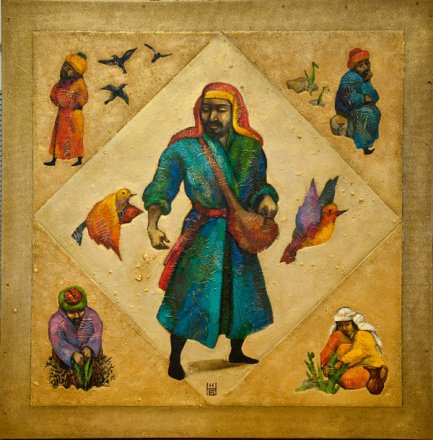
Copyright by Norwegian Bible Society , used with permission.
For other images of Nelly Bube in TIPs, see here.
Following are a number of back-translations of Matthew 13:7:
Other seeds fell upon thorns may leave the impression that the seeds were thrown into a patch of full-grown thorn bushes. It is only toward the end of the verse that the reader realizes that the thorn bushes were not already there at the time of the sowing. The reference is either to ground that contains the roots of old thorn bushes which will sprout in the coming season, or to ground in which thorn seeds have also fallen. This information may be necessary to provide in translation; for example, “Some of the seed fell among places where thorn bushes were going to grow up” or “… where the seeds (or, roots) of thorn bushes were already in the ground.”
For thorns, translators should use some plant or weed that grows quickly and is covered by thorns.
Grew up translates a verb which means “shoot up” or “spring up” when used of plants. Jesus is here referring to thorn plants which grow simultaneously with the newly sprouted grain plants. They grow more quickly and have more durability than the grain plants, and so they choke out the grain.
Notice that despite the fact that seeds is repeated at the beginning of the verse, them really refers again to the newly sprouted grain. Thus “choked the young crops” or “choked the seeds that had sprouted” are possible translations.
Languages will generally have a way of referring to one plant being choked by another, although a short phrase such as “made it impossible for them to grow” may be required.
Quoted with permission from Newman, Barclay M. and Stine, Philip C. A Handbook on the Gospel of Matthew. (UBS Handbook Series). New York: UBS, 1988. For this and other handbooks for translators see here .
13:7a
Other seed fell among thorns: The phrase fell among thorns probably refers to soil where roots or seeds of thorny plants were present. So when the seeds began to grow, the thorn plants also grew. It is also possible that these seeds fell along the edge of the field where thorny plants were already growing.
Here are some other ways to translate this clause:
Some other seeds fell where thornbushes grew up (Contemporary English Version)
-or-
Other seeds fell where thorns habitually grow
-or-
Other seeds fell upon soil with thorn seeds/roots
fell: Translate this verb as you did in 13:4b and 13:5a.
sowing seeds near thorns
thorns: The Greek word that the Berean Standard Bible translates as thorns refers to any kind of thorny plant. In this context, this word refers to either:
(a) young thorny plants
(b) the seeds or roots of thorny plants
Some ways to translate the word thorns are:
• Use a general term in your language for thorny plants or for undesirable plants that compete with grain plants. For example:
⌊young⌋ thorny plants/bushes
-or-
thorn ⌊seeds/roots⌋
-or-
thistles/briars
• Use a specific word that describes a strong, fast-growing plant from your area that is annoying to farmers. If you choose a specific plant, try to choose one that has thorns.
In 13:7b, these thorns grow tall, perhaps one meter or more. So do not use a word for a plant that only grows close to the ground.
13:7b
which grew up: The phrase which grew up refers to the thorn plants growing tall.
choked the seedlings: The Greek word that the Berean Standard Bible translates as choked means “grab at the neck and squeeze so (the person) cannot breathe.” In this context, the verb choked figuratively refers to the thorn plants crowding the good plants. The plants did not have enough room, soil, water, or sunlight to grow well.
Here are some other ways to translate this phrase:
crowded the ⌊grain/good⌋ plants
-or-
squeezed/drowned them
-or-
hindered the grain from growing well
© 2023 by SIL International®
Made available under the terms of a Creative Commons Attribution-ShareAlike 4.0 License (CC BY-SA) creativecommons.org/licenses/by-sa/4.0.
All Scripture quotations in this publication, unless otherwise indicated, are from The Holy Bible, Berean Standard Bible.
BSB is produced in cooperation with Bible Hub, Discovery Bible, OpenBible.com, and the Berean Bible Translation Committee.
No comments yet.
Leave a Reply
You must be logged in to post a comment.