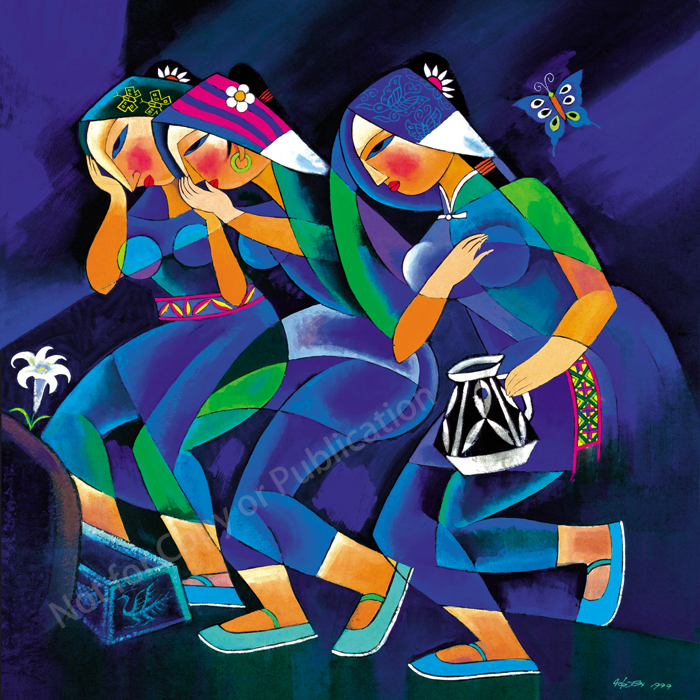
He Qi © 2021 All Rights Reserved.
Image taken from He Qi Art . For purchasing prints of this and other artworks by He Qi go to heqiart.com .
For other images of He Qi art works in TIPs, see here.

καὶ ἔλεγον πρὸς ἑαυτάς, Τίς ἀποκυλίσει ἡμῖν τὸν λίθον ἐκ τῆς θύρας τοῦ μνημείου;
3They had been saying to one another, “Who will roll away the stone for us from the entrance to the tomb?”
Image taken from He Qi Art . For purchasing prints of this and other artworks by He Qi go to heqiart.com .
For other images of He Qi art works in TIPs, see here.
Following is the translation of Mark 16:1-9 into Mexican Sign Language with back-translations into Spanish and English underneath:
© La Biblia en LSM / La Palabra de Dios
María Magdalena antes tenía adentro siete demonios que Jesús había expulsado.
El sábado descansaron hasta la noche (y entonces) María Magdalena, María y Salome se fueron a comprar perfume para ungir y frotar el perfume en el cuerpo muerto de Jesús.
El domingo, temprano en la mañana Jesús resucitó y primero encontró a María Magdalena, ella vio con sus propios ojos que Jesús estaba vivo otra vez y se fue.
Después de la salida del sol las otras mujeres estaban en camino para ir a la tumba, y mientras caminaban dijeron: “¿Cómo vamos a quitar la piedra? ¿Quién nos va a ayudar a rodar la piedra?”
Continuaron en el camino y vieron que la piedra fue revuelta, y fueron y entraron y vieron a un hombre jóven con ropa blanca sentado.
Las mujeres se asustaron y el ángel dijo: “No tengan miedo, uds buscan a Jesús de Nazarét, que fue crucificado y murió, ya se ha levantado, su cuerpo no está, miren.
Ahorita vayanse y adviertan a los discípulos y a Pedro diciendo: “Recuerden que recien antes Jesús les ha dicho: ‘voy a Galilela y uds también vayan a Galilea a ver a Jesús.'”
Las mujeres tenían miedo y estaban nerviosas y huyeron caminando, y no decían nada y se fueron.
Mary Magdalene before had seven demons inside her that Jesus had thrown out.
On Saturday they rested till nighttime and (then) Mary Magdalene, Mary and Salome went off to buy perfume to anoint and rub the perfume onto Jesus’ dead body.
On Sunday, early in the morning Jesus rose and first met Mary Magdalene, who saw with her own eyes that Jesus was alive again and went off.
After sunrise the other women were on their way to go to the tomb, and while they walked they said: “How are we going to take away the stone? Who will help us to roll the stone away?”
They went on and saw that the stone had been rolled away, and they went over and entered and saw a young man with white clothes sitting there.
The women were frightened and the angel said: “Do not be afraid, you are looking for Jesus of Nazareth who was crucified and died, he has already risen, his body is not here, look.
Now go and warn the disciples and Peter saying: “Remember that not long ago Jesus has told you: ‘I go to Galilee and you must also go to Galilee to see Jesus.'”
The women were afraid and nervous and they fled, walking away and they said nothing about it and left.
Source: La Biblia en LSM / La Palabra de Dios
<< Mark 15:42-47 in Mexican Sign Language
Mark 16:10-14 in Mexican Sign Language >>
Following is the translation of Mark 16:1-8 into Russian Sign Language with a back-translation underneath:
Source: Russian Bible Society / Российское Библейское Общество
The Sabbath had already ended, and the next day had come. Three women — Mary Magdalene, another Mary, she has a son James, and the third Salome, they went to the market and bought aromatic oils. They planned to go to the tomb of Jesus to anoint his body. This was the custom of the Jews — to rub the body of the dead with aromatic oils. Early in the morning, on Sunday, when the sun had just risen, they went to the tomb. On the way, they talked among themselves:
— There is such a big stone blocking the entrance to the tomb! We cannot move it! Who will help us? We ourselves do not have enough strength to move it!
So they talked among themselves. But when they came to the tomb, they saw that this huge stone was lying to the side, and the passage was open. They entered the tomb and were very afraid, seeing that there was a young man there. He was dressed in snow-white clothes and was sitting on the right side. The women were very afraid. The young man said:
— Do not be afraid! I know you are looking for Jesus from the city of Nazareth. Jesus was crucified, buried in this place, but now he is not here! Jesus has risen from the dead, he is alive. You go and tell his disciples and Peter that Jesus has already gone to Galilee, and there you will see him.
Those three women were very afraid, trembled with fear and quickly ran from that place. They could not tell the disciples anything, they were so afraid.
Суббота уже закончилась, наступил следующий день. Три женщины — Мария Магдалина, еще одна Мария, у нее сын Иаков, и третья Саломея, они пошли на рынок и купили ароматных масел. Они планировали пойти к гробнице Иисуса, чтобы намазать его тело. Такой был обычай у иудеев — натирать тело умершего ароматными маслами. Ранним утром, в воскресенье, когда только взошло солнце, они пошли к гробнице. По пути они между собой разговаривали:
— Там такой большой камень закрывает вход в гробницу! Мы не можем его отодвинуть! Кто нам поможет? У нас самих нет столько сил, чтобы его отодвинуть!
Так они говорили между собой. Но когда они пришли к гробнице, то увидели что этот огромный камень лежит в стороне, а проход открыт. Они вошли в гробницу, и очень испугались, увидев, что там был юноша. Он был в белоснежной одежде и сидел с правой стороны. Женщины испугались очень сильно. Юноша сказал:
— Не бойтесь! Я знаю, вы ищете Иисуса из города Назарета. Иисус был распят, погребен вот на этом месте, но сейчас его здесь нет! Иисус воскрес из мёртвых, он живой. Вы же идите и скажите его ученикам и Петру, что Иисус уже отправился в Галилею, и там вы его увидите. Те три женщины очень сильно испугались, задрожали от страха и быстро побежали из этого места. Они не смогли ничего рассказать ученикам, так сильно они боялись.
Back-translation by Luka Manevich
<< Mark 15:33-47 in Russian Sign Language
Mark 16:9-20 in Russian Sign Language >>
The following is a stained glass window from 1855 by artist H. Beiler over the altar of the Evangelische Stadtkirche Bad Rappenau, Bad Rappenau, Germany:

Photo by Llez, hosted by Wikimedia Commons under a Creative Commons Attribution-Share Alike 3.0 Unported license
Stained glass is not just highly decorative, it’s a medium which has been used to express important religious messages for centuries. Literacy was not widespread in the medieval and Renaissance periods and the Church used stained glass and other artworks to teach the central beliefs of Christianity. In Gothic churches, the windows were filled with extensive narrative scenes in stained glass — like huge and colorful picture storybooks — in which worshipers could ‘read’ the stories of Christ and the saints and learn what was required for their religious salvation. (Source: Victoria and Albert Museum )
The inclusive “we” specifically includes the addressee (“you and I and possibly others”), while the exclusive “we” specifically excludes the addressee (“he/she/they and I, but not you”). This grammatical distinction is called “clusivity.” While Semitic languages such as Hebrew or most Indo-European languages such as Greek or English do not make that distinction, translators of languages with that distinction have to make a choice every time they encounter “we” or a form thereof (in English: “we,” “our,” or “us”).
For this verse, translators typically select the inclusive form (including the addressee).
Source: Velma Pickett and Florence Cowan in Notes on Translation January 1962, p. 1ff.
Following are a number of back-translations of Mark 16:3:
Exegesis:
pros heautas (cf. 10.26; 12.7) ‘to themselves,’ i.e. ‘to one another’ (as in 11.31; 14.4).
For the words in the question, ‘Who will roll away the stone for us from the door of the tomb?’ cf. 15.46.
apokuliō (only here in Mark; cf. proskuliō 15.46) ‘roll away.’
Translation:
A translation of the question in some languages may have to be ‘who will roll away the stone which blocks the entrance to the tomb,’ for door is ‘doorway’ or ‘entrance,’ not ‘door’ in its more usual sense.
Quoted with permission from Bratcher, Robert G. and Nida, Eugene A. A Handbook on the Gospel of Mark. (UBS Handbook Series). New York: UBS, 1961. For this and other handbooks for translators see here .
No comments yet.

Leave a Reply
You must be logged in to post a comment.