Balinese uses 4 different 3rd person pronouns: two to indicate important and very important persons (dane and ida), one to speak of a person of lower standing but in a familiar manner, and one to speak of such a person in a polite manner (ia and ipun). In the case of this verse where the Greek (and English) does not give any indication to whom the three instances of the third person plural pronoun refers to, the Balinese has to make a disctinction: jeg wenten mega nyayubin Ida miwah dane sareng sami, tur rikala Ida miwah dane kasayubin antuk megane punika, sisiane makatetiga punika pada karesresan: “a cloud came and overshadowed them (Moses and Elijah — marked as very important); and they (the disciples — marked as important) were terrified as they (Moses and Elijah — marked as very important) entered the cloud.”
Following is a Ukrainian Orthodox icon of the Transfiguration by Ivan Rutkovych (c. 1650 – c. 1708) (for the Church of Christ’s Nativity in Zhovkva, Ukraine, today in the Lviv National Museum).
Orthodox Icons are not drawings or creations of imagination. They are in fact writings of things not of this world. Icons can represent our Lord Jesus Christ, the Virgin Mary, and the Saints. They can also represent the Holy Trinity, Angels, the Heavenly hosts, and even events. Orthodox icons, unlike Western pictures, change the perspective and form of the image so that it is not naturalistic. This is done so that we can look beyond appearances of the world, and instead look to the spiritual truth of the holy person or event. (Source )
The Greek that is translated as “to fear” or “to be afraid” or similar in English is translated in Ashe as agõõi iwei or “hearing fear.” (Source: David Rowbory)
Following are a number of back-translations of Luke 9:34:
Noongar: “As he was speaking, a cloud came and covered them, and the disciples became afraid because the cloud came on top of them.” (Source: Warda-Kwabba Luke-Ang)
Uma: “While Petrus was still speaking, a cloud arrived shadowing/sheltering them. They were afraid seeing the cloud that enclosed them.” (Source: Uma Back Translation)
Yakan: “While he was still speaking there came a cloud (bright, not rain cloud) and they were overshadowed and they were afraid when they were covered by the cloud.” (Source: Yakan Back Translation)
Western Bukidnon Manobo: “And then while Peter was still speaking, they were covered by a cloud and the three disciples were very much afraid when they were covered by the cloud.” (Source: Western Bukidnon Manobo Back Translation)
Kankanaey: “While he was still talking, a cloud suddenly-arrived and blocked-them all -from-view. After that plural Jesus were hidden-from-view and his disciples became-frightened.” (Source: Kankanaey Back Translation)
Tagbanwa: “Pedro was still speaking when suddenly/unexpectedly they were overshadowed by a cloud. Well since they were now enveloped by that cloud, Pedro and company were very scared.” (Source: Tagbanwa Back Translation)
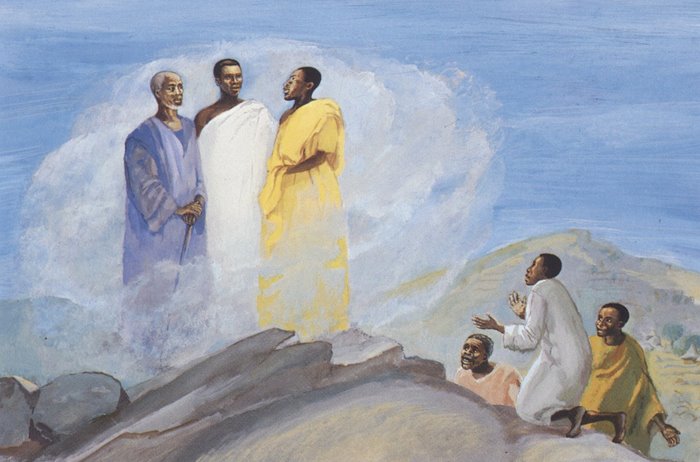
Following is a 1973 painting of the JESUS MAFA project, a response to New Testament readings from the Lectionary by a Christian community in Cameroon, Africa. Each of the readings was selected and adapted to dramatic interpretation by the community members. Photographs of their interpretations were made, and these were then transcribed to paintings:
In this theatrical representation of Jesus’ transfiguration, Jesus is robed in a dazzling white garment, as the story in the gospels describes. He appears to be greeting Moses and Elijah like old friends as they are surrounded by a cloud that makes the whole scene feel ethereal. Peter, James, and John look on with flabbergasted and fearful expressions, bewildered at what they should do. This painting invites the viewer to imagine what it would be like to have seen such amazing things. Undoubtedly, it would inspire one to follow and obey Jesus, just as God commands in the story: “This is my son, the beloved. Listen to him!”
From Art in the Christian Tradition, a project of the Vanderbilt Divinity Library, Nashville, TN. Image retrieved March 23, 2026. Original source: librairie-emmanuel.fr.
Living Water is produced for the Bible translation movement in association with Lutheran Bible Translators. Lyrics derived from the ESV® Bible (The Holy Bible, English Standard Version®).
egeneto nephelē kai epeskiazen autous ‘a cloud came and (for some time) overshadowed them.’ egeneto (aorist) refers to the punctiliar event of the appearing of the cloud, epeskiazen (imperfect) to the linear situation that followed. For episkiazō cf. on 1.35. autous may refer to all present, or to the three disciples only, preferably the former.
ephobēthēsan de en tō eiselthein autous eis tēn nephelēn ‘and they (i.e. the disciples) were frightened after they (i.e. Moses and Elijah) went into the cloud.’ ephobēthēsan describes the feeling of the three disciples at the end of the strange happening.
Translation:
Specifying the three pronouns of the third person plural in accordance with the interpretation preferred in Exegesis one may say. ‘all of them,’ ‘all (those who were) there/in that place’ for them, ‘the disciples for the first they, whereas the second they may be replaced by Moses and Elijah’ (Sranan Tongo), by ‘they two’ (Bahasa Indonesia KB), or by a deictic element indicating a group different from the group already referred to.
Came. ‘Clouds’ may not be said ‘to come’ but ‘to-be-there suddenly’ (Balinese), ‘to arrive unexpectedly’ (Bible de Jérusalem, survint), ‘to appear,’ ‘to emerge.’
Overshadowed, see on 1.35, of the two verbs mentioned there for Indonesian languages number (2) seems to be preferable here.
Entered the cloud, or, ‘disappeared into (or, were enveloped by) the cloud’ (Javanese), ‘the cloud encompassed/enveloped them’ (Tagalog).
Quoted with permission from Reiling, J. and Swellengrebel, J.L. A Handbook on the Gospel of Luke. (UBS Handbook Series). New York: UBS, 1971. For this and other handbooks for translators see here . Make sure to also consult the Handbook on the Gospel of Mark for parallel or similar verses.
a cloud…enveloped them…as they entered the cloud: There are at least three views about which people the cloud enveloped and who entered the cloud:
(1) A cloud enveloped everyone there (Jesus, the disciples, Moses, and Elijah). Everyone entered the cloud.
(2) A cloud enveloped Jesus, Moses, and Elijah. Jesus, Moses, and Elijah entered the cloud.
(3) A cloud enveloped only Moses and Elijah. Moses and Elijah entered the cloud.
English versions do not indicate which interpretation they follow. If possible, you should translate in a way that does not make explicit who was enveloped by the cloud and who entered it. However, if you need to choose an interpretation, it is recommended that you follow interpretation (1).
9:34a
While Peter was speaking: The clause While Peter was speaking refers to when Peter was still speaking the words in 9:33b–c.
a cloud: The cloud represented the presence of God. Use a general expression that could refer to any type of cloud. If your language only has specific terms for each type of cloud, use the term that would be appropriate here. In some languages the term for a white, puffy, fair-weather cloud would fit this context.
appeared and enveloped: The actions of a cloud appearing and enveloping people often happen almost at the same time. Here are two ways to translate the two verbs:
• Use two or more verbs. For example:
a cloud appeared and covered them with its shadow (Good News Translation)
• Use only one verb. It may be possible to make the verb “appeared” implicit. For example:
a cloud overshadowed them (New Living Translation (2004))
Describe these actions in a natural way in your language.
appeared: In this context, the Greek verb that the Berean Standard Bible translates as appeared means “came” or “appeared.” Use a natural way in your language to speak of a cloud forming. Some ways to do this in English are:
came (New Jerusalem Bible) -or-
formed (New American Standard Bible)
enveloped: There are two ways to interpret the Greek word that the Berean Standard Bible translates as enveloped:
(1) It means cast its shadow or overshadowed. The cloud passed between them and the sun, and they were in its shadow. For example:
covered…with its shadow (Good News Translation)
(Revised Standard Version, Good News Translation, New Jerusalem Bible, New American Standard Bible, God’s Word, New Living Translation (2004), NET Bible, Phillips’ New Testament in Modern English, Revised English Bible, King James Version, English Standard Version)
(2) It means surrounded or enveloped. They were on a mountain. So when the cloud came, it surrounded them so that they were in the middle of the cloud. It was like being in a fog. For example:
enveloped (New International Version) -or-
came in around (NLV)
(Berean Standard Bible, New International Version, NLV)
It is recommended that you follow interpretation (1) along with most English versions.
9:34b
they were afraid as they entered the cloud: The words they were afraid as they entered the cloud indicate that the three disciples were frightened when the cloud began to cover them and the others who were there.
entered the cloud: The words entered the cloud means that the shadow of the cloud moved until it completely covered them. It does not mean that anyone moved forward and went inside the cloud. Other ways to translate this clause are:
the cloud covered them (New Century Version) -or-
the cloud came over them (Good News Translation)
General Comment on 9:34a–b
In some languages the phrases “a cloud appeared and covered them with its shadow” (9:34a in the Good News Translation) and “they entered the cloud” (9:34b) may seem redundant. One way to avoid this problem is to use the word “began.” For example:
34aa cloud formed and began to overshadow them; and 34b…they entered the cloud (New American Standard Bible)



Leave a Reply
You must be logged in to post a comment.